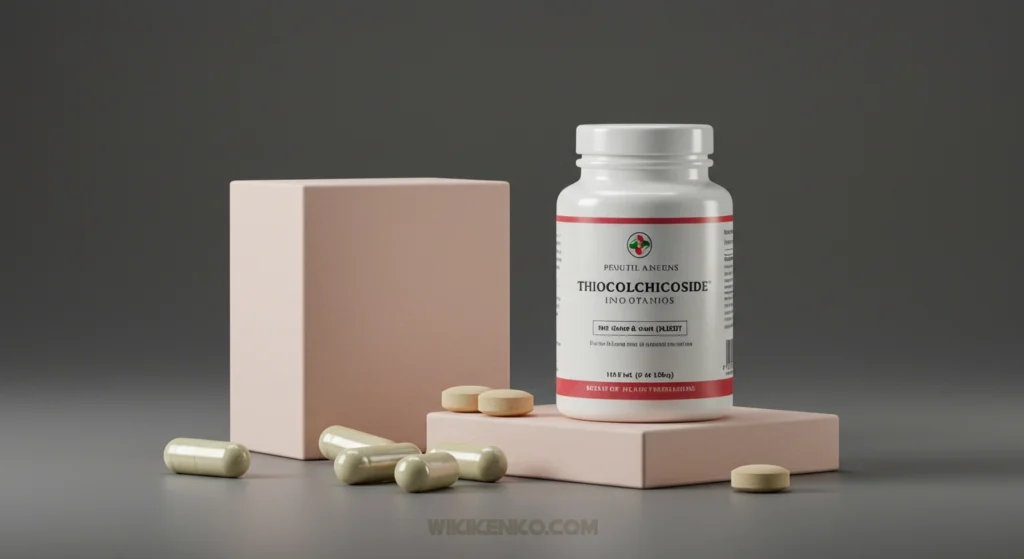
Thiocolchicoside is a semi-synthetic derivative of colchicoside, a naturally occurring compound extracted from the seeds of Gloriosa superba. It is primarily used as a centrally acting muscle relaxant with additional anti-inflammatory and analgesic properties. Thiocolchicoside is widely prescribed in the management of painful muscle spasms, musculoskeletal disorders, and neuromuscular conditions. Unlike traditional skeletal muscle relaxants, it possesses a unique profile of GABA-mimetic and glycine receptor-agonist activity, which underlies its therapeutic effects on muscle tone and pain.
Due to its favorable tolerability and efficacy, it is commonly combined with non-steroidal anti-inflammatory drugs (NSAIDs) in both oral and parenteral formulations. However, its use is accompanied by safety considerations due to potential genotoxicity, especially at higher doses or with prolonged use.
Chemical Structure
- IUPAC Name: (S)-N-[3-(β-D-Glucopyranosyloxy)-1,2-dimethoxy-10-methyl-9-oxo-5,6,7,9-tetrahydrobenzo[a]heptalen-7-yl]acetamide
- Molecular Formula: C27H33NO11
- Molecular Weight: ~563.55 g/mol
- Chemical Class: Semi-synthetic colchicine derivative
- Appearance: Yellow crystalline powder, odorless, tasteless
- Solubility: Soluble in water and alcohol
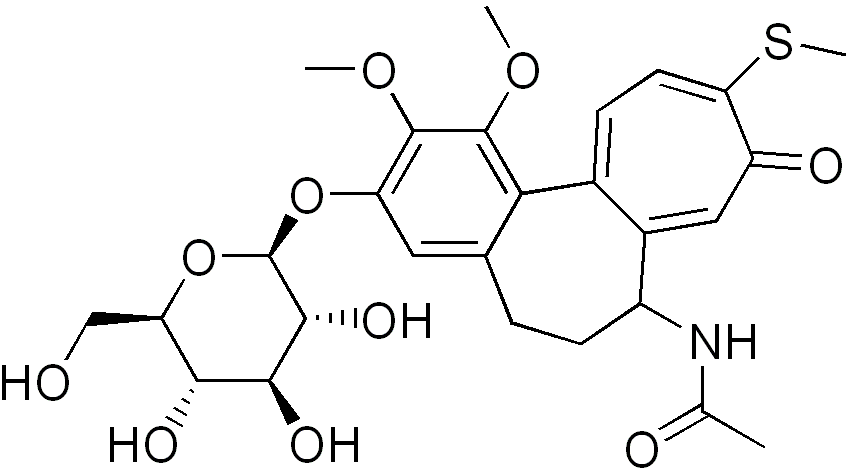
Its structure retains the colchicine nucleus but is glycosylated, which improves its pharmacokinetic and pharmacodynamic properties.
Thiocolchicoside-Based Medicines List
- Muscoril® – Widely used branded formulation available in tablets, capsules, and injectable form.
- Coltramyl® – Available in European and Middle Eastern countries.
- Thioquest® – Often co-formulated with NSAIDs.
- Myoril® – Marketed in India and Southeast Asia.
- Tiochol® – Popular in Latin American countries.
- Muvera-TC® – Combined with meloxicam (NSAID).
- Thiospas® – A common prescription for muscle spasms.
- Flexabenz-TC® – A fixed-dose combination of thiocolchicoside and other pain relievers.
Mechanism of Action
“Thiocolchicoside” acts centrally to reduce muscle tone and pain. Its mechanism of action involves:
- Agonist activity at GABA-A and glycine receptors, which are key inhibitory neurotransmitter systems in the central nervous system (CNS). This leads to reduced neuronal excitability in the spinal cord and supraspinal centers.
- Modulation of pain perception by influencing inhibitory neurotransmission pathways, indirectly contributing to analgesia.
- Unlike other muscle relaxants, it does not act at the neuromuscular junction, making it less sedating in some individuals.
Pharmacokinetics
| Pharmacokinetic Parameter | Details |
|---|---|
| Absorption | Rapid and well-absorbed orally and intramuscularly |
| Bioavailability | Moderate (~25–35% oral) |
| Time to Peak Concentration | ~1–1.5 hours (oral); ~30 min (IM) |
| Plasma Protein Binding | ~90% |
| Metabolism | Extensively metabolized in the liver into active and inactive metabolites |
| Half-life | ~5–7 hours (varies by route and individual) |
| Excretion | Mainly via kidneys (urine), minor fecal elimination |
Notably, its metabolites have been linked to genotoxic potential, which restricts its long-term use.
Therapeutic Uses
| Condition | Therapeutic Role |
|---|---|
| Acute muscle spasms | Short-term relief of painful muscular contractions |
| Low back pain (lumbago) | Reduces spasm and associated discomfort |
| Cervical spondylosis | Alleviates stiffness and spasm-related neck pain |
| Sciatica | Adjuvant in reducing nerve root compression-associated spasm |
| Rheumatoid arthritis (adjunctive) | Symptomatic muscle relaxation |
| Post-operative muscle rigidity | Facilitates recovery by reducing tension |
| Traumatic muscle injuries | Speeds up resolution of pain and stiffness |
| Tendinitis or bursitis (adjunct) | Helps in pain relief and muscle relaxation |
Side Effects
Most side effects of Thiocolchicoside are dose-dependent and mild to moderate in severity.
Common Side Effects
- Drowsiness
- Nausea
- Diarrhea
- Gastric discomfort
- Headache
Rare or Serious Side Effects
- Allergic reactions (rash, pruritus, angioedema)
- Hypotension (especially with IM form)
- Seizures (at high doses or in susceptible individuals)
- Potential genotoxicity (mutagenicity observed in metabolites)
Due to these risks, long-term or high-dose use is not recommended.
Drug Interactions
Thiocolchicoside may interact with CNS-active drugs and some metabolic inhibitors.
Key Drug Interactions
- Alcohol and CNS depressants: Increased risk of sedation and dizziness.
- Antiepileptics: Potential additive neurotoxicity; caution with seizure-prone patients.
- NSAIDs: Commonly co-prescribed, but increase risk of GI irritation when taken together.
- CYP3A4 inhibitors: May alter metabolism and enhance systemic exposure.
There is no significant interaction with anticoagulants, but caution is advised due to potential GI side effects.
Safety Considerations
General Recommendations
- Use only short-term (typically ≤7 days) at the lowest effective dose.
- Avoid in pregnant and breastfeeding women due to embryotoxicity and genotoxic potential.
- Not recommended for children <16 years, except under strict medical supervision.
- Contraindicated in patients with epilepsy, muscle hypotonia, or severe hepatic dysfunction.
Genotoxicity and Fertility Warning
- Preclinical studies have demonstrated mutagenic and genotoxic effects of thiocolchicoside metabolites.
- Regulatory agencies limit its use and mandate strict warnings on package inserts regarding reproductive toxicity.
Regulatory Status
- Europe (EMA): Approved with restricted indications; injectable form use is limited to hospitals or short-term treatment.
- India (CDSCO): Widely marketed in oral and injectable forms with ongoing pharmacovigilance.
- Latin America and Asia: Approved and available under multiple brand names.
- United States (FDA): Not currently approved.
- Prescription-only medication (Rx) in all markets.
Several national regulatory bodies have updated product labels to include warnings about genotoxicity and reproductive toxicity.
Conclusion
Thiocolchicoside is a well-established muscle relaxant with proven clinical benefits in the short-term management of painful muscle conditions. Its dual action on GABA and glycine receptors provides effective muscle relaxation without heavy sedation. However, due to concerns regarding genotoxicity and reproductive toxicity, its use is now governed by strict safety guidelines.
When used judiciously under medical supervision, especially in acute musculoskeletal pain, Thiocolchicoside remains an important component of symptomatic therapy. It is most effective when prescribed for short durations, preferably in combination with other pain-relieving agents.