
Propiverine Hydrochloride is a synthetic anticholinergic and calcium antagonist used primarily in the management of urinary bladder dysfunction, specifically overactive bladder (OAB) and urge urinary incontinence. It works by inhibiting involuntary contractions of the detrusor muscle of the bladder, thereby improving bladder storage capacity and reducing symptoms such as urinary urgency, frequency, and urge incontinence. Propiverine offers a dual mechanism of action that makes it effective in both neurogenic and idiopathic detrusor overactivity. It is considered well-tolerated, with both immediate-release and extended-release oral formulations available.
Chemical Structure
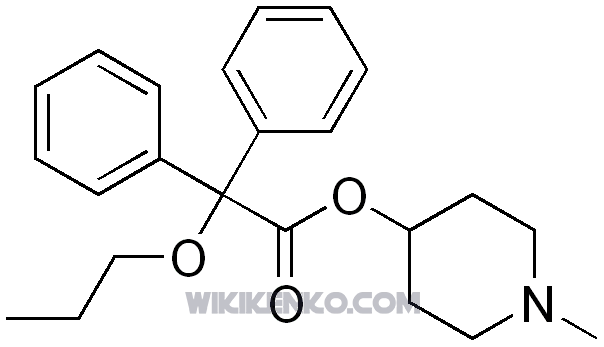
Propiverine Hydrochloride is the hydrochloride salt of propiverine, chemically named 1-methyl-4-piperidyl diphenylpropoxyacetate hydrochloride.
- Molecular Formula: C23H29NO3 · HCl
- Molecular Weight: ~403.94 g/mol (hydrochloride salt)
- Structure: Contains a piperidine ring, aromatic groups, and an ester functional group.
- Appearance: White to off-white crystalline powder, soluble in water.
The molecule is structurally related to other antimuscarinic agents but exhibits additional smooth muscle relaxant properties through calcium antagonism.
Propiverine-Based Medicines List
- Mictonorm® – Available in immediate and modified-release tablets/capsules.
- Detrunorm® – Modified-release capsules used widely across Europe.
- Mictoryl® – Marketed in several countries for urinary urgency and incontinence.
- Uraplex® – Prescribed in Asia and the Middle East.
- Apropin® – Used in Russia and neighboring regions.
- Vesitone® – Targeted formulation for OAB in the elderly.
- Uriton® – Combination or standalone product in certain markets.
- Proviron® OAB – Different from androgen medication; specific to regional branding.
Mechanism of Action
Propiverine exerts its effect via dual pharmacological pathways:
- Anticholinergic Action: It acts as a muscarinic receptor antagonist, primarily blocking M3 receptors in the bladder detrusor muscle. This inhibits acetylcholine-mediated involuntary bladder contractions.
- Calcium Antagonist Effect: Propiverine also inhibits voltage-dependent calcium channels, leading to further relaxation of smooth muscle and suppression of spontaneous bladder contractions.
These combined effects lead to:
- Increased bladder capacity
- Reduced urgency
- Decreased frequency and incontinence episodes
Pharmacokinetics
| Pharmacokinetic Parameter | Details |
|---|---|
| Absorption | Rapid and complete oral absorption |
| Bioavailability | ~90% for immediate-release; modified in extended forms |
| Time to Peak Plasma | ~1–2 hours (immediate-release); ~3–5 hours (extended-release) |
| Plasma Protein Binding | ~90% |
| Metabolism | Hepatic, via CYP450 enzymes (mainly CYP3A4) |
| Half-life | ~12–20 hours (depending on formulation and patient) |
| Excretion | Primarily via urine (as metabolites) |
The pharmacokinetic profile allows once- or twice-daily dosing, improving compliance.
Therapeutic Uses
| Indication | Clinical Role |
|---|---|
| Overactive Bladder (OAB) | First-line or adjunct treatment to reduce urgency/frequency |
| Urge Urinary Incontinence | Suppresses involuntary bladder contractions |
| Neurogenic Detrusor Overactivity (e.g., spinal injury) | Reduces bladder instability in neurological disorders |
| Nocturia (night-time urination) | Improves sleep by reducing night-time bladder activity |
| Pediatric Enuresis (off-label in select cases) | Used under strict clinical monitoring in children |
| Benign Prostatic Hyperplasia-related LUTS | Symptom relief when OAB co-exists with BPH |
| Postoperative Bladder Spasm | Provides smooth muscle relaxation |
| Detrusor Hyperreflexia | Treatment for patients with CNS disorders causing bladder issues |
Side Effects
Propiverine is generally well-tolerated, with side effects mostly related to its anticholinergic activity.
Common Side Effects
- Dry mouth
- Constipation
- Blurred vision
- Dizziness
- Fatigue
Less Common or Rare Side Effects
- Tachycardia
- Urinary retention
- Headache
- Gastrointestinal discomfort
- Photosensitivity

Elderly patients may be more susceptible to cognitive effects such as confusion, especially at higher doses.
Drug Interactions
Propiverine may interact with drugs metabolized by CYP3A4 enzymes and those with anticholinergic properties.
Notable Interactions
- Ketoconazole, Erythromycin, Ritonavir: May increase Propiverine levels via CYP3A4 inhibition.
- Other Anticholinergics (e.g., oxybutynin, tolterodine): Additive side effects like dry mouth, constipation.
- Alcohol and CNS depressants: Enhance sedative and cognitive side effects.
- Cholinesterase inhibitors (e.g., donepezil): May reduce efficacy in Alzheimer’s disease.
Monitoring is advised when combining with other drugs that affect cardiac conduction or have narrow therapeutic indices.
Safety Considerations
General Safety
- Approved for adults and elderly with urinary symptoms.
- Requires dose adjustments in hepatic impairment.
- Caution in renal insufficiency, especially with extended-release forms.
Special Populations
- Pregnancy Category C: Use only if benefits outweigh potential risks.
- Lactation: Not well-studied; avoidance recommended unless necessary.
- Pediatric Use: Off-label; should be used under specialist care only.
- Elderly Patients: Monitor for cognitive impairment, especially in those with dementia.
Contraindications
- Urinary retention
- Severe ulcerative colitis
- Toxic megacolon
- Narrow-angle glaucoma
- Myasthenia gravis
- Known hypersensitivity to the compound
Regulatory Status
Propiverine Hydrochloride is approved in Europe, Asia, and several Middle Eastern and Latin American countries for the treatment of overactive bladder and related conditions.
- European Medicines Agency (EMA): Approved as a prescription medicine.
- Japan (PMDA): Approved under brand names for urinary dysfunction.
- US FDA: Not currently approved for marketing in the United States.
- Prescription-Only Medicine (Rx): In all countries where marketed.

The drug has undergone post-marketing surveillance with a favorable safety and efficacy profile over decades of use.
Conclusion
“Propiverine Hydrochloride” is a versatile, well-tolerated treatment for various forms of bladder dysfunction, particularly overactive bladder and urge urinary incontinence. Its dual mechanism—combining antimuscarinic and calcium antagonist actions—makes it uniquely effective in a diverse range of urological conditions. With a long-standing safety record and multiple formulations, it remains an important agent in both first-line and adjunctive management of urinary disorders, especially where tolerability is a key consideration.