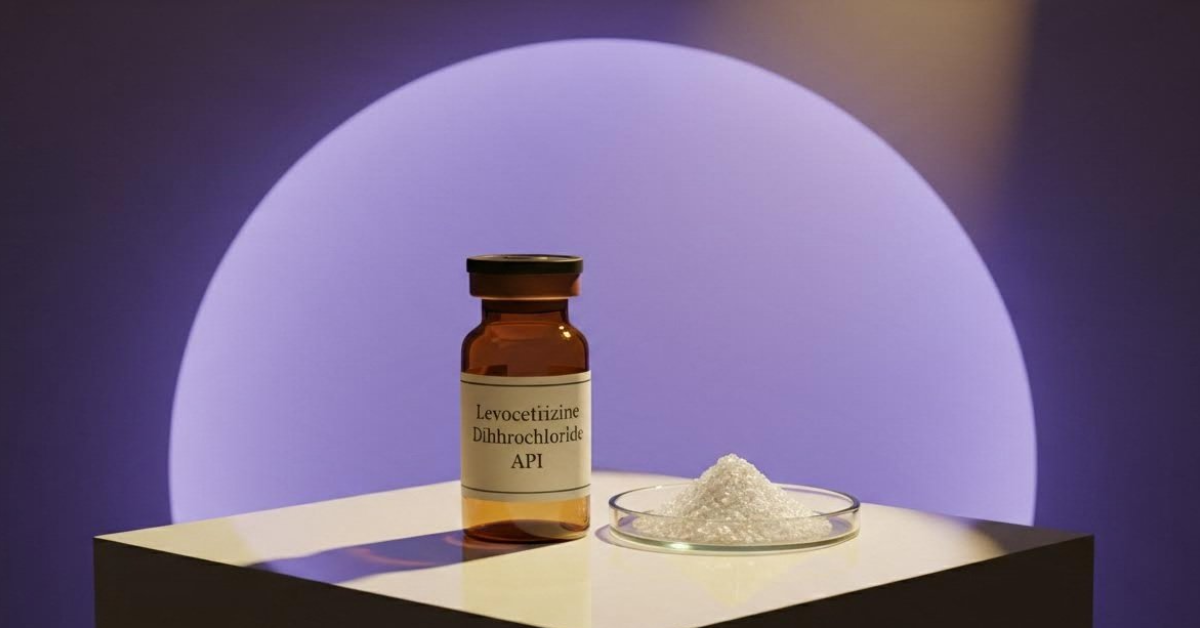
Levocetirizine dihydrochloride is the dihydrochloride salt of levocetirizine, a selective second-generation histamine H1-receptor antagonist. It is the active R-enantiomer of cetirizine and is used mainly to relieve symptoms of seasonal and perennial allergic rhinitis and to treat uncomplicated chronic idiopathic urticaria, commonly called long-term hives.
Compared with older first-generation antihistamines, levocetirizine generally causes less sedation because it has limited penetration into the central nervous system. However, drowsiness can still occur, particularly at higher exposure or when it is combined with alcohol or other sedating medicines. It is available as tablets, oral solutions, and generic formulations.
Chemical Structure
“Levocetirizine dihydrochloride” is chemically described as 2-[2-[4-[(R)-(4-chlorophenyl)-phenylmethyl]piperazin-1-yl]ethoxy]acetic acid dihydrochloride. It is the R-enantiomer of cetirizine hydrochloride, meaning it has the same atoms as cetirizine but a specific three-dimensional arrangement.
Its molecular formula is , also written as . The molecular weight is approximately 461.81 g/mol, and the principal API CAS number is 130018-87-0.
The molecule contains a piperazine ring, carboxylic acid group, ether linkage, and chlorinated aromatic ring. Formation of the dihydrochloride salt improves its pharmaceutical properties and enables manufacture of stable oral dosage forms.

Levocetirizine-Based Medicines: Top Eight
Representative products include:
- Xyzal tablets.
- Xyzal oral solution.
- Xyzal Allergy.
- Generic levocetirizine dihydrochloride tablets.
- Generic levocetirizine oral solution.
- Zilola.
- Xusal.
- Xuzal or Xozal, depending on the market.
Brand availability varies by country. Xyzal is the best-known brand, while Zilola, Xusal, Xuzal, and Xozal are regional names. Generic products may be sold simply as levocetirizine dihydrochloride tablets or oral solution.
Mechanism of Action
Levocetirizine selectively inhibits peripheral histamine H1 receptors. During an allergic reaction, histamine binds to H1 receptors and contributes to itching, sneezing, watery eyes, nasal discharge, congestion, redness, and swelling. By blocking these receptors, levocetirizine reduces the symptoms caused by histamine.
In urticaria, levocetirizine reduces histamine-related skin wheals and itching. It does not remove the underlying cause of an allergy and does not prevent severe anaphylaxis. It should not be used as a substitute for epinephrine in a life-threatening allergic reaction.
Because Levocetirizine Dihydrochloride is a second-generation antihistamine, it is less likely than older agents to cause marked sedation, dry mouth, blurred vision, and impaired coordination. Nevertheless, the product label warns that some individuals may experience drowsiness or reduced alertness.
Pharmacokinetics
Levocetirizine Dihydrochloride is rapidly and extensively absorbed after oral administration. Peak plasma concentrations are usually reached approximately 0.9 hour after an oral tablet. Daily dosing reaches steady state after about two days, with an accumulation ratio of approximately 1.12.
Plasma protein binding is approximately 91%–92%, and the apparent volume of distribution is about 0.4 L/kg. Levocetirizine undergoes limited metabolism; less than 14% of a dose is metabolized. Therefore, differences caused by genetic variation in hepatic enzymes or inhibition of liver-metabolizing enzymes are expected to be relatively small.
The plasma elimination half-life in healthy adults is approximately 8–9 hours. Urine is the major elimination route, accounting for approximately 85.4% of the dose, while feces account for approximately 12.9%. Because renal elimination is important, exposure increases in kidney impairment and dosage reduction may be necessary.
Therapeutic Uses
| Condition | Therapeutic role | Typical use |
|---|---|---|
| Seasonal allergic rhinitis | Relieves sneezing, runny nose, itching, and watery eyes | Usually 5 mg once daily in adults |
| Perennial allergic rhinitis | Controls year-round nasal allergy symptoms | Usually 5 mg once daily |
| Chronic idiopathic urticaria | Reduces hives and itching | Usually 5 mg once daily in adults |
| Pediatric allergic rhinitis | Treats approved symptoms in children | Usually 5 mg once daily |
| Pediatric chronic urticaria | Reduces uncomplicated hives and itching | Age-specific dose required |
| Allergy-related itching | Provides histamine-related symptom relief | Used according to medical advice |
| Night-time allergy symptoms | May reduce symptoms during sleep | Evening administration is common |
| Maintenance allergy treatment | Supports ongoing symptom control | Taken consistently during exposure periods |
For adults and children aged 12 years and older, the usual dose is 5 mg once daily in the evening. Children aged 6–11 years commonly receive 2.5 mg once daily. Some patients may respond to a lower dose, but dosing must be adjusted for kidney function and age.
Side Effects
The most common adverse effects include somnolence, fatigue, dry mouth, headache, and nasopharyngitis. Drowsiness may impair driving, operating machinery, or other activities requiring complete alertness.
Other possible effects include sore throat, abdominal discomfort, nausea, diarrhea, dizziness, and cough. Rare reactions may include hypersensitivity, angioedema, rash, difficulty breathing, or severe allergic responses.
Urinary retention has been reported rarely. Patients with spinal-cord lesions, prostate enlargement, or other conditions predisposing them to urinary retention should use levocetirizine cautiously. The medicine should be discontinued and medical advice obtained if urinary retention develops.
Rare liver injury has been reported with cetirizine and Levocetirizine Dihydrochloride, although clinically significant hepatotoxicity is uncommon. Yellowing of the skin, dark urine, or persistent abdominal symptoms require medical evaluation.
Drug Interactions
Alcohol and other central nervous system depressants may increase drowsiness and reduce alertness. Patients should avoid alcohol until they know how Levocetirizine Dihydrochloride affects them and should discuss sedatives, sleep medicines, opioid analgesics, and sedating psychiatric medicines with a healthcare professional.
Levocetirizine Dihydrochloride has limited metabolism and is unlikely to cause major interactions through inhibition or induction of hepatic drug-metabolizing enzymes. However, medicines that reduce kidney function or compete for renal elimination may increase exposure.
Studies with racemic cetirizine found no clinically important interaction with antipyrine, pseudoephedrine, erythromycin, azithromycin, ketoconazole, or cimetidine. Theophylline slightly reduced cetirizine clearance, and ritonavir increased cetirizine exposure; caution may therefore be appropriate in patients taking multiple medicines.
Safety Considerations
Levocetirizine Dihydrochloride should be used cautiously or at a reduced dose in patients with kidney impairment. Severe renal impairment may require avoidance depending on the product label. Elderly patients are more likely to have reduced renal function and may be more sensitive to drowsiness or urinary retention.
Patients should avoid hazardous activities until they know whether the medicine causes sleepiness. Alcohol should be avoided or minimized. Levocetirizine should not be used to manage anaphylaxis, facial swelling with breathing difficulty, or other medical emergencies.
Pregnant or breastfeeding patients should discuss treatment with a healthcare professional. Although systemic exposure is generally modest, levocetirizine passes into breast milk and the potential effects on an infant should be considered.

Regulatory Status
Levocetirizine Dihydrochloride was first approved in Europe in 2001 and received U.S. FDA approval for Xyzal tablets in 2007. The U.S. FDA subsequently approved oral solution formulations. Approved indications include seasonal and perennial allergic rhinitis and uncomplicated skin manifestations of chronic idiopathic urticaria.
The medicine is available by prescription in some countries and over the counter in others. Strengths, pediatric indications, oral-solution availability, and brand names vary internationally. Generic levocetirizine products are widely marketed.
Conclusion
Levocetirizine dihydrochloride is a selective peripheral H1 antihistamine used for allergic rhinitis and chronic idiopathic urticaria. It is rapidly absorbed, minimally metabolized, primarily eliminated through the kidneys, and generally administered once daily. The most important precautions involve drowsiness, alcohol or sedative use, kidney impairment, and urinary retention. Product-specific labeling and professional medical advice should guide treatment.