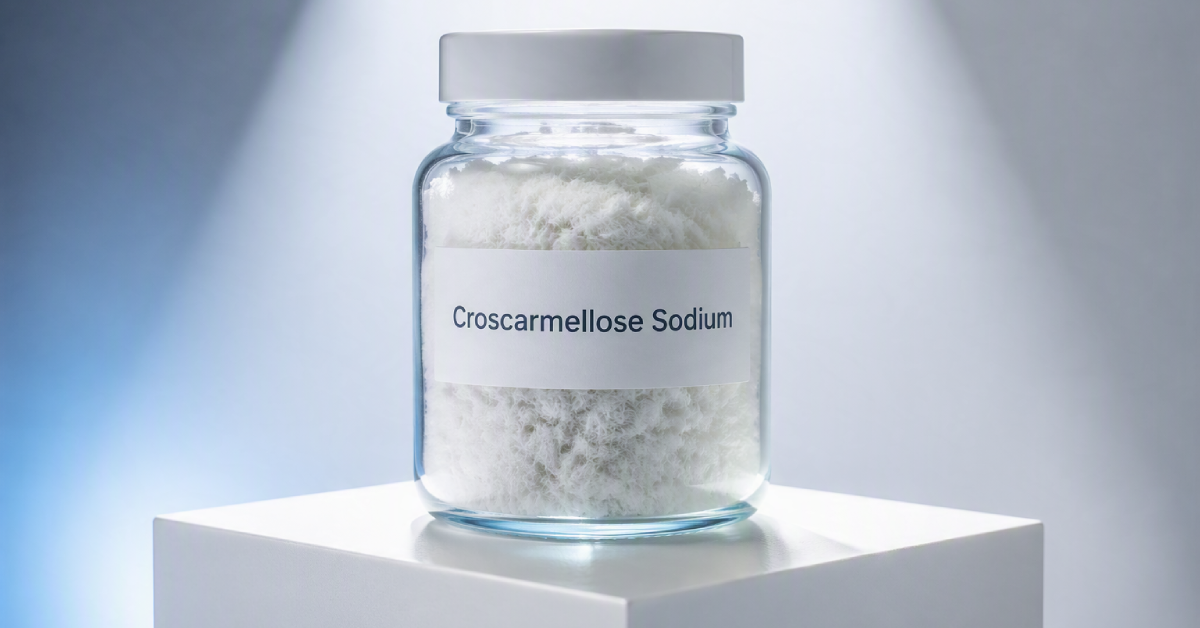
“Croscarmellose sodium” is a chemically modified, cross-linked form of sodium carboxymethylcellulose. It is mainly a pharmaceutical excipient rather than a pharmacologically active drug. Its principal function is as a superdisintegrant in tablets and capsules, where it helps a solid dosage form break apart rapidly after contact with gastrointestinal fluid.
The material is a white, fibrous, free-flowing powder. Because it absorbs water and swells strongly, it promotes rapid tablet disintegration and can improve dissolution and availability of the active medicine. It is used in many prescription, over-the-counter, and generic oral products.
Chemical Structure
Croscarmellose sodium is the sodium salt of cross-linked, partly O-carboxymethylated cellulose. It is produced by chemically modifying cellulose and introducing carboxymethyl groups, followed by cross-linking. Unlike a small molecule, it does not have one precise molecular weight or a single discrete structural formula.
Its CAS number is 74811-65-7. Related sodium carboxymethylcellulose materials may also be identified by CAS number 9004-32-4, but ordinary sodium carboxymethylcellulose and croscarmellose sodium are not identical materials. The general structure is based on substituted anhydroglucose units, with the polymeric cellulose backbone retaining hydroxyl groups and carrying sodium carboxymethyl substituents.
Cross-linking makes croscarmellose sodium insoluble or only partially dispersible in water while preserving high swelling capacity. This combination allows it to absorb fluid without dissolving completely, which is essential for rapid tablet breakup.

Croscarmellose Sodium-Based Medicines: Top Eight Examples
Croscarmellose sodium is present as an inactive ingredient in numerous medicines. Representative examples include:
- Acetaminophen tablets.
- Ibuprofen tablets.
- Cetirizine tablets.
- Famotidine tablets.
- Naproxen tablets.
- Diclofenac delayed-release tablets.
- Sildenafil tablets.
- Apixaban tablets.
The exact excipients differ by manufacturer, strength, and dosage form. Croscarmellose sodium is not the therapeutic ingredient in these products; it supports tablet performance. Drugs.com lists many marketed medicines containing this excipient, including acetaminophen, cetirizine, naproxen, sildenafil, and apixaban.
Mechanism of Action in Formulations
Croscarmellose sodium acts through two related physical mechanisms: wicking and swelling. Wicking draws gastrointestinal fluid into the compact tablet through capillary channels. Once hydrated, the cross-linked polymer expands and exerts force within the tablet matrix.
This swelling breaks the tablet into smaller particles, increasing the surface area available for dissolution. Faster disintegration can support more consistent drug release, although actual drug absorption still depends on the active ingredient, formulation, gastrointestinal conditions, and other excipients.
Croscarmellose sodium is therefore a formulation-performance agent rather than a receptor-active medicine. It does not lower blood pressure, relieve pain, kill bacteria, or produce a direct therapeutic effect.
Pharmacokinetics
Croscarmellose sodium is not expected to undergo meaningful systemic absorption when used in normal pharmaceutical quantities. It passes through the gastrointestinal tract largely as a high-molecular-weight cellulose derivative and is eliminated mainly in feces.
Because it is not systemically absorbed to a significant extent, conventional pharmacokinetic parameters such as plasma concentration, metabolism, and elimination half-life are generally not clinically relevant. Its important behavior occurs locally inside the tablet and gastrointestinal tract, where it absorbs fluid and swells.
The pharmacokinetics of the active medicine in a tablet may be influenced indirectly by croscarmellose sodium because improved disintegration can change dissolution. This is one reason excipient grade, concentration, particle size, and manufacturing process are controlled carefully.
Therapeutic and Formulation Uses
| Use | Function of croscarmellose sodium |
|---|---|
| Immediate-release tablets | Promotes rapid tablet breakup |
| Hard gelatin capsules | Helps capsule contents disperse after shell dissolution |
| Chewable tablets | Supports breakup and dispersion of particles |
| Orally disintegrating products | Helps create rapid disintegration when properly formulated |
| Generic medicines | Supports comparable dissolution and performance |
| High-dose tablets | Reduces the risk of slow disintegration |
| Poorly soluble drug products | Increases surface exposure by promoting particle breakup |
| Nutraceutical tablets | Functions as a disintegrant in supplements |
Croscarmellose sodium is commonly used at low percentages, often around 2–5% of tablet weight, although the suitable level depends on the formulation. Excessive quantities or inappropriate processing can sometimes reduce tablet strength or alter dissolution.
Side Effects
Most people do not experience effects specifically attributable to the small amount of croscarmellose sodium present in a medicine. It is generally considered a low-toxicity, nonirritating pharmaceutical excipient.
Large accidental amounts may theoretically cause gastrointestinal effects such as bloating, abdominal discomfort, loose stools, or a laxative effect because cellulose derivatives can retain water. Such effects are uncommon at normal tablet-excipient levels.
Allergic reactions are rare, but patients may occasionally react to an excipient or another ingredient in a tablet. Rash, swelling, breathing difficulty, or severe gastrointestinal symptoms after taking a product require medical attention. In many cases, the active medicine rather than croscarmellose sodium is responsible for an adverse reaction.
Drug Interactions
Croscarmellose sodium has no well-established systemic drug interactions because it is minimally absorbed. It is not a hepatic enzyme inhibitor or inducer and does not usually alter drug concentrations through systemic mechanisms.
However, the excipient can influence tablet disintegration and drug release. In theory, a formulation containing large quantities of swelling polymer could affect the release of another medicine if taken as a separate supplement or bulk product. Patients should not use industrial or nonpharmaceutical cellulose materials as substitutes for approved medicines.
Any apparent interaction should be assessed in the context of the complete product, including its active ingredient and other excipients. The therapeutic drug, rather than croscarmellose sodium, is usually the main source of clinically important interactions.
Safety Considerations
Croscarmellose sodium is used in oral tablets, capsules, granules, sublingual tablets, and other nonparenteral products. It is included in the FDA Inactive Ingredient Database for several oral dosage routes.
Patients with known sensitivity to cellulose derivatives should review inactive ingredients with a pharmacist. People with difficulty swallowing should not crush or split modified-release, enteric-coated, or specially formulated tablets unless instructed, because doing so may alter drug release.
Croscarmellose sodium is not intended for injection. Pharmaceutical-grade material must meet appropriate compendial specifications for identity, substitution, viscosity, moisture, microbial quality, and impurities.

Regulatory Status and Manufacturers
Croscarmellose sodium is recognized as a pharmaceutical excipient by major pharmacopoeial systems, including USP–NF, European Pharmacopoeia, and Japanese Pharmacopoeia grades. It is listed in the FDA Inactive Ingredient Database for approved oral products and is widely used in medicines licensed in the United States, United Kingdom, Canada, and other jurisdictions.
Major commercial manufacturers and branded suppliers include FMC/IFF Pharma Solutions, DFE Pharma, JRS Pharma, Ashland, and Asahi Kasei. Common trade names include Ac-Di-Sol, Primellose, Vivasol, Pharmacel XL, Nymcel ZSX, Explocel, and Solutab. DFE Pharma manufactures Primellose at its dedicated facility in Foxhol, the Netherlands, while JRS Pharma produces Vivasol and Vivasol GF grades.
Conclusion
Croscarmellose sodium is a cross-linked cellulose-derived superdisintegrant used to help tablets and capsules break apart rapidly after administration. It has no direct pharmacological activity, minimal systemic absorption, and few independent safety concerns at normal excipient levels. Its main importance is technological: by promoting fluid penetration and swelling, it supports reliable dissolution and performance of many oral medicines.