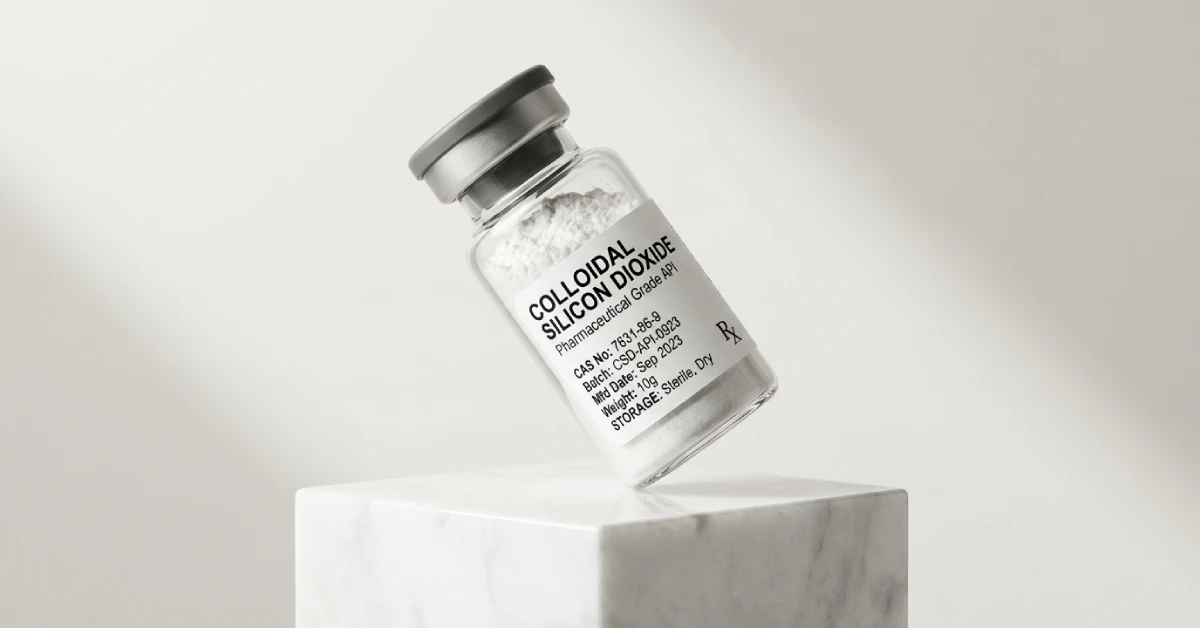
Colloidal silicon dioxide, also called colloidal silica, fumed silica, or synthetic amorphous silica, is a widely used pharmaceutical excipient rather than a pharmacologically active drug. It is added to medicines to improve powder flow during tablet and capsule manufacture, prevent caking, stabilize suspensions, thicken gels, and support the uniform distribution of active ingredients.
Because it is not a therapeutic API, colloidal silicon dioxide does not treat disease through a pharmacological mechanism. Instead, its value lies in its physical and colloidal properties: an extremely small particle size, high surface area, strong adsorption capacity, and ability to modify powder flow, viscosity, and moisture behavior. It appears in many oral tablets, capsules, suspensions, topical preparations, and soft-gel formulations.
Chemical Structure
Colloidal silicon dioxide is composed of silicon dioxide, , with a molecular weight of 60.08 g/mol and CAS number 7631-86-9. Pharmaceutical grades are typically synthetic amorphous silica, meaning the particles lack the ordered crystalline structure of crystalline silica.
The material is produced as very small primary particles, commonly in the nanometer range, which aggregate and agglomerate into larger structures. EFSA describes synthetic amorphous silica as consisting of mostly spherical particles approximately 2 to 28 nm in size that form complex aggregates.
Its high surface area allows it to adsorb moisture, oils, and other formulation components. This property makes it useful as a glidant, anti-caking agent, adsorbent, suspending aid, and viscosity modifier.
Colloidal Silicon Dioxide-Based Medicines
“Colloidal silicon dioxide” is present as an inactive ingredient in a very large number of medicines. Common examples include:
- Lamotrigine tablets.
- Levothyroxine tablets.
- Montelukast tablets.
- Atorvastatin tablets.
- Pantoprazole tablets.
- Fexofenadine tablets.
- Multivitamin and mineral tablets.
- Pancreatic enzyme products such as Pancreaze.
These products use colloidal silicon dioxide to improve manufacturing performance and dosage-form stability. Its presence on a drug label does not mean it provides a therapeutic effect; it is included as an excipient.
Mechanism of Action
Colloidal silicon dioxide does not act on receptors, enzymes, or signaling pathways in the human body. Its “mechanism of action” is physical rather than pharmacological. In powder blends, it coats particles and reduces interparticle friction, allowing powders to flow more smoothly during tablet compression or capsule filling.
In liquids and semi-solids, colloidal silicon dioxide increases viscosity and helps suspend insoluble particles, preventing settling. In emulsions, it stabilizes droplets and improves texture. In solid dosage forms, it can also act as an adsorbent for oils or moisture-sensitive ingredients and as a disintegrant aid.
Because it is chemically inert and poorly absorbed after oral administration, it does not produce a systemic pharmacodynamic effect. Its clinical relevance is therefore formulation quality, dose uniformity, and product stability rather than disease treatment.
Pharmacokinetics
Colloidal silicon dioxide is not absorbed to a meaningful extent through the gastrointestinal tract. Most orally administered silicon dioxide passes through the digestive system unchanged and is excreted in feces.
A small fraction of silicon-containing material may be absorbed, but systemic bioavailability is considered very low. EFSA estimates that systemic availability of synthetic amorphous silica is below 0.2%, and absorption decreases at higher doses as particles form larger agglomerates.
Any absorbed silicon is primarily excreted through urine. There is no evidence of toxic accumulation in the body at normal exposure levels, though EFSA notes that some uncertainty remains regarding nanoparticle behavior and long-term tissue distribution.
Therapeutic Uses
| Application | Role of colloidal silicon dioxide |
|---|---|
| Tablet manufacturing | Acts as a glidant to improve powder flow |
| Capsule filling | Improves powder flow and dose uniformity |
| Oral suspensions | Acts as a suspending and anti-settling agent |
| Oral solutions | Functions as a viscosity-increasing agent |
| Emulsions | Stabilizes droplets and prevents separation |
| Topical creams and gels | Thickens and stabilizes semi-solid formulations |
| Soft-gel capsules | Acts as an adsorbent and anti-caking agent |
| Moisture-sensitive drugs | Helps protect against moisture uptake |
| Suppositories | Increases viscosity and reduces sedimentation |
| Aerosols | Helps suspend particles and prevent nozzle clogging |
Colloidal silicon dioxide is not used as a therapeutic agent itself. Its role is to improve the physical performance, stability, and manufacturability of medicines.
Side Effects
Because colloidal silicon dioxide is poorly absorbed and chemically inert, it is generally considered nontoxic and nonirritating when used orally or topically at normal pharmaceutical levels. Most patients do not experience side effects from the small amounts present in medicines.
Rarely, gastrointestinal symptoms such as nausea, bloating, or constipation may occur, though these are more often related to the overall formulation or other excipients rather than silicon dioxide itself. Allergic reactions are extremely uncommon but possible in sensitive individuals.
Colloidal silicon dioxide should not be administered parenterally. Injection into tissue can cause local reactions or granulomas, which is why it is restricted to oral, topical, and certain non-injectable dosage forms.
Drug Interactions
Colloidal silicon dioxide does not have clinically significant pharmacological drug interactions because it is not absorbed systemically and does not act on drug-metabolizing enzymes. However, its strong adsorption capacity can theoretically affect drug release or stability if used in excessive amounts or in poorly designed formulations.
In practice, pharmaceutical formulators control the amount and grade of colloidal silicon dioxide to ensure it does not interfere with active ingredient dissolution or absorption. FDA guidance notes that excipients should not modulate drug absorption in biowaiver-based formulations.
No specific food or drug interactions are associated with colloidal silicon dioxide at normal excipient levels. Patients with concerns about a particular medicine should consult the product label or a pharmacist.
Safety Considerations
Colloidal silicon dioxide is listed as generally recognized as safe (GRAS) by the FDA and is included in the FDA Inactive Ingredients Database for oral capsules, suspensions, tablets, and certain topical and rectal or vaginal preparations. It is also approved as a food additive under 21 CFR 172.480, with a limit of 2% by weight in food.
The main safety concern relates to inhalation exposure during manufacturing rather than patient use. Fine silica dust can pose a respiratory hazard if inhaled in large amounts, which is why occupational exposure limits and dust-control measures are important in production facilities.
EFSA’s 2024 re-evaluation concluded that silicon dioxide E551 does not raise a safety concern in any population group, including infants under 16 weeks, though it noted uncertainties around nanoparticle characterization and long-term effects.
Regulatory Status
Colloidal silicon dioxide is recognized in major pharmacopoeias including the United States Pharmacopeia/National Formulary (USP-NF), European Pharmacopoeia (Ph. Eur.), and Japanese Pharmacopoeia (JP). It is listed as E551 in the European food additive system and is widely accepted as a pharmaceutical excipient.
In the United States, it is approved as a food additive and is included in the FDA Inactive Ingredients Database for multiple dosage forms. FDA guidance for BCS Class 3 biowaivers lists a recommended maximum allowable amount of 40 mg for colloidal silicon dioxide in immediate-release tablets or capsules.
Globally, colloidal silicon dioxide is used in pharmaceutical, food, cosmetic, and industrial applications. Its regulatory status is well established, and it is considered a safe, inert excipient when used within accepted limits.
Conclusion
Colloidal silicon dioxide is a synthetic amorphous silica excipient used to improve the flow, stability, and physical performance of medicines. It is not a therapeutic API and does not act pharmacologically in the body. Instead, it serves as a glidant, anti-caking agent, suspending aid, and viscosity modifier across tablets, capsules, suspensions, and topical products.
Its safety profile is well established, with very low oral absorption and no significant systemic effects at normal exposure levels. Regulatory authorities including the FDA and EFSA recognize it as safe when used appropriately, though manufacturing-related inhalation exposure and nanoparticle characterization remain areas of ongoing attention.