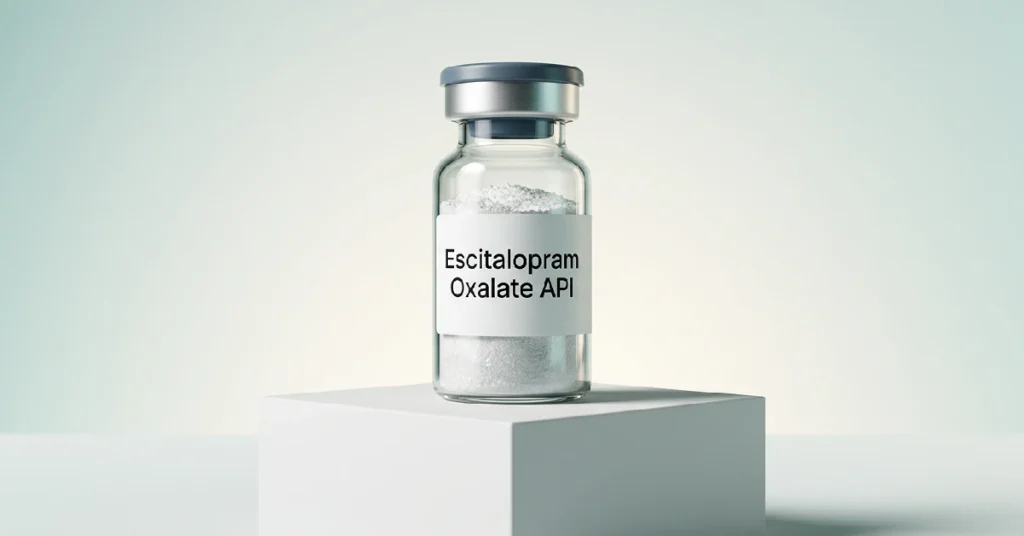
Escitalopram oxalate is the pharmaceutical salt of escitalopram, a selective serotonin reuptake inhibitor used primarily for depression and anxiety disorders. The oxalate supports pharmaceutical formulation; Escitalopram Oxalate provides the therapeutic activity. Treatment aims to reduce symptoms and improve functioning, rather than produce immediate sedation or euphoria.
Its benefits develop gradually, and prescribing requires assessment of diagnosis, interactions, suicide risk, and tolerability. The information below describes the API and its medicines, not an individualized treatment plan. Approved indications and pediatric age limits differ between countries.
Chemical Structure
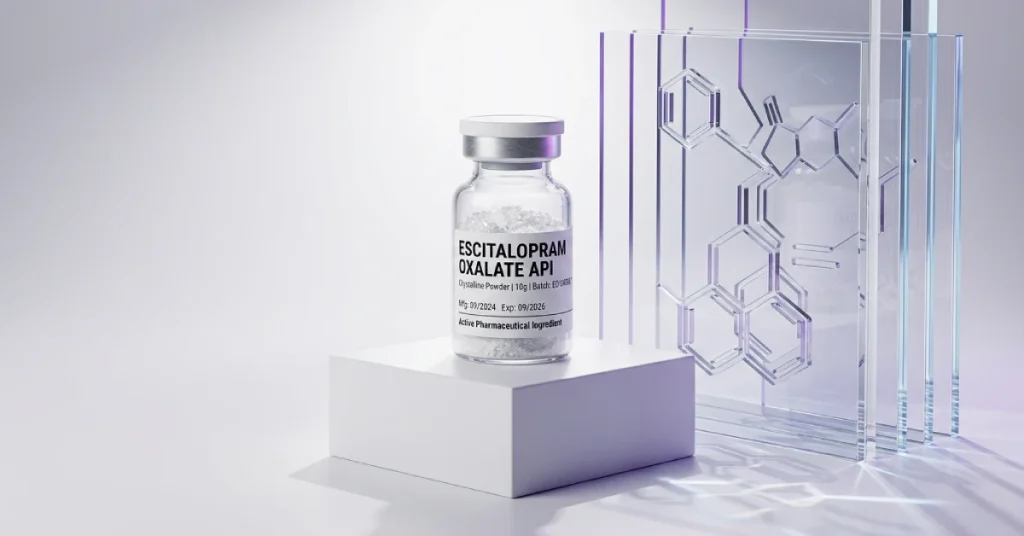
Escitalopram Oxalate is the S-enantiomer of citalopram, meaning it is one specific mirror-image form of that molecule. Its chemical name is S(+)-1-[3-(dimethylamino)propyl]-1-(4-fluorophenyl)-1,3-dihydroisobenzofuran-5-carbonitrile. The medicinal ingredient is supplied as its oxalate salt, with formula C20H21FN2O·C2H2O4 and molecular weight approximately 414.43 g/mol.
The API is a white to slightly yellow crystalline powder. Tablet strengths generally describe the equivalent amount of Escitalopram Oxalate base, not the total oxalate salt mass. Consequently, manufacturing specifications and patient-facing dose statements use related but different quantities.
Escitalopram Oxalate-Based Medicines
Eight brand examples are listed below; these are not a sales ranking.
- Lexapro.
- Cipralex.
- Lexam.
- Elicea.
- Nexito.
- Rexipra.
- Stalopam.
- Depralin.
Availability, strengths, and licensed indications vary by market. Check the ingredient panel because similarly named combination products may contain additional medicines. Generic “escitalopram oxalate” is also widely available.
Formulations and Administration
Common formulations include film-coated tablets containing 5, 10, or 20 mg Escitalopram Oxalate equivalent, alongside oral solutions in selected markets. Some solutions contain 1 mg/mL, but concentrations and availability must be checked locally. Tablets and appropriately matched oral solution formulations can be bioequivalent.
Escitalopram Oxalate is usually taken once daily, morning or evening, with or without food. Consistent administration supports adherence. Liquid doses require a suitable measuring device, rather than a household spoon. Formulation changes should preserve the prescribed escitalopram-equivalent dose.
Mechanism of Action
Escitalopram Oxalate inhibits the serotonin transporter, reducing serotonin reuptake into presynaptic neurons. This increases serotonin availability in the synaptic space and modifies serotonergic signaling. It has comparatively little affinity for several other neurotransmitter receptors, distinguishing it from less selective antidepressants.
However, depression is not adequately explained as a simple serotonin deficiency. Transporter inhibition occurs before full clinical improvement, and downstream adaptation contributes to the treatment response. Early changes may precede broader improvement over several weeks; effectiveness and tolerability require reassessment rather than automatic dose escalation.
Pharmacokinetics
After oral administration, peak blood concentrations occur at approximately five hours. Food does not meaningfully alter absorption. Plasma protein binding is approximately 56%, and steady state generally develops within about one week of regular dosing. The terminal elimination half-life is approximately 27–32 hours, supporting daily administration.
Metabolism occurs predominantly in the liver, particularly through CYP2C19 and CYP3A4, producing demethylated metabolites with less pharmacological activity. Genetic differences and enzyme inhibitors can alter exposure. Older age and hepatic impairment can increase exposure; severe renal impairment requires caution because supporting data are limited.
Therapeutic Uses
| Condition | Role and approval context |
|---|---|
| Major depressive disorder | United States approval includes adults and adolescents aged 12 years or older. |
| Generalized anxiety disorder | United States approval includes adults and children aged seven years or older. |
| Panic disorder | Licensed in certain countries, including UK products; not FDA-approved for this indication. |
| Social anxiety disorder | Licensed in certain countries; United States use is off-label. |
| Obsessive-compulsive disorder | Licensed in certain countries; United States use is off-label. |
Approval does not guarantee benefit for every patient. Diagnosis, previous treatment, patient preferences, psychotherapy access, and comorbidities influence selection. Pediatric prescribing must follow the specific local authorization and monitoring requirements.
Dosage Considerations
United States labeling generally recommends 10 mg once daily initially for approved depression and anxiety indications, with a maximum of 20 mg daily. Dose increases depend on age, indication, response, and tolerability; pediatric escalation intervals differ from adult schedules. These figures describe labeling, not personal instructions.
For most older adults and patients with hepatic impairment, the recommended dose is 10 mg daily. Mild or moderate renal impairment generally does not require adjustment. In adult depression trials, 20 mg did not demonstrate greater average benefit than 10 mg, while adverse effects increased.
Side Effects
Common adverse effects include nausea, insomnia, sleepiness, fatigue, sweating, diarrhea, and sexual dysfunction. Sexual effects may involve reduced libido, delayed ejaculation, erectile difficulties, or delayed or absent orgasm. Patients should discuss these symptoms directly, because they may otherwise remain unrecognized and undermine adherence.
Less common but serious risks include serotonin syndrome, low sodium, abnormal bleeding, seizures, mania or hypomania, and angle-closure glaucoma in susceptible individuals. Dose-dependent QT prolongation can predispose vulnerable patients to dangerous arrhythmias. New suicidal thoughts or marked behavioral changes require urgent assessment, particularly early in treatment or after dose changes.
Drug Interactions
Monoamine oxidase inhibitors are contraindicated with Escitalopram Oxalate because of serotonin syndrome risk. United States labeling requires at least 14 days between stopping psychiatric MAOIs and starting escitalopram, and vice versa. Linezolid and intravenous methylene blue also create important contraindicated combinations requiring specialist management.
Other serotonergic substances, including tramadol, lithium, triptans, buspirone, and St John’s wort, can increase serotonin toxicity risk. Aspirin, NSAIDs, antiplatelets, and anticoagulants increase bleeding risk. Pimozide is contraindicated. QT-prolonging drugs and CYP2C19 inhibitors require careful review; alcohol is best avoided during treatment.
Safety Considerations and Monitoring
Before treatment, clinicians should screen for bipolar disorder and review seizure history, cardiac disease, glaucoma risk, bleeding problems, and all medicines or supplements. ECG assessment and electrolyte testing may be appropriate when cardiac or sodium-related risks exist, rather than being mandatory for everyone.
The United States boxed warning highlights increased suicidal thoughts and behaviors in pediatric and young adult patients. Monitor all patients for worsening symptoms. Seek emergency help for suicidal intent, seizures, fainting, or suspected serotonin syndrome, especially fever with agitation, muscle rigidity, tremor, or confusion.
Pregnancy and Breastfeeding
Pregnancy decisions require individualized assessment of medication risks and untreated illness. Late-pregnancy SSRI exposure can be associated with neonatal adaptation symptoms and persistent pulmonary hypertension; exposure near delivery may increase postpartum bleeding risk. These possibilities do not justify abrupt discontinuation without medical advice.
Escitalopram Oxalate enters breast milk. Prescribers weigh maternal benefit against infant exposure and monitor for excessive sleepiness, feeding difficulties, or inadequate weight gain. Pregnancy planning and breastfeeding discussions should consider illness severity, previous relapse, alternative treatments, and available support.
Discontinuation and Overdose
Abrupt stopping can cause dizziness, anxiety, irritability, insomnia, nausea, and electric-shock sensations. A gradual, individualized taper reduces withdrawal risk; some patients need slower reductions than others. Withdrawal symptoms are distinct from addiction, although distinguishing withdrawal from relapse can require clinical review.
Overdose requires urgent medical assessment, even without immediate symptoms. Potential complications include seizures, serotonin toxicity, and cardiac rhythm disturbances. Do not induce vomiting; contact emergency services or a poison information service promptly.
Practical Handling
Store the dispensed medicine according to its package instructions, protected from inappropriate heat and moisture and inaccessible to children. Never share prescribed Escitalopram Oxalate. Keep an updated medication list and check before starting painkillers, herbal products, or another antidepressant, because apparently routine additions can change bleeding, serotonin, or cardiac risk. Include nonprescription medicines and supplements.
Regulatory Status
Escitalopram Oxalate received initial United States approval in 2002 and remains a prescription medicine. US authorization includes specified pediatric depression and anxiety populations, whereas some other countries restrict routine use below eighteen. UK product information includes additional anxiety-related indications and contraindicates established QT prolongation. Always consult the current local product label.