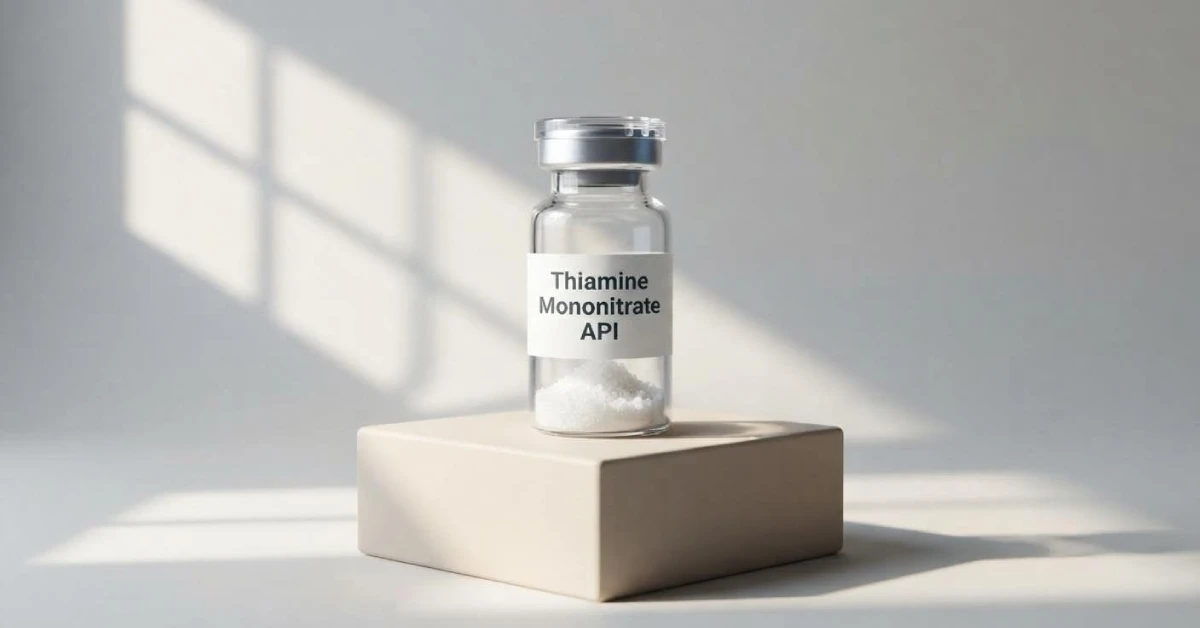
Thiamine mononitrate is the nitrate salt of thiamine, commonly known as vitamin B1. It is a stable, water-soluble nutritional API used in dietary supplements, fortified foods, and selected pharmaceutical preparations. Thiamine is essential for carbohydrate metabolism, nerve function, and energy production, and the body requires a continuous dietary supply because it stores only a limited amount.
The mononitrate form is widely chosen for oral products because it is relatively stable during storage and processing. It is chemically distinct from thiamine hydrochloride, another common pharmaceutical salt, although both provide biologically active thiamine after absorption. Deficiency can cause beriberi and, in high-risk patients, Wernicke encephalopathy, a medical emergency requiring prompt parenteral thiamine.
Chemical Structure
Thiamine mononitrate has the molecular formula C12H17N5O4S and a molecular weight of approximately 327.36 g/mol. Its systematic name is 3-[(4-amino-2-methylpyrimidin-5-yl)methyl]-5-(2-hydroxyethyl)-4-methyl-1,3-thiazol-3-ium nitrate. The molecule consists of a substituted pyrimidine ring linked to a thiazolium ring, with a nitrate counterion.
Thiamine itself is achiral and contains both a pyrimidine and a thiazole moiety. In the body, thiamine is phosphorylated to thiamine pyrophosphate (TPP), also called cocarboxylase, which is the active coenzyme form. The mononitrate salt is sparingly soluble in water and is used extensively in solid oral dosage forms and food fortification.
Thiamine Mononitrate-Based Medicines
The following are examples of products that may contain thiamine mononitrate. Formulations and exact salts vary by country, so the ingredient panel should always be checked.
- Berocca.
- Neurobion.
- Neurobion Forte.
- Centrum multivitamin products.
- Theragran multivitamin products.
- Dialyvite.
- TM-Vite RX.
- Generic thiamine mononitrate tablets.
Many products combine thiamine with other B vitamins, minerals, or antioxidants. Combination products should not be assumed equivalent to single-ingredient thiamine supplements, because their doses, indications, and safety profiles differ.
Mechanism of Action
Thiamine is converted intracellularly by thiamine pyrophosphokinase-1 into thiamine pyrophosphate. TPP serves as an essential cofactor for several enzyme systems involved in energy metabolism, including pyruvate dehydrogenase, alpha-ketoglutarate dehydrogenase, and transketolase. These enzymes support the tricarboxylic acid cycle, carbohydrate oxidation, and the pentose phosphate pathway.
Through these actions, thiamine enables cells—especially the brain, heart, skeletal muscle, and peripheral nerves—to use glucose efficiently. In deficiency, impaired aerobic metabolism leads to accumulation of metabolic intermediates, neuronal dysfunction, cardiovascular changes, and the clinical syndromes of beriberi and Wernicke encephalopathy.
Pharmacokinetics
After oral intake, thiamine is absorbed mainly in the duodenum and proximal jejunum. At nutritional doses, absorption occurs through a saturable, carrier-mediated process; at higher pharmacologic doses, passive diffusion also contributes. Intestinal phosphatases first hydrolyze phosphorylated dietary thiamine into free thiamine before absorption.
Absorption from a single large oral dose is limited, and excess thiamine is rapidly excreted in urine. After an oral dose, urinary excretion peaks at about two hours and is nearly complete by four hours. At high repeated doses, plasma steady state may take about one week, while the body’s overall thiamine pool has a longer biological half-life of approximately nine to eighteen days.
Therapeutic Uses
| Therapeutic area | Typical use of thiamine mononitrate |
|---|---|
| Nutritional deficiency | Prevention and correction of dietary thiamine deficiency |
| Beriberi | Supportive management of wet or dry beriberi associated with deficiency |
| Wernicke encephalopathy | Emergency treatment generally uses parenteral thiamine rather than oral mononitrate |
| Alcohol use disorder | Nutritional support in people at risk of deficiency |
| Malabsorption states | Supplementation in bariatric surgery, chronic vomiting, or intestinal disease |
| Parenteral nutrition | Included in multivitamin preparations to prevent deficiency |
| Pregnancy-related vomiting | Nutritional support when severe vomiting impairs intake |
| General supplementation | Daily vitamin or B-complex supplementation |
“Thiamine mononitrate” is primarily a preventive and nutritional API. For established Wernicke encephalopathy, urgent parenteral thiamine is preferred because oral absorption and distribution may be inadequate in critically ill or malnourished patients.
Side Effects
Oral thiamine mononitrate is generally well tolerated at nutritional and supplemental doses. Because it is water soluble, excess amounts are usually excreted in urine rather than stored extensively in tissues. Reported adverse effects are uncommon and may include mild gastrointestinal upset, nausea, or allergic skin reactions in susceptible individuals.
Parenteral thiamine carries a more important safety concern: hypersensitivity and anaphylactic reactions can occur, particularly after repeated injections. Reported reactions include warmth, itching, hives, sweating, nausea, throat tightness, angioedema, cyanosis, pulmonary edema, collapse, and rarely death. Injectable products therefore require appropriate clinical supervision and readiness to manage anaphylaxis.
Drug Interactions
Thiamine itself is not known to produce major pharmacokinetic drug-drug interactions. However, some medicines can lower thiamine status or increase the risk of deficiency. Long-term furosemide use can increase urinary thiamine loss and has been associated with reduced thiamin concentrations.
Other factors that may increase thiamine requirements or reduce availability include chronic alcohol use, malabsorption, prolonged vomiting, bariatric surgery, and highly restricted diets. Patients using diuretics or receiving long-term parenteral nutrition should have their nutritional status reviewed by a healthcare professional, particularly if they have neuropathy, heart failure, confusion, or unexplained fatigue.
Safety Considerations
Thiamine mononitrate should be used as part of a balanced nutritional plan rather than as a substitute for medical evaluation of fatigue, neuropathy, memory problems, or heart failure. Persistent symptoms may reflect another condition or a deficiency of another nutrient, such as vitamin B12, folate, or iron.
People with known allergy to thiamine should avoid further exposure and seek medical advice before using thiamine-containing products. Injectable thiamine should not be self-administered without appropriate medical supervision because of the risk of serious hypersensitivity reactions. Pregnant or breastfeeding individuals should use products according to labeled doses or professional guidance.
Regulatory Status
Thiamine mononitrate has a dual regulatory role. It is an approved nutrient supplement and food additive in the United States, listed under 21 CFR 184.1878 for nutrient-supplementation purposes. It is also used as an ingredient in prescription and over-the-counter vitamin products, depending on the product’s formulation, dose, and intended use.
In the European Union and many other jurisdictions, thiamine is recognized as an essential vitamin and is permitted in fortified foods and food supplements within applicable limits. Regulatory classification can differ substantially between a low-dose multivitamin, a high-dose therapeutic supplement, and an injectable thiamine product.
Clinical Perspective
Thiamine mononitrate is a foundational nutritional API with a well-established role in preventing vitamin B1 deficiency. Its stability, water solubility, and suitability for tablets and fortified foods make it especially useful in public-health nutrition and routine supplementation.
Its most important clinical limitation is that oral supplementation is not always sufficient for acute, severe deficiency. In suspected Wernicke encephalopathy or severe beriberi, prompt parenteral thiamine is the priority, followed by identification and correction of the underlying cause, such as alcohol use disorder, malabsorption, or inadequate nutrition.