Ciclopirox olamine, sometimes referred to as “Siklopiroksola” in certain regions, is a versatile antifungal agent with unique properties that distinguish it from other antimycotic medications. This synthetic hydroxypyridone derivative has garnered attention for its efficacy against a wide spectrum of fungal infections and its favorable safety profile. The following comprehensive analysis explores the various facets of this important pharmaceutical compound, from its chemical composition to clinical applications.
Introduction
Ciclopirox olamine is a synthetic antifungal agent belonging to the hydroxypyridone derivative class. Unlike the more common azole antifungals, ciclopirox olamine operates through a distinctive mechanism that makes it particularly valuable in treating various fungal infections of the skin and nails.
First developed as an alternative to traditional antifungal medications, ciclopirox olamine has demonstrated remarkable versatility in combating a broad range of pathogenic organisms including dermatophytes, yeasts, and even certain bacteria. The compound is particularly notable for its efficacy against Malassezia furfur, the causative agent of tinea versicolor, a common fungal skin condition. As an olamine salt of ciclopirox, this medication offers enhanced stability and improved topical delivery compared to its base form, making it a preferred choice for various dermatological applications.
Chemical Structure
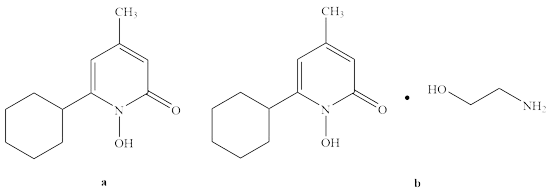
Ciclopirox olamine is chemically identified as 2-aminoethanol;6-cyclohexyl-1-hydroxy-4-methylpyridin-2-one. Its molecular formula is C12H17NO2 with a molecular weight of 268.35 g/mol. Structurally, ciclopirox olamine consists of a hydroxypyridone nucleus with a cyclohexyl and methyl group attached. The compound appears as a white powder with a density between 1.2 and 1.4 g/cm³.
X-ray crystallographic studies reveal that ciclopirox olamine is the 2-aminoethanol salt of ciclopirox. In its crystalline form, two molecules of ciclopirox associate with one molecule of 2-aminoethanol. The cyclohexane rings in ciclopirox adopt a chair conformation, while the pyridinone rings are nearly planar.
This specific spatial arrangement contributes to the compound’s ability to chelate metal ions effectively, which is crucial for its antifungal activity. The inherent conformation of ciclopirox olamine facilitates its interaction with target enzymes within fungal cells, enabling it to disrupt essential metabolic processes.
Ciclopirox Olamine-Based Medicines List
Below are eight prominent brand names of ciclopirox olamine-based medications available in various markets:
- Candirox – Manufactured by Incepta Pharmaceuticals Ltd., available as 0.77% cream in 15 gm tubes
- Cicloderm – Produced by Popular Pharmaceuticals Ltd., marketed as 1% cream in 15 gm tubes
- Ciclorox – Made by Opsonin Pharma Ltd., offered as 1% cream in 15 gm tubes
- Clopirox – Manufactured by Square Pharmaceuticals PLC, available as 1% cream in 15 gm tubes
- Fungirox – Produced by Renata Limited, marketed as 1% cream in 15 gm tubes
- Tinactin – Made by Healthcare Pharmaceuticals Ltd., offered as 1% cream in 15 gm tubes
- Penlac – A well-known brand name for ciclopirox nail lacquer formulation, used specifically for onychomycosis
- Loprox – Another widely recognized ciclopirox olamine-based product line for various dermatological applications
These pharmaceutical preparations are primarily available as creams, though ciclopirox olamine is also formulated as nail lacquer, shampoo, and topical solutions depending on the specific fungal condition being treated.
Mechanism of Action
Ciclopirox olamine exhibits a unique mechanism of action that differentiates it from other antifungal agents such as azoles or allylamines. Its primary mode of action involves chelating polyvalent metal cations, particularly trivalent metal ions like Fe³⁺ and Al³⁺, which are vital for fungal cellular functions. This chelation process leads to the inhibition of multiple metal-dependent enzymes including cytochromes, catalase, and peroxidase that are essential for fungal metabolism and survival.
Beyond enzyme inhibition, ciclopirox olamine disrupts multiple aspects of fungal cellular function. It interferes with mitochondrial electron transport chains, hampering energy production critical for fungal growth. The compound also affects membrane permeability, blocking the transport of essential nutrients and precursors across the fungal cell membrane. At higher concentrations, ciclopirox olamine can compromise the integrity of the cell membrane itself, resulting in leakage of potassium ions and other intracellular components, ultimately leading to fungal cell death.
Research using yeast models has revealed that ciclopirox olamine may target multiple proteins involved in various components of cellular metabolism, including DNA replication, DNA repair, and cellular transport. Studies have identified specific genes affected by ciclopirox olamine, including a Fe/Cu reductase (FRE1/COS107), an oxidative stress response gene (YAP1/COS110), and a gene involved in signal transduction (YBR203W/COS111). This multi-target approach may explain the compound’s broad spectrum of activity and relatively low incidence of resistance development compared to other antifungal agents.
Pharmacokinetics
The pharmacokinetic profile of ciclopirox olamine is characterized by its absorption, distribution, metabolism, and elimination patterns following administration. When applied topically, ciclopirox olamine demonstrates limited systemic absorption, which contributes to its favorable safety profile. However, when administered through more permeable routes such as the buccal mucosa, absorption can be more significant.
In a study using buccal administration in rabbits, ciclopirox olamine reached maximum plasma concentration (Cmax) of 5.73 μg/mL at approximately 1.7 hours post-administration. The elimination half-life was determined to be around 3.8 hours following this route of administration. For topical formulations, such as the 1% solution, the half-life is reported to be approximately 1.7 hours.
Following absorption, ciclopirox olamine distributes throughout the body, penetrating various tissues including the hair, epidermis, hair follicles, sebaceous glands, and dermis to reach the sites of infection. This broad tissue penetration contributes to its therapeutic efficacy against superficial fungal infections. Of particular clinical significance is ciclopirox olamine’s ability to penetrate the nail plate, making it valuable for treating onychomycosis.
Metabolically, ciclopirox olamine primarily undergoes glucuronidation, forming glucuronide conjugates. These metabolic products, along with unchanged drug, are primarily eliminated through renal excretion. This elimination pathway helps minimize potential adverse effects by efficiently clearing the drug from the body. The relatively short half-life necessitates frequent application for topical preparations to maintain therapeutic concentrations at the infection site.
Therapeutic Uses
| Condition | Description | Administration Form | Efficacy |
|---|---|---|---|
| Onychomycosis | Fungal infection of fingernails or toenails | Nail lacquer, topical solution | Effectively penetrates nail plate; clinical studies demonstrate efficacy particularly for mild to moderate cases |
| Dermatophyte Infections | Includes tinea corporis (body), tinea cruris (groin), tinea pedis (athlete’s foot) | Cream, topical solution | Comparable or superior efficacy to clotrimazole in controlled studies |
| Cutaneous Candidiasis | Yeast infections of the skin | Cream, topical solution | Effective against Candida species with broad-spectrum activity |
| Tinea Versicolor | Skin condition caused by Malassezia globosa | Cream, topical solution | Particularly effective against the causative organism |
| Seborrheic Dermatitis | Inflammatory skin condition often involving fungal component | Cream, shampoo | Demonstrates anti-inflammatory properties in addition to antifungal effects |
| Superficial Mycoses | General term for various fungal infections affecting skin | Cream, topical solution | Broad-spectrum activity against numerous pathogenic fungi |
Side Effects
Ciclopirox olamine is generally well-tolerated when used as directed, but like all medications, it can cause adverse reactions in some individuals. The most commonly reported side effects from topical application include localized skin reactions such as itching, burning sensation, and redness at the application site. These reactions are typically mild and transient, resolving as treatment continues or upon discontinuation of the medication.
Less frequently, patients may experience contact dermatitis or hypersensitivity reactions manifesting as more severe skin irritation, swelling, or rash. In rare instances, allergic reactions may occur, necessitating immediate discontinuation of the treatment. When ciclopirox olamine is used as a nail lacquer for onychomycosis, temporary nail discoloration or changes in nail texture have been reported by some patients during the course of treatment.
Systemic side effects are exceedingly rare due to the minimal absorption of topically applied ciclopirox olamine into the bloodstream. This limited systemic exposure contributes significantly to the medication’s favorable safety profile, making it suitable for prolonged use in chronic fungal infections like onychomycosis that often require extended treatment periods. The low incidence of serious adverse effects distinguishes ciclopirox olamine from oral antifungal agents, which typically carry greater risks of systemic toxicity.
Drug Interactions
Due to its primarily topical application and limited systemic absorption, ciclopirox olamine has few significant drug interactions compared to orally administered antifungal medications. This characteristic represents one of its clinical advantages, particularly for patients on multiple medications who may be at risk for drug interaction complications.
However, there are some considerations for concomitant use with other topical preparations. Applying other medicinal products, cosmetics, or occlusive dressings to the same treatment area may potentially alter the penetration or efficacy of ciclopirox olamine. It is generally recommended to allow sufficient time between the application of ciclopirox olamine and other topical products to ensure optimal absorption and effectiveness.
For nail lacquer formulations, interaction with nail polish or artificial nails may interfere with the medication’s ability to penetrate the nail plate and reach the infection site. Patients are typically advised to avoid using nail cosmetics during treatment for onychomycosis. Additionally, the alcohol content in some ciclopirox olamine formulations could theoretically interact with other topical products, potentially causing increased dryness or irritation in sensitive individuals.
Safety Considerations
When using ciclopirox olamine, several safety considerations should be taken into account to maximize therapeutic benefits while minimizing risks. The medication is intended for external use only and should never be ingested or applied to the eyes, mouth, or other mucous membranes unless specifically formulated and prescribed for such use (as in the case of buccal preparations studied experimentally).
For pregnant or breastfeeding women, ciclopirox olamine should be used with caution and only when clearly needed, as comprehensive safety data in these populations are limited. While topical application results in minimal systemic absorption, healthcare providers typically weigh the potential benefits against possible risks before recommending treatment during pregnancy or lactation.
Patients with known hypersensitivity to ciclopirox olamine or any components of its formulations should avoid using these products. Furthermore, broken or inflamed skin at the application site may increase systemic absorption, potentially leading to greater risk of adverse effects. It is advisable to consult a healthcare provider if the treated condition shows no improvement after the recommended treatment duration or if irritation or sensitivity develops.
For nail lacquer formulations used in treating onychomycosis, patients should be counseled on proper application techniques and the importance of adherence to the prescribed regimen, which may extend for several months due to the slow growth rate of nails and the persistent nature of nail fungal infections.
Regulatory Status
Ciclopirox olamine has received regulatory approval in numerous countries worldwide for the treatment of various fungal infections. It is available in multiple formulations including creams, lotions, shampoos, and nail lacquers, with specific approved indications varying somewhat by region and regulatory authority.
In the United States, the Food and Drug Administration (FDA) has approved ciclopirox formulations for multiple indications. The topical solution specifically designed for onychomycosis is approved for use in combination with regular nail trimming to treat fungal infections of both fingernails and toenails. Other formulations have received approval for treating seborrheic dermatitis, tinea pedis, tinea cruris, tinea corporis, cutaneous candidiasis, and tinea versicolor.
Globally, ciclopirox olamine preparations are marketed under various trade names and are generally available by prescription, though in some regions certain formulations may be available over-the-counter for specific indications. The drug’s favorable safety profile, combined with its broad spectrum of antifungal activity and low incidence of resistance development, has established it as an important component of the antifungal armamentarium in clinical practice.
Ongoing research continues to explore novel delivery systems and formulations to enhance the efficacy of ciclopirox olamine, particularly for challenging conditions like onychomycosis where drug delivery through the nail plate remains a significant therapeutic challenge.
Conclusion
Ciclopirox olamine represents a valuable contribution to the antifungal therapeutic arsenal, offering clinicians and patients an effective option for treating various fungal infections with a favorable safety profile. Its unique mechanism of action through metal ion chelation differentiates it from other antifungal classes and may contribute to its broad spectrum of activity and low incidence of resistance development.
The versatility of ciclopirox olamine is demonstrated by its efficacy against multiple fungal pathogens and its formulation in various pharmaceutical preparations tailored to specific clinical scenarios. From treating common dermatophyte infections to addressing the challenging condition of onychomycosis, ciclopirox olamine continues to play an important role in contemporary dermatological practice.
As research advances, further refinements in drug delivery systems and formulations may enhance the clinical utility of this established antifungal agent. The ongoing evolution of ciclopirox olamine preparations underscores the enduring value of this medication in the management of fungal infections, even as newer antifungal compounds enter the therapeutic landscape.