
Description
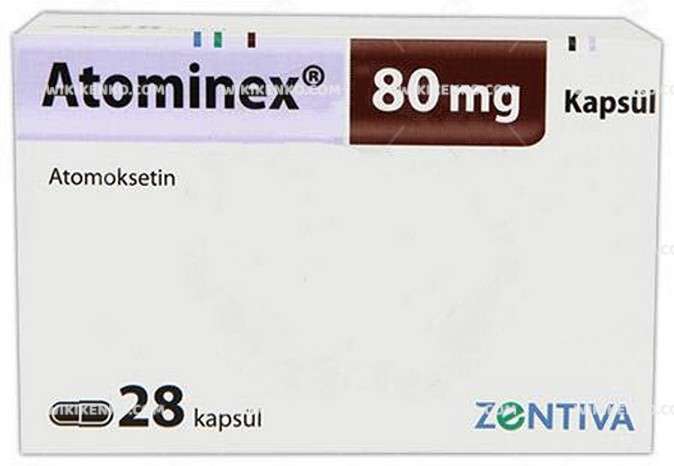
Atominex is a generic atomoxetine hydrochloride product that is therapeutically equivalent to reference atomoxetine formulations such as Strattera (atomoxetine hydrochloride) capsules. It is reported to be manufactured in Turkey by Sanofi Pharma Ltd. and marketed as a prescription‑only medicine for ADHD as part of a comprehensive treatment plan that includes psychological and educational interventions.
The active substance, atomoxetine hydrochloride, is an established selective norepinephrine reuptake inhibitor (NRI) registered in numerous jurisdictions for the treatment of ADHD in children, adolescents and adults. Regulatory product information for atomoxetine (e.g. FDA label, European product information, national monographs) is applicable to Atominex 80 mg, provided bioequivalence has been demonstrated.
Qualitative and quantitative composition
Each hard capsule of Atominex 80 mg contains atomoxetine hydrochloride in an amount equivalent to 80 mg of atomoxetine base. Excipients typically include capsule shell components (such as gelatin, colorants like titanium dioxide and iron oxides) and conventional oral capsule excipients, although exact qualitative details depend on the local marketing authorization dossier.
Atomoxetine is a phenoxy‑propylamine derivative and is present as a hydrochloride salt to improve stability and aqueous solubility. Reference atomoxetine 80 mg capsules are described as size 1, yellow‑white or similar hard gelatin capsules containing white to off‑white powder, a description consistent with generic 80 mg atomoxetine capsules.
Mechanism of action and pharmacodynamics
Atomoxetine is a highly selective presynaptic norepinephrine transporter (NET) inhibitor with minimal direct affinity for other monoamine transporters or receptors at therapeutic concentrations. By inhibiting NET, atomoxetine increases extracellular norepinephrine (and secondarily dopamine) in the prefrontal cortex, a region critically involved in attention, executive function and behavioral inhibition in ADHD.
Functional imaging and neurochemical studies suggest enhanced prefrontal cortical signaling without the rapid dopaminergic surge in striatal regions that characterizes stimulant medications, which may account for its negligible abuse potential. Atomoxetine induces modest increases in heart rate and blood pressure consistent with its noradrenergic mechanism, which are usually not clinically significant but warrant monitoring in susceptible patients.
Pharmacokinetics
Absorption and distribution
Atomoxetine is rapidly and almost completely absorbed after oral administration, with capsule formulations (including 80 mg strength) suitable for once‑ or twice‑daily dosing. Absolute oral bioavailability ranges from approximately 63% in extensive metabolizers to higher levels in poor CYP2D6 metabolizers, reflecting reduced first‑pass metabolism in the latter. Peak plasma concentrations are generally reached within about 1–2 hours in adults, and food has minimal clinically relevant effect on exposure; therefore, Atominex may be administered with or without food.
Atomoxetine is moderately distributed, with high plasma protein binding predominantly to albumin and alpha‑1 acid glycoprotein. It crosses the blood–brain barrier to exert central noradrenergic effects.
Metabolism and elimination
Atomoxetine is extensively metabolized in the liver, primarily via cytochrome P450 2D6 (CYP2D6) to 4‑hydroxyatomoxetine, which is subsequently glucuronidated. CYP2D6 genetic polymorphism leads to distinct pharmacokinetic phenotypes: poor metabolizers exhibit higher plasma exposure, longer elimination half‑life and increased risk of adverse effects at standard doses. In extensive metabolizers, the elimination half‑life is approximately 5 hours, whereas in poor metabolizers it may be around 20 hours, justifying genotype‑informed dosing recommendations in some guidelines.
Elimination occurs predominantly via the urine as metabolites, with only a small fraction excreted unchanged. Hepatic impairment reduces clearance, and formal product information recommends a 50% dose reduction in moderate hepatic impairment and 75% reduction in severe hepatic impairment.
Clinical indications
Atomoxetine (and by extension Atominex 80 mg) is indicated for the treatment of ADHD in children aged 6 years and older, adolescents, and adults in accordance with national product labeling. Treatment should be part of a comprehensive management program including psychological, educational and social measures.
The diagnosis of ADHD must be established according to recognized criteria (e.g. DSM or ICD) by clinicians experienced in behavioral disorders. Atomoxetine is often considered when stimulant therapy is contraindicated, not tolerated, or ineffective, or when there is concern about misuse or diversion.
Dosage and administration
Atominex Capsule 80 mg is not typically used as the initial dose but as a maintenance strength reached by titration. Atomoxetine may be administered once daily in the morning or divided into two doses (morning and late afternoon/early evening), with similar overall efficacy and tolerability.
In adults and adolescents over 70 kg, reference labels recommend starting at 40 mg/day for a minimum of 3–7 days, then increasing to a target daily dose of 80 mg, which corresponds to one Atominex 80 mg capsule once daily or 40 mg twice daily when using other strengths. If response is suboptimal after 2–4 weeks, the total daily dose may be increased up to a maximum of 100 mg/day according to clinical response and tolerability.
Weight‑based dosing in pediatric patients
In children and adolescents up to 70 kg, dosing is weight‑based, typically initiated at approximately 0.5 mg/kg/day and increased after several days to a target dose around 1.2 mg/kg/day. There is no consistent evidence of additional benefit above 1.2 mg/kg/day, and maximum doses are generally limited to 1.4 mg/kg/day or 100 mg/day, whichever is lower.
Dose adjustment in special populations
In moderate hepatic impairment, initial and target doses should be reduced to 50% of standard doses, and to 25% in severe hepatic impairment. In patients receiving strong CYP2D6 inhibitors (e.g. paroxetine, fluoxetine, quinidine), adult guidelines recommend starting at 40 mg/day and increasing to 80 mg/day only if symptoms fail to improve adequately after several weeks and the lower dose is well tolerated.
Older adults, patients with significant cardiovascular disease, and those with pre‑existing psychiatric comorbidities require individualized risk–benefit assessment and careful titration.
Practical administration
Capsules should be swallowed intact with fluid and must not be opened, as contact of capsule contents with the eye can be irritating and may require rinsing. If a dose is missed, standard advice is to take it as soon as remembered on the same day unless it is close to the time for the next dose; double dosing to compensate is not recommended.
Clinical efficacy
Randomized controlled trials and meta‑analyses demonstrate that atomoxetine significantly reduces core ADHD symptoms (inattention, hyperactivity, impulsivity) compared with placebo in both pediatric and adult populations. Symptomatic improvement usually begins within 1–2 weeks but may continue to accrue over 6–12 weeks, justifying adequate treatment duration before deeming the response insufficient.
Atomoxetine provides clinically meaningful benefit in measures of global functioning and quality of life and can improve symptoms in patients with comorbid conditions such as anxiety disorders or tic disorders, although the magnitude of effect may vary. Long‑term studies (up to 2 years or more) indicate sustained efficacy without evidence of tolerance or abuse liability.
Evidence on dose–response
Systematic analyses indicate that increasing atomoxetine doses above approximately 1.2–1.4 mg/kg/day (or above 80 mg/day in typical adults) does not consistently enhance overall response rates, even though higher doses are sometimes used within labeled limits. A responder‑related dose around 1.55 ± 0.28 mg/kg has been identified in some analyses, offering a pragmatic target for titration in clinical practice.
Safety profile and adverse reactions
Common adverse reactions
The most frequently reported adverse reactions with atomoxetine, including formulations such as Atominex, involve the gastrointestinal and central nervous systems and appetite regulation. In both adult and pediatric datasets, commonly observed reactions (generally mild to moderate and often transient) include decreased appetite, nausea, vomiting, abdominal pain, dyspepsia, dry mouth, constipation, fatigue, somnolence, dizziness, insomnia, and weight loss.
In adults, sexual adverse reactions such as decreased libido, erectile dysfunction or ejaculatory disorders are also reported. Cardiovascular effects include small mean increases in heart rate and blood pressure, which may be more relevant in patients with underlying cardiovascular disease.
Serious and rare adverse reactions
Serious but uncommon or rare adverse reactions include:
-
Severe liver injury, including reversible hepatitis and markedly elevated liver enzymes, typically occurring within several months of therapy.
-
Suicidal ideation and behavior, particularly in children and adolescents, leading to boxed warnings and recommendations for close monitoring.
-
Aggression, hostility, psychotic or manic symptoms, seizures and prolonged QT interval, which are rarely reported but clinically important.
-
Very rare reports of serotonin syndrome, particularly in the context of overdose or concomitant serotonergic agents.
Post‑marketing data include isolated fatalities in mixed‑substance overdoses; pure atomoxetine overdose is usually characterized by gastrointestinal symptoms, somnolence, agitation, tachycardia and hypertension.
Representative safety data (table)
| Safety domain | Typical findings with atomoxetine | Evidence source |
|---|---|---|
| Appetite and weight | Decreased appetite and modest weight loss common in children; decreased appetite often the most frequent treatment‑emergent adverse event. | Clinical trials and post‑marketing surveillance. |
| Gastrointestinal | Nausea, vomiting, abdominal pain and dyspepsia frequently reported, usually early in treatment and often transient. | Pediatric and adult RCTs, patient information leaflets. |
| Cardiovascular | Mean heart rate increase about 5 beats/min and small increases in blood pressure; few discontinuations for cardiovascular reasons. | Adult placebo‑controlled trials and long‑term analyses. |
| Hepatic | Rare cases of severe liver injury and reversible hepatitis reported in post‑marketing period (~3 cases among millions exposed). | Regulatory safety reviews and post‑marketing reports. |
| Psychiatric | Suicidal ideation, increased aggression/hostility and psychotic or manic symptoms rarely observed, particularly in pediatric patients. | Pooled analyses and post‑marketing experience. |
Contraindications and precautions
Absolute contraindications include:
-
Hypersensitivity to atomoxetine or any capsule component.
-
Concomitant use with monoamine oxidase inhibitors (MAOIs) or within 14 days of discontinuing an MAOI, due to risk of serious, potentially life‑threatening reactions.
-
Severe cardiovascular or cerebrovascular disorders where increases in blood pressure or heart rate would be hazardous, depending on local labeling.
Precautions are warranted in patients with:
-
Hypertension, tachycardia, cardiovascular or cerebrovascular disease, or congenital/acquired QT prolongation.
-
History of mania, hypomania, psychosis, or seizures.
-
Pre‑existing hepatic impairment or elevated liver enzymes.
-
Glaucoma or urinary retention, given atomoxetine’s noradrenergic effects on smooth muscle tone.
Monitoring recommendations generally include regular assessment of blood pressure and heart rate, growth parameters in children and adolescents, behavioral changes (particularly suicidality), and liver function tests when clinically indicated.
Drug–drug interactions
Atomoxetine is a substrate of CYP2D6 and is susceptible to pharmacokinetic interactions with strong CYP2D6 inhibitors such as paroxetine, fluoxetine, and quinidine, which can increase atomoxetine plasma concentrations several‑fold. Dose reductions and careful clinical monitoring are recommended when these combinations cannot be avoided.
Caution is advised when co‑administering atomoxetine with drugs that increase blood pressure or heart rate (e.g. decongestants, certain antidepressants) or that prolong the QT interval (e.g. some antipsychotics, antiarrhythmics). While atomoxetine is not a potent inhibitor or inducer of major cytochrome P450 enzymes at therapeutic doses, theoretical additive noradrenergic or serotonergic effects with other psychoactive agents should be considered.
Use in specific populations
In pregnancy, atomoxetine is classified as having limited human data; animal studies show some reproductive toxicity at high exposures, and use is generally considered when potential benefit justifies potential risk. During lactation, small amounts of atomoxetine may be excreted in breast milk and careful individual risk assessment is required.
In pediatric populations, atomoxetine has an established efficacy and safety profile but requires monitoring of growth, appetite, sleep and mood. In adults, particular attention should be paid to cardiovascular parameters and psychiatric comorbidities.
Overdose and management
Clinical experience with atomoxetine overdose indicates a symptom profile characterized by gastrointestinal complaints (nausea, vomiting), somnolence, dizziness, tremor, tachycardia, hypertension and behavioral changes; seizures and serotonin syndrome are rare but reported, especially with co‑ingestion of other agents. Management is supportive, including airway and cardiovascular monitoring, symptomatic treatment of agitation or seizures, and consideration of activated charcoal if the patient presents early and ingestion is substantial.
Conclusion
Atominex Capsule 80 mg is a Turkish‑manufactured atomoxetine hydrochloride formulation that aligns pharmacologically and clinically with established atomoxetine products used in the treatment of ADHD across the lifespan. Its therapeutic efficacy is supported by a robust body of evidence for atomoxetine, with a safety profile characterized by predictable noradrenergic and gastrointestinal adverse effects and rare but clinically significant hepatic and psychiatric risks that necessitate careful patient selection, dose titration and ongoing monitoring.


Reviews
There are no reviews yet.