
Description
Composition and Pharmaceutical Form
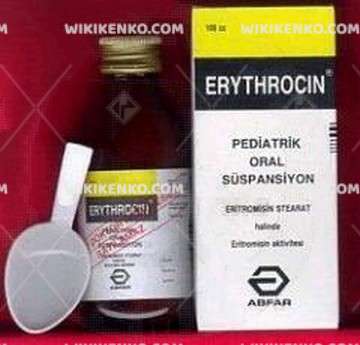
Erythrocin Pediatrik Oral Suspension is supplied as a flavored, sugar‑containing oral suspension for pediatric use, with each 5 ml (“one scale”) containing erythromycin stearate equivalent to 100 mg of erythromycin base. This strength and pediatric positioning are consistent with multiple erythromycin oral suspensions where 100–250 mg erythromycin base per 5 ml is standard for pediatric dosing.
Active ingredient
-
Erythromycin stearate
-
A salt/ester form of erythromycin designed to improve stability and palatability for oral administration, analogous to erythromycin ethylsuccinate suspensions (e.g., Ery-Ped, E.E.S.).
-
Each 5 ml contains erythromycin stearate equivalent to 100 mg erythromycin base, which aligns with typical pediatric suspension strengths (125–250 mg/5 ml as ethylsuccinate).
-
Erythromycin is a 14‑membered lactone macrolide that exerts bacteriostatic or bactericidal activity depending on concentration and organism susceptibility. Similar erythromycin suspensions (ethylsuccinate salt) are widely used for pediatric infections, underscoring class‑level extrapolation of pharmacology and clinical indications.
Excipients
The described excipients are:
-
Methyl paraben (methyl parahydroxybenzoate) – antimicrobial preservative
-
Propyl paraben (propyl parahydroxybenzoate) – antimicrobial preservative
-
Sodium citrate – buffering agent to stabilise pH and improve erythromycin stability, also present in many erythromycin suspensions.
-
Colorants:
-
Dye Red F.D.C. No. 3 (FD&C Red No. 3; erythrosine)
-
Dye Yellow F.D.C. No. 5 (Tartrazine; FD&C Yellow No. 5)
-
Dye Yellow F.D.C. No. 6 (FD&C Yellow No. 6; sunset yellow)
Synthetic dyes of these codes are frequently used in erythromycin pediatric preparations (e.g., FD&C Red No. 40, Yellow No. 6) for identification and palatability.
-
-
Sugar (sucrose) – sweetener, enhances palatability; sucrose is commonly listed at 2–3 g per 5 ml in comparable erythromycin suspensions.
-
Cinnamon aroma – flavoring agent to improve taste.
Parabens and sodium citrate appear in multiple erythromycin oral suspensions and other pediatric antibiotic formulations, supporting the plausibility and conventional nature of this excipient profile.
Mechanism of Action and Pharmacodynamics
Erythromycin belongs to the macrolide class and binds reversibly to the 50S ribosomal subunit of susceptible bacteria, inhibiting translocation steps in protein synthesis. This leads to impaired peptide chain elongation and exerts predominantly bacteriostatic effects, although bactericidal activity can be seen at higher concentrations against highly susceptible strains.
Macrolides, including erythromycin ethylsuccinate and base formulations, display good activity against many Gram‑positive cocci (e.g., Streptococcus pyogenes, Streptococcus pneumoniae) and selected Gram‑negative pathogens (e.g., Bordetella pertussis, Legionella spp.), and atypical organisms (Mycoplasma pneumoniae). The mechanism of action and spectrum for erythromycin stearate in suspension are considered equivalent to other oral erythromycin salts because they release the same active moiety, erythromycin.
Pharmacokinetics
Absorption
Erythromycin base is acid labile; therefore, ester and salt forms such as stearate and ethylsuccinate are formulated to improve stability in the gastric environment. Regulatory product information for erythromycin ethylsuccinate oral suspensions notes that these forms are “readily and reliably absorbed” when administered orally, with bioavailability influenced by gastric pH and food intake. Erythromycin stearate behaves similarly, serving as a pro‑form that liberates erythromycin in the small intestine.
Food can variably affect macrolide absorption depending on formulation, and some erythromycin oral suspensions are recommended to be taken on an empty stomach, whereas others may be given with food in children to improve tolerance, according to specific product labels.
Distribution, metabolism, and elimination
Once absorbed, erythromycin is widely distributed in body tissues and fluids, reaching therapeutic concentrations in respiratory tract secretions, middle ear fluid, skin, and soft tissues, but with low cerebrospinal fluid levels in the absence of meningeal inflammation. It is extensively metabolised in the liver and excreted primarily in bile; a smaller fraction appears in urine. Erythromycin also acts as an inhibitor of cytochrome P450 isoenzyme CYP3A4, leading to important drug–drug interactions (see Section 7).
Indications and Clinical Uses
Although the exact Turkish label for “Erythrocin Pediatrik” is not accessible here, its composition and strength are closely aligned with erythromycin pediatric suspensions (e.g., Ery-Ped/E.E.S.) whose approved uses can inform the likely indication profile. These products are indicated for infections caused by erythromycin‑susceptible organisms and as an alternative in patients allergic to penicillins.
Likely indications (by analogy to erythromycin pediatric suspensions)
Based on SmPCs and labels for erythromycin ethylsuccinate/ethylsuccinate granules and suspensions:
-
Upper respiratory tract infections
-
Tonsillitis, pharyngitis, sinusitis, otitis media, especially when due to Streptococcus pyogenes or other susceptible organisms.
-
-
Lower respiratory tract infections
-
Bronchitis, pneumonia (including atypical pneumonia due to Mycoplasma pneumoniae), and infections due to Legionella species.
-
-
Skin and soft tissue infections
-
Impetigo, erysipelas, cellulitis, infected wounds when organisms are susceptible to erythromycin.
-
-
Diphtheria and pertussis
-
Treatment and chemoprophylaxis of Bordetella pertussis infection; adjunctive therapy for Corynebacterium diphtheriae infections.
-
-
Alternative to penicillins
-
In patients with penicillin hypersensitivity, erythromycin is widely used as an alternative agent for streptococcal pharyngitis and other indications.
-
Local (e.g., Turkish) regulatory indications may vary and should always be verified in the official product information; nevertheless, the above uses are widely documented across erythromycin oral suspensions.
Dosage and Administration
General pediatric dosing (class‑based)
SmPCs and FDA labels for erythromycin ethylsuccinate suspensions typically recommend pediatric total daily doses of approximately 30–50 mg/kg/day of erythromycin base, divided into two to four doses, depending on severity and indication. Higher doses (up to 90 mg/kg/day) may be used for more severe infections or specific indications (e.g., pertussis) under specialist guidance.
For a 100 mg/5 ml suspension, 30 mg/kg/day corresponds to 1.5 ml/kg/day, divided over several doses. Precise regimens, maximum daily doses, and duration of therapy must follow the official national product information for Erythrocin Pediatrik and local guidelines.
Administration considerations
-
The suspension should be shaken well before use to ensure uniform dispersion.
-
If local labeling mirrors other erythromycin suspensions, dosing may be recommended on an empty stomach (e.g., 1–2 hours before meals) to enhance absorption, although in pediatric practice it is often given with food to reduce gastrointestinal intolerance, depending on specific product instructions.
-
A calibrated measuring device (syringe or cup) should be used for accurate dosing.
Contraindications and Warnings
Contraindications
Regulatory documents for erythromycin suspensions consistently list:
-
Known hypersensitivity to erythromycin or other macrolides.
-
Known hypersensitivity to any excipient, including parabens (methyl paraben, propyl paraben) and specific dyes such as tartrazine, especially in patients with allergy or intolerance to azo dyes.
-
Concomitant use with drugs highly dependent on CYP3A for clearance and known to be associated with serious arrhythmias when their serum levels increase (see Section 7).
In some SmPCs, pre‑existing significant hepatic dysfunction or history of cholestatic jaundice associated with macrolide use are additional contraindications.
Special warnings and precautions
-
Hepatic effects: Erythromycin has been associated with cholestatic hepatitis, particularly with estolate—but caution is generally advised in all erythromycin formulations in patients with pre‑existing liver disease.
-
Cardiac effects: Prolongation of QT interval, ventricular arrhythmias (including torsades de pointes) have been reported, especially in patients with risk factors (pre‑existing QT prolongation, hypokalaemia, concurrent QT‑prolonging drugs).
-
Superinfection: Prolonged use may result in overgrowth of non‑susceptible organisms, including fungi and resistant bacteria.
-
Allergic reactions: Parabens and certain dyes (e.g., tartrazine) are known to cause allergic reactions, which may manifest as skin rash, bronchospasm, or anaphylactoid reactions in susceptible individuals.
Drug–Drug Interactions
Erythromycin is a potent inhibitor of CYP3A4. SmPCs and FDA labels for erythromycin oral suspensions specify clinically significant interactions, some of which are contraindicated:
-
Serious interactions and contraindicated combinations:
-
Terfenadine, astemizole, cisapride, pimozide – increased risk of QT prolongation and serious ventricular arrhythmias.
-
Ergot derivatives (ergotamine, dihydroergotamine) – risk of ergot toxicity (ergotism).
-
-
Important interactions requiring dose adjustment/monitoring:
-
Carbamazepine, cyclosporine, tacrolimus, theophylline, digoxin, warfarin, phenytoin, some benzodiazepines (e.g., midazolam), and others.
-
Concomitant use with statins metabolized by CYP3A4 (e.g., simvastatin) increases myopathy/rhabdomyolysis risk; adult data may be relevant in adolescents.
-
Table 1 summarises key interaction classes commonly highlighted for oral erythromycin suspensions.
Table 1. Selected clinically relevant interactions of oral erythromycin suspensions (class‑based)
| Interaction class / examples | Mechanism (simplified) | Clinical concern |
|---|---|---|
| Non‑sedating antihistamines (terfenadine, astemizole) | CYP3A4 inhibition → ↑ parent drug levels | QT prolongation, torsades de pointes |
| GI motility agents (cisapride) | CYP3A4 inhibition → ↑ cisapride levels | Serious ventricular arrhythmias |
| Antipsychotics (pimozide) | CYP3A4 inhibition | QT prolongation, arrhythmia |
| Ergot alkaloids (ergotamine, dihydroergotamine) | Reduced clearance | Ergotism (vasospasm, ischemia) |
| Calcineurin inhibitors (cyclosporine, tacrolimus) | CYP3A4 inhibition | Nephrotoxicity, neurotoxicity |
| Theophylline | Reduced clearance | Theophylline toxicity (nausea, arrhythmia, seizures) |
| Oral anticoagulants (e.g., warfarin) | Altered metabolism/intestinal flora | Enhanced anticoagulant effect, bleeding risk |
| Statins (simvastatin, lovastatin) | CYP3A4 inhibition | Myopathy, rhabdomyolysis (more relevant in adults) |
Clinicians should always consult the local prescribing information for Erythrocin Pediatrik and check for interactions before prescribing, particularly in patients on multiple concomitant medications.
Adverse Effects
Gastrointestinal
Gastrointestinal reactions are the most commonly reported adverse events with oral erythromycin formulations, including ethylsuccinate suspensions:
-
Nausea, vomiting
-
Abdominal cramping
-
Diarrhoea, occasional pseudomembranous colitis due to Clostridioides difficile (rare but serious)
These reactions are dose‑related and may be mitigated by dividing doses or administering with food where permitted by product labeling.
Hepatic
-
Cholestatic hepatitis, with or without jaundice, has been reported with erythromycin, particularly the estolate salt; however, class warnings often extend to all oral erythromycin preparations.
-
Elevations in liver enzymes may occur and are usually reversible on discontinuation.
-
Urticaria, rash, pruritus, and rare severe skin reactions have been reported.
-
Parabens (methyl and propyl paraben) are associated with hypersensitivity reactions in susceptible individuals.
-
Tartrazine (FD&C Yellow No. 5) and other azo dyes can cause allergic‑type reactions, including bronchospasm, especially in patients with aspirin sensitivity.
Other
-
Reversible hearing loss has been described, predominantly with very high doses or in patients with renal impairment, mostly in adults.
-
Rare reports of arrhythmias and QT prolongation as described above.
Use in Special Populations
Pediatric use
Erythromycin suspensions are specifically formulated for pediatric use and have extensive clinical experience in children across multiple indications. Dosing is weight‑based, and prescribers must observe age‑appropriate dosing schedules, maximum daily doses, and cautions regarding excipients like sucrose (relevant in children with hereditary fructose intolerance, sucrose‑isomaltase deficiency, or diabetes) and sorbitol when present in other formulations.
Hepatic and renal impairment
-
In hepatic impairment, cautious use and possible dose reduction or extended dosing intervals may be required, given hepatic metabolism of erythromycin.
-
In renal impairment, accumulation is less pronounced than for primarily renally excreted drugs, but dose adjustment may be considered for severe impairment, particularly at high doses.
Pharmaceutical Considerations and Stability
Regulatory documents for related erythromycin stearate and ethylsuccinate suspensions state that:
-
Products may be supplied as granules or dry powder to be reconstituted with water, or as ready‑made suspensions; the final concentration is defined as mg erythromycin base per 5 ml.
-
After reconstitution, suspensions must be stored within specified temperature ranges (often below 25 °C or refrigerated) and discarded after a defined period (e.g., 7–14 days), as per product label.
-
Excipients such as sodium citrate, xanthan gum, sucrose and parabens contribute to stability, viscosity, and microbial preservation, similar to other erythromycin pediatric liquids.
Because specific Turkish stability and storage details for Erythrocin Pediatrik are not available here, pharmacists and clinicians should refer directly to the local Summary of Product Characteristics or package insert for definitive guidance.
Comparative overview with other erythromycin pediatric suspensions
To contextualise Erythrocin Pediatrik within the broader class, Table 2 compares key features of selected erythromycin pediatric oral suspensions documented in regulatory sources.
Table 2. Selected erythromycin pediatric oral suspensions: strength and key excipients (illustrative comparison)
| Product (region/example) | Erythromycin per 5 ml (base) | Salt/ester form | Key excipients noted in label |
|---|---|---|---|
| Erythrocin Pediatrik Oral Suspension (described) | 100 mg/5 ml (equivalent) | Erythromycin stearate | Sucrose, sodium citrate, methyl paraben, propyl paraben, FD&C Red No. 3, Yellow No. 5, Yellow No. 6, cinnamon aroma |
| Ery-Ped / E.E.S. 200 Liquid (US) | 200 mg/5 ml | Erythromycin ethylsuccinate | Sucrose, sodium citrate, methylparaben, propylparaben, polysorbate, FD&C Red 40, flavors, xanthan gum |
| E.E.S. 400 Liquid (US) | 400 mg/5 ml | Erythromycin ethylsuccinate | Sucrose, sodium citrate, methylparaben, propylparaben, D&C Yellow 10, FD&C Yellow 6, polysorbate, xanthan gum |
| Erythromycin 125 mg/5 ml granules (UK) | 125 mg/5 ml | Erythromycin ethylsuccinate | Sorbitol, sodium, flavourings; sugar‑free formulation |
| Erythromycin ethylsuccinate 250 mg/5 ml (UK) | 250 mg/5 ml | Erythromycin ethylsuccinate | Sucrose (~2.6 g/5 ml), sodium (~29 mg/5 ml), flavourings |
The table illustrates that Erythrocin Pediatrik’s strength (100 mg/5 ml) is at the lower end of the usual pediatric range, while excipient profiles (parabens, sodium citrate, synthetic dyes, sweetener, flavor) mirror other commercial erythromycin suspensions.
Clinical and Regulatory Considerations
From a pharmaceutical and clinical standpoint, Erythrocin Pediatrik Oral Suspension can be understood as a conventional erythromycin pediatric formulation with a standard strength per 5 ml and a typical excipient profile tailored to children. Its likely indication spectrum, dosing principles, interaction profile, and safety considerations are congruent with those described in regulatory documents for erythromycin ethylsuccinate and related oral suspensions.
However, for any clinical decision, dosing, or prescribing in a specific patient—especially in Turkey or another jurisdiction—healthcare professionals must consult the official local product information (Summary of Product Characteristics or equivalent), national formularies, and up‑to‑date infectious disease guidelines.










Reviews
There are no reviews yet.