
Description
Pharmaceutical Composition and Dosage Form
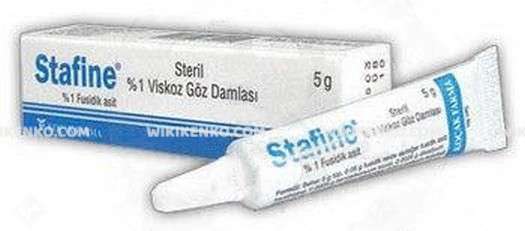
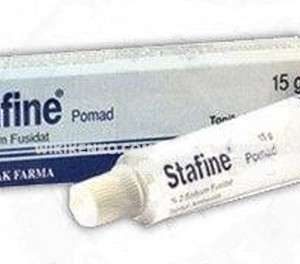
Stafine Viskoz Eye Drop is formulated as a white, opaque, viscous eye drop solution (gel‑like) for ophthalmic use.
-
Active substance: fusidic acid hemihydrate 50.87 mg, equivalent to 50 mg fusidic acid per 5 g tube (1% w/w).
-
Pharmaceutical form: sterile viscous ocular solution in laminated tube of 5 g.
Excipients
The product contains benzalkonium chloride as a preservative together with other formulation excipients (e.g., buffers, viscosity‑enhancing agents) similar to other fusidic acid viscous eye drops.
-
Benzalkonium chloride: 5 mg of 10% solution per 5 g tube (equivalent to 0.01% w/w), an excipient with known effect on the ocular surface and contact lenses.
Mechanism of Action and Antimicrobial Spectrum
Fusidic acid is a narrow‑spectrum steroidal antibiotic that inhibits bacterial protein synthesis by interfering with elongation factor G (EF‑G) at the ribosome level, thereby blocking translocation and halting bacterial growth.
-
Mechanism: primarily bacteriostatic, with possible bactericidal activity at high concentrations against susceptible organisms.
Antibacterial Spectrum
Stafine demonstrates high activity against gram‑positive cocci and some gram‑negative organisms relevant to ocular infections.
-
High activity:
-
Staphylococcus aureus
-
Staphylococcus epidermidis
-
Corynebacterium diphtheriae
-
Neisseria meningitidis
-
Neisseria gonorrhoeae
-
Clostridium spp.
-
-
Clinically relevant susceptibility also reported for:
-
Streptococci
-
Haemophilus spp.
-
Moraxella spp.
-
Corynebacteria species.
-
Minimum inhibitory concentrations (MICs) for S. aureus are low; the MIC90 is reported around 0.06 mg/L, which is well below the levels achieved in ocular tissues after topical application.
Pharmacokinetics and Ocular Tissue Distribution
The viscous formulation provides prolonged residence time in the conjunctival sac, resulting in sustained drug release onto the ocular surface.
Ocular Bioavailability
After administration of a single drop of Stafine to the eye, fusidic acid concentrations in tear film remain above MIC for common pathogens for at least 12 hours.
-
In tear fluid, mean fusidic acid concentrations at 1, 3, 6, and 12 hours after a single drop are approximately 15.7 mg/L, 15.2 mg/L, 10.5 mg/L, and 5.6 mg/L respectively.
Fusidic acid penetrates the cornea in both intact and operated epithelium and reaches the aqueous humour.
-
Mean concentration in aqueous humour is around 0.3 mg/L, maintained for at least 12 hours after a single instillation, remaining above MIC values for most clinically relevant pathogens.
Systemic Exposure
Systemic absorption following topical ocular use is negligible, and clinically relevant systemic concentrations are not expected, which supports a favourable safety profile in pregnancy and breast‑feeding.
Therapeutic Indications
Although the Turkish product information should be consulted for exact wording, Stafine Viskoz Eye Drop is indicated for the topical treatment of superficial bacterial infections of the eye caused by fusidic‑acid‑sensitive organisms.
Typical indications in line with other 1% fusidic acid viscous eye drops include:
-
Acute bacterial conjunctivitis.
-
Blepharitis (infection of eyelid margins).
-
Hordeolum (stye).
-
Superficial corneal infection (keratitis) where susceptible organisms are involved.
-
Dacryocystitis (infection of the lacrimal sac), as part of local therapy.
Use should be guided by clinical evaluation and, where appropriate, microbiological testing.
Dosage and Method of Administration
Posology
The recommended dose, consistent with Turkish and international fusidic acid eye drop products, is:
-
Adults, elderly, and children: instill one drop into the affected eye(s) twice daily (every 12 hours).
Treatment should be continued for at least 48 hours after the eye has returned to normal to minimize the risk of relapse.
Method of Administration
-
For ophthalmic use only; do not inject or ingest.
-
Patients should wash hands, tilt the head back, pull down the lower eyelid to form a conjunctival sac, and instill one drop, avoiding contact between the tube tip and eye or surrounding structures to prevent contamination.
-
If more than one ophthalmic product is used, a sufficient interval (typically 5–10 minutes) should be allowed between applications, with Stafine often applied last when possible to sustain contact time.
Contraindications
Stafine Viskoz Eye Drop is contraindicated in:
-
Hypersensitivity to fusidic acid or to any of the excipients, including benzalkonium chloride.
-
A previous severe allergic reaction (e.g., angioedema, severe conjunctival hypersensitivity) attributed to fusidic acid products.
Warnings, Precautions, and Special Populations
Ocular Warnings and Contact Lens Use
-
Contact lenses (soft or hard) should not be worn during treatment with Stafine or similar fusidic acid viscous eye drops.
-
Microcrystalline fusidic acid and benzalkonium chloride may scratch the lens or cornea and can adsorb to soft lenses, causing discoloration or irritation.
-
Lenses may be reintroduced only after the infection has resolved and treatment is completed.
-
Transient blurred vision may occur after instillation due to the viscous formulation; patients should wait until vision clears before driving or operating machinery.
Risk of Resistance
As with all topical antibiotics, prolonged or repeated use may contribute to the development of antimicrobial resistance, particularly in staphylococci. Treatment should be limited to the recommended duration, and lack of response should prompt clinical reassessment.
Use in Pregnancy
Systemic exposure after ocular administration is very low, and no adverse effects in pregnancy are anticipated.
-
Regulatory information for fusidic acid viscous eye drops supports use during pregnancy when clinically indicated, as teratogenic effects have not been observed with systemic or topical fusidic acid.
Lactation
-
Use during breast‑feeding is considered acceptable because systemic exposure in the nursing mother is negligible and transfer into breast milk, if any, is expected to be minimal.
-
As a general precaution, avoid direct contact of the infant’s eyes with treated areas and observe for any signs of allergy.
Paediatric and Geriatric Use
-
Fusidic acid 1% viscous eye drops are licensed for all age groups, including children, with the same dosing (one drop twice daily).
-
Some manufacturers note that evidence in children under 2 years is limited; clinical judgement is required in this age group.
-
No dosage adjustment is required in elderly patients.
Hepatic and Renal Impairment
Given the minimal systemic absorption, no dose modification is generally required in hepatic or renal impairment; however, formal clinical data are limited.
Adverse Reactions
The safety profile of fusidic acid 1% viscous eye drops has been extensively characterised; adverse reactions are usually mild and transient, primarily ocular and hypersensitivity‑related.
Expected Adverse Reactions
The table below summarises adverse reactions reported with fusidic acid viscous eye drops, categorised by system organ class and frequency.
| System organ class | Frequency | Adverse reaction examples |
|---|---|---|
| Eye disorders | Common | Transient blurred vision after instillation. |
| Eye disorders | Uncommon | Eyelid oedema, increased lacrimation. |
| Eye disorders | Rare | Exacerbation of conjunctivitis. |
| Immune system disorders | Uncommon | Hypersensitivity reactions (e.g., eye irritation). |
| Skin and subcutaneous tissue disorders | Uncommon | Rash, angioedema. |
Most reactions resolve without sequelae upon discontinuation of therapy. Serious systemic reactions are exceedingly rare due to negligible systemic exposure.
Overdose
No cases of clinically significant overdose with fusidic acid viscous eye drops, including Stafine, have been reported.
-
Inadvertent oral ingestion of the contents of a 5 g tube (approximately 50 mg fusidic acid) does not exceed the accepted total daily oral dose and is unlikely to cause systemic toxicity.
-
The quantity of excipients is also too low to pose a clinical safety risk in accidental ingestion.
Management of suspected overdose is supportive, including ocular irrigation in case of excessive local application and observation for signs of irritation or allergy.
Drug Interactions
Clinically significant drug–drug interactions are not expected due to minimal systemic exposure.
-
No specific interactions have been documented for fusidic acid viscous eye drops.
-
When used with other topical ophthalmic agents, spacing doses by several minutes is recommended to avoid dilution or washing out of the viscous preparation.
Clinical Efficacy Overview
Clinical experience and regulatory product information for fusidic acid 1% viscous eye drops show effective resolution of bacterial conjunctivitis and other superficial ocular infections with twice‑daily dosing.
-
The sustained‑release viscous formulation provides adequate tissue levels over 12 hours, supporting a low‑frequency dosing regimen and potentially improving adherence compared with more frequently dosed antibiotics.
-
Microbiological eradication parallels clinical cure in infections caused by susceptible organisms, particularly staphylococcal species.
Practical Clinical Considerations
In practice, Stafine Viskoz Eye Drop is a convenient narrow‑spectrum ophthalmic antibiotic suitable for first‑line treatment of mild to moderate bacterial conjunctivitis and related infections in regions where fusidic acid remains effective.
-
Advantages include twice‑daily dosing, viscous sustained‑release formulation, and favourable safety profile in pregnancy, lactation, children, and elderly.
-
Limitations involve relatively narrow spectrum, potential resistance in staphylococci, and the need to avoid use in contact lens wearers during active treatment.
Summary Table: Key Properties of Stafine Viskoz Eye Drop
| Parameter | Description |
|---|---|
| Active ingredient | Fusidic acid hemihydrate, 50.87 mg ≈ 50 mg fusidic acid per 5 g (1% w/w). |
| Dosage form | Sterile, white, opaque viscous eye drop solution (gel‑like). |
| Indications | Bacterial conjunctivitis, blepharitis, hordeolum, superficial keratitis, dacryocystitis due to susceptible organisms. |
| Dose (all ages) | One drop in affected eye(s) twice daily; continue ≥48 h after clinical resolution. |
| Key warnings | Do not wear contact lenses during use; risk of hypersensitivity; avoid prolonged use to limit resistance. |
| Use in pregnancy/lactation | Acceptable; systemic exposure negligible, no expected harm to fetus or breast‑fed infant. |
| Common adverse effect | Transient blurred vision post‑instillation. |













Reviews
There are no reviews yet.