
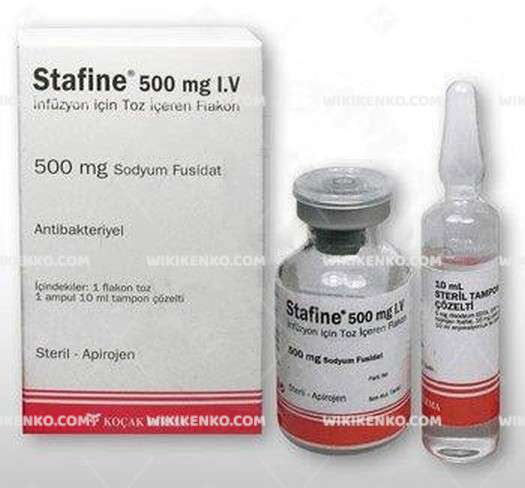
Description
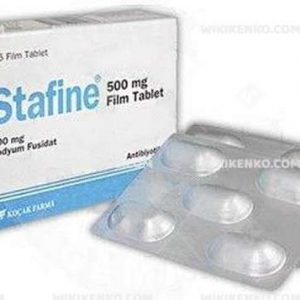
Stafine L.V. 500 mg “infusion için powder içeren vial” is a parenteral antibacterial medicinal product containing sodium fusidate 500 mg, a water‑soluble salt of fusidic acid, formulated for intravenous infusion when oral therapy is inappropriate or not feasible. It is primarily indicated for severe staphylococcal infections caused by susceptible strains, particularly when deep‑seated or systemic infection necessitates high and reliable serum and tissue concentrations.
Qualitative and quantitative composition
Each vial of Stafine L.V. contains 500 mg sodium fusidate, corresponding approximately to 480 mg fusidic acid base, together with excipients, and provides 3.16 mmol (72.6 mg) of sodium after reconstitution. The product is usually supplied with a separate buffer/solvent vial, and after reconstitution the resulting concentrate is further diluted in a suitable infusion fluid (e.g. 500 ml glucose or sodium chloride solution) for IV administration.
Composition and sodium load (illustrative data)
| Parameter | Stafine L.V. vial | Clinical relevance |
|---|---|---|
| Active substance | Sodium fusidate 500 mg (≈ 480 mg fusidic acid) | Defines antibacterial potency and dosing basis. |
| Sodium content (per vial) | 3.16 mmol ≈ 72.6 mg sodium | Contributes ≈3.6% of recommended maximum daily sodium intake in adults; relevant in sodium‑restricted patients. |
| Pharmaceutical form | Powder for solution for infusion in vial (with separate buffer) | Requires reconstitution and further dilution before IV use. |
Mechanism of action and antibacterial spectrum
Sodium fusidate is a steroid‑like fusidane antibiotic that selectively inhibits bacterial protein synthesis by interfering with elongation factor G (EF‑G)–mediated translocation on the ribosome. The drug exhibits primarily bacteriostatic, and at higher exposures bactericidal, activity against staphylococci; minimal inhibitory concentrations of 0.03–0.12 micrograms/ml inhibit nearly all strains of Staphylococcus aureus, including many methicillin‑resistant isolates, and it is also active against Staphylococcus epidermidis.
Indications and clinical use
Parenteral sodium fusidate 500 mg infusion is indicated for the treatment of severe infections due to susceptible staphylococci, including osteomyelitis, pneumonia, septicaemia and deep wound infections, particularly when oral therapy is unsuitable or gastrointestinal absorption is unreliable. In deep‑seated or prolonged infections, IV sodium fusidate is generally administered concurrently with another antistaphylococcal antibiotic (e.g. beta‑lactamase‑resistant penicillins) to reduce resistance emergence and enhance bactericidal effect.
Posology and method of administration
For adults weighing more than 50 kg, the usual IV dose is 500 mg sodium fusidate three times daily, often corresponding to a total daily dose of 1500–2000 mg in divided doses. In children and adults weighing less than 50 kg, a weight‑based regimen of 6–7 mg/kg three times daily is recommended, with each dose infused after appropriate dilution.
For adults over 50 kg, the reconstituted fusidate/buffer solution (10 ml) is added to 500 ml of infusion fluid and administered over approximately 2 hours via a central venous line; in patients under 50 kg, the same 500 ml dilution is used but the infused volume per dose is 6–7 ml/kg. When administered through a peripheral vein, a slower infusion over at least 6 hours via a wide‑bore vein with good blood flow is advised to minimise venous irritation.
Pharmacokinetics
After a single 500 mg IV infusion over 2 hours, peak plasma concentrations (Cmax) of about 52 micrograms/ml are achieved in adults, and repeated dosing every 8 hours for 2–3 days yields cumulative steady‑state levels of approximately 60–120 micrograms/ml. Fusidic acid/fusidate shows extensive tissue penetration, with bactericidal concentrations demonstrated in bone and necrotic tissue, which underpins its use in osteomyelitis and other deep infections. Population pharmacokinetic analyses indicate that sodium fusidate exhibits high protein binding, a relatively small volume of distribution and non‑linear kinetics at higher doses, supporting front‑loaded systemic dosing strategies in some regimens.
Safety profile and adverse reactions
Clinical trial and post‑marketing data suggest that up to approximately 30% of critically ill patients may experience an adverse reaction during IV sodium fusidate therapy, although this incidence decreases when the drug is infused via a central venous catheter rather than a peripheral vein. Venous intolerance, particularly venous spasm and thrombophlebitis, is very common with peripheral administration, and a small prospective series reported thrombophlebitis in 12 of 14 patients treated for 24 hours or longer via peripheral veins.
Other adverse effects include gastrointestinal disturbances (nausea, vomiting, diarrhoea), transient hepatic enzyme elevations or hyperbilirubinaemia, and rare hypersensitivity reactions. High doses or prolonged use, especially in combination therapies, have been associated with reversible liver function abnormalities in animal models and occasional clinical cases, emphasising the need for hepatic monitoring in at‑risk patients.
Key adverse effects (narrative table)
| Adverse effect | Frequency/characteristics | Clinical considerations |
|---|---|---|
| Thrombophlebitis, venous spasm | Very common with peripheral IV use; 12/14 patients in one series developed thrombophlebitis after ≥24 h peripheral infusion | Prefer central vein; extend infusion duration; monitor infusion site and switch route if symptoms occur. |
| Hepatic enzyme abnormalities, hyperbilirubinaemia | Transient increases in liver enzymes or bilirubin; postoperative hyperbilirubinaemia reported in some patients | Baseline and periodic liver tests in prolonged therapy or hepatic impairment; consider dose adjustment or discontinuation if significant changes occur. |
| Gastrointestinal symptoms | Nausea, vomiting, diarrhoea reported with systemic fusidic acid/fusidate | Symptomatic management; assess benefit–risk if severe. |
| Hypersensitivity reactions | Uncommon; may include rash or angio‑oedema | Discontinue and treat according to severity; avoid re‑exposure in serious reactions. |
Contraindications and major precautions
Systemic sodium fusidate must not be co‑administered with statins, because combined use markedly increases the risk of myopathy and rhabdomyolysis, including reported fatal cases; if IV sodium fusidate is essential, statin therapy should be stopped during treatment and restarted only seven days after the last dose, unless exceptional supervised co‑administration is justified. The product should also be used with caution in patients with pre‑existing hepatic dysfunction, biliary obstruction or those receiving other hepatotoxic drugs, with regular monitoring of liver function tests during prolonged courses.
Patients with sodium‑restricted diets (e.g. severe heart failure, advanced renal disease) should have the additional sodium load per vial taken into account in the overall daily balance. When prolonged systemic therapy is anticipated, especially for deep‑seated staphylococcal infections, the use of combination therapy and microbiological susceptibility testing is recommended to reduce the risk of resistance.
Use in special populations
There is inadequate controlled evidence on the safety of IV sodium fusidate in pregnancy, although animal data and accumulated clinical experience do not suggest teratogenic effects; the drug crosses the placenta, and its use in pregnant women should be restricted to situations where potential maternal benefit outweighs possible foetal risk. Fusidic acid/fusidate is excreted in breast milk, so caution is necessary during lactation, with consideration of either temporary discontinuation of breastfeeding or alternative antimicrobial therapy, depending on clinical urgency.
In paediatric populations, weight‑based dosing (6–7 mg/kg three times daily) is employed, and the general precautions regarding venous irritation and hepatic monitoring apply; systemic IV use is usually reserved for serious infections requiring hospital care. In elderly patients, no specific dosage adjustment is mandated solely on the basis of age, but comorbidities such as hepatic impairment, renal dysfunction and polypharmacy (including statins) necessitate individual risk assessment.
Resistance considerations and combination therapy
Resistance to fusidic acid arises mainly via mutations in fusA (encoding EF‑G) or acquisition of fusB‑family resistance genes, which may confer reduced susceptibility in staphylococci and can be selected during monotherapy, particularly in high‑inoculum or prolonged infections. Accordingly, in severe or deep‑seated staphylococcal infections, IV sodium fusidate is generally recommended in combination with other antistaphylococcal agents such as cloxacillin, flucloxacillin, ampicillin, methicillin or erythromycin, to enhance bactericidal activity and mitigate resistance development.
Place in therapy
Stafine L.V. (sodium fusidate 500 mg infusion) occupies a therapeutic niche as an anti‑staphylococcal agent with excellent tissue penetration, including bone, and an established role in severe methicillin‑susceptible and some methicillin‑resistant staphylococcal infections when oral therapy is not feasible. Its clinical utility is balanced by a significant risk of venous intolerance with peripheral administration and a critical interaction with statins, necessitating careful route selection, monitoring and comprehensive medication review in hospital practice.













Reviews
There are no reviews yet.