
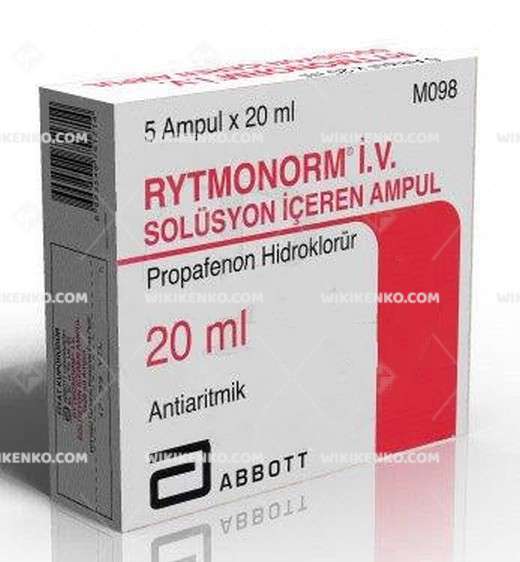
Description
Rytmonorm Intravenous Solution is a parenteral antiarrhythmic preparation containing propafenone hydrochloride as the active pharmaceutical ingredient, belonging to the Vaughan‑Williams class IC group. Each 20 ml ampoule of the injectable solution contains 70 mg of propafenone hydrochloride, corresponding to 3.5 mg/ml, in a sterile aqueous vehicle for intravenous administration. The product is marketed in several European markets (including Germany and other EU countries) and is closely related in branding and composition to oral Rytmonorm tablets, which contain propafenone hydrochloride as the sole active substance.
Mechanism of Action and Pharmacodynamic Profile
Propafenone exerts a potent membrane‑stabilising effect on cardiac myocytes through high‑affinity blockade of fast voltage‑gated sodium channels, resulting in a marked reduction in phase 0 depolarisation velocity and slowed conduction in atrial, nodal and ventricular tissue. As a class IC agent, it prolongs intramyocardial conduction time with minimal effect on repolarisation duration, thereby widening the QRS complex while exerting relatively small effects on the QT interval when dosed appropriately.
The molecule displays additional weak non‑selective beta‑adrenergic blocking and mild calcium channel–blocking properties, which may contribute to suppression of triggered activity and reduction of sympathetic influences on arrhythmogenesis. Clinically, these electrophysiological actions translate into suppression of premature ventricular complexes, termination or prevention of recurrent paroxysmal supraventricular tachycardia and atrial fibrillation/flutter in carefully selected patients under continuous ECG monitoring.
Pharmacokinetics of Intravenous Propafenone
After intravenous administration of 70 mg propafenone from commercial Rytmonorm ampoules in healthy volunteers, plasma concentrations rise rapidly and exhibit multi‑compartment disposition with an initial distribution phase followed by a slower elimination phase. Propafenone undergoes extensive hepatic biotransformation via CYP2D6, CYP3A4 and CYP1A2 to active metabolites, with marked inter‑individual variability related to genetic polymorphism of CYP2D6 (fast versus slow metabolisers).
The elimination half‑life after IV dosing has been reported to range from approximately 2 to 10 hours depending on metaboliser status and hepatic function, while systemic clearance is substantially reduced in patients with hepatic impairment, necessitating dose reduction and intensified monitoring. Protein binding is high (around 90–95%), and propafenone distributes widely into tissues including cardiac tissue, which accounts for the pronounced electrophysiological effects despite relatively rapid decline of plasma concentrations after bolus dosing.
Illustrative pharmacokinetic parameters (IV 70 mg in adults)
| Parameter | Typical finding (range/notes) |
|---|---|
| Dose administered (IV bolus) | 70 mg propafenone hydrochloride per ampoule |
| Cmax | Rapid peak shortly after injection; concentration depends on rate and body weight |
| Distribution | Multi‑compartment; extensive tissue distribution |
| Elimination half‑life | Approx. 2–10 hours depending on CYP2D6 status |
| Metabolism | Hepatic via CYP2D6, CYP3A4, CYP1A2 to active metabolites |
| Protein binding | High (about 90–95% bound to plasma proteins) |
| Effect of hepatic impairment | Decreased clearance, prolonged half‑life, need for dose reduction |
Therapeutic Indications and Clinical Use
Rytmonorm intravenous solution is used for the treatment and prophylaxis of clinically significant cardiac arrhythmias when rapid parenteral therapy is required and oral therapy is inadequate or not feasible. Indications for propafenone (including brands such as Rytmonorm and related products) encompass treatment of symptomatic ventricular arrhythmias such as sustained ventricular tachycardia and frequent premature ventricular complexes, as well as prophylaxis and treatment of paroxysmal supraventricular tachycardias, atrial flutter and atrial fibrillation in patients without significant structural heart disease.
Intravenous administration is typically reserved for hospital settings with continuous ECG and haemodynamic monitoring, for example to acutely terminate episodes of paroxysmal supraventricular tachycardia or to stabilise patients with serious ventricular arrhythmias when other measures are insufficient or contraindicated.
Intravenous Dosage and Method of Administration
Dosing of propafenone intravenous solution must be individualised, starting at the lowest effective dose and titrated under continuous ECG and blood pressure monitoring in a setting equipped for resuscitation. Published clinical practice and product information for parenteral propafenone generally recommend slow intravenous injection or short infusion, with total doses adjusted to body weight and clinical response, and with careful attention to QRS widening, PR prolongation and blood pressure changes as stopping criteria.
In many regions, intravenous propafenone is used as a short‑term intervention prior to transition to oral therapy, and repeated or continuous administration should be guided by cardiology specialists, especially in patients with impaired hepatic function, conduction abnormalities or concomitant antiarrhythmic therapy.
Contraindications and Special Warnings
Propafenone is contraindicated in patients with significant structural heart disease (such as previous myocardial infarction with reduced left ventricular function), cardiogenic shock, severe bradycardia, marked hypotension, advanced atrioventricular block (second or third degree) or sick sinus syndrome in the absence of a functioning pacemaker. Additional contraindications include uncontrolled congestive heart failure, severe obstructive pulmonary disease with marked bronchospasm, known Brugada syndrome, pronounced electrolyte disturbances and hypersensitivity to propafenone or any of the excipients.
Use in patients with pacemakers requires careful adjustment and monitoring, because propafenone can elevate pacing and sensing thresholds, potentially compromising device function. Intravenous use demands particular caution in elderly patients, those with hepatic impairment or electrolyte imbalance, and in individuals receiving concomitant QT‑prolonging or conduction‑slowing drugs.
Adverse Reactions and Safety Profile
The safety profile of propafenone is characterised by dose‑dependent cardiac conduction disturbances, proarrhythmic effects and a spectrum of non‑cardiac adverse reactions affecting the central nervous, gastrointestinal and haematologic systems. Cardiac adverse events include bradycardia, sinus node dysfunction, atrioventricular block, bundle branch block, hypotension, exacerbation of existing arrhythmias, new ventricular tachycardia or ventricular fibrillation, and, rarely, cardiac failure, some of which may be life‑threatening.
Non‑cardiac reactions frequently reported with propafenone include dizziness, headache, blurred vision, metallic taste, nausea, vomiting, constipation, abdominal discomfort, and less often, hepatic enzyme elevations, cholestasis and rare cases of agranulocytosis.
Selected adverse effects of propafenone (including Rytmonorm)
| System organ class | Common/important adverse reactions |
|---|---|
| Cardiac | Worsening arrhythmia, ventricular tachycardia, ventricular fibrillation, bradycardia, AV block, bundle branch block, heart failure, palpitations |
| Vascular | Hypotension, orthostatic hypotension |
| Nervous system | Dizziness, headache, tremor, paraesthesia, rarely convulsions |
| Gastrointestinal | Metallic taste, nausea, vomiting, constipation, abdominal pain |
| Hepatobiliary | Elevated transaminases, cholestatic jaundice (rare) |
| Blood and lymphatic | Rare agranulocytosis or other haematologic disturbances |
| Respiratory | Dyspnoea, bronchospasm in susceptible patients |
Drug Interactions
Propafenone is both a substrate and inhibitor of cytochrome P450 isoenzymes, notably CYP2D6 and CYP3A4, leading to numerous potential pharmacokinetic interactions. Co‑administration with strong CYP2D6 or CYP3A4 inhibitors (such as certain antidepressants, azole antifungals or macrolide antibiotics) can significantly increase propafenone plasma levels and enhance the risk of conduction disturbances and proarrhythmia. Conversely, enzyme inducers such as phenobarbital may reduce efficacy, requiring monitoring and potential dose adjustment.
As a potent inhibitor of CYP2D6, propafenone can elevate plasma concentrations of other CYP2D6 substrates, including some beta‑blockers and antidepressants, thereby increasing the risk of bradycardia, hypotension or CNS toxicity. Additive negative inotropic and dromotropic effects may occur with concomitant beta‑blockers, calcium channel blockers (e.g. verapamil, diltiazem) or other class I and III antiarrhythmics, which should therefore be combined only under specialist supervision.
Use in Special Populations
In patients with hepatic impairment, reduced metabolic capacity results in elevated propafenone exposure, prolonged half‑life and increased risk of adverse reactions, so lower doses, slower titration and close ECG monitoring are mandatory. Limited data exist in patients with renal impairment; although renal excretion of unchanged drug is low, metabolites may accumulate, and cautious use with careful monitoring is recommended.
In older adults, heightened sensitivity to negative inotropic and conduction‑slowing effects, as well as higher prevalence of latent structural heart disease, justify conservative dosing and rigorous selection of candidates for therapy. Safety and efficacy in paediatric patients are less well established and parenteral use should be restricted to specialised centres with paediatric electrophysiology expertise.
Clinical Considerations and Monitoring
Before initiating intravenous Rytmonorm, clinicians should perform a comprehensive evaluation including ECG, echocardiography where appropriate, electrolyte assessment and review of concomitant medications to exclude significant structural heart disease and modifiable risk factors for proarrhythmia. During and after intravenous administration, continuous ECG and blood pressure monitoring is essential, with particular attention to QRS and PR interval prolongation, development of new arrhythmias and signs of impaired ventricular function or hypotension.
Transition to oral therapy should be carefully managed, accounting for pharmacokinetic variability and the need to adjust dose according to metabolic status, organ function and clinical response. Owing to the potential for serious proarrhythmic events, propafenone, including Rytmonorm intravenous solution, should be reserved for patients in whom the anticipated benefits in rhythm control clearly outweigh the recognised risks, and its use should be guided by experienced cardiologists or electrophysiologists.












Reviews
There are no reviews yet.