
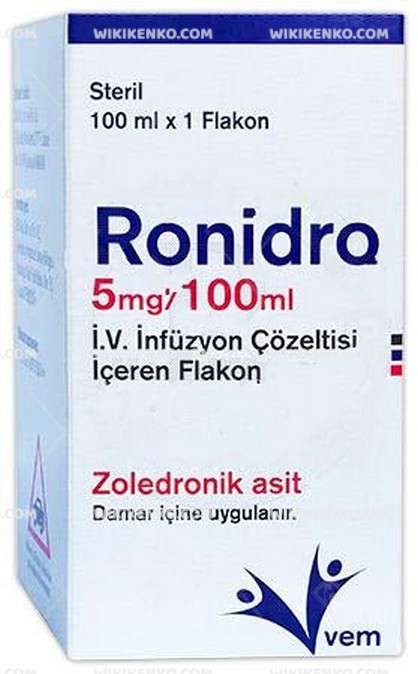
Description
Ronidro is a branded generic zoledronic acid injection manufactured by Vem Pharma Ltd. in Turkey and positioned as a generic equivalent to zoledronic acid 5 mg/100 mL infusion products such as Reclast/Aclasta. It is supplied as a clear, ready-to-infuse solution for intravenous use, intended for administration by healthcare professionals in hospital or outpatient settings.
Composition and pharmaceutical form
Each Ronidro vial contains zoledronic acid monohydrate in an amount equivalent to 5 mg anhydrous zoledronic acid in 100 mL aqueous solution for infusion. Excipients in comparable licensed zoledronic acid 5 mg/100 mL solutions include sodium chloride, mannitol, and sodium citrate or similar buffering agents, with water for injections as the vehicle, and the solution is typically clear, colourless, and sterile. The pH is adjusted to a physiologically acceptable range and the osmolality is approximately isotonic to permit peripheral intravenous administration.
Mechanism of action and pharmacology
Zoledronic acid is a highly potent nitrogen-containing bisphosphonate that preferentially binds to hydroxyapatite at sites of active bone remodelling. It inhibits farnesyl pyrophosphate synthase in the mevalonate pathway in osteoclasts, impairing prenylation of small GTP‑binding proteins, leading to suppression of osteoclast activity, induction of osteoclast apoptosis, and subsequent reduction in bone resorption. Clinically, this translates into increased bone mineral density, reduced bone turnover markers, and a reduction in vertebral and non‑vertebral fracture risk in osteoporosis.
After initiation of a 5 mg infusion, plasma concentrations rise rapidly to a peak at the end of the infusion and decline to less than 10% of peak by 4 hours and less than 1% by 24 hours, followed by a prolonged phase of very low concentrations (<0.1% of peak), reflecting extensive skeletal uptake and slow release. Zoledronic acid is not metabolised and is eliminated unchanged via renal excretion, with about 39–45% of the dose recovered in urine within 24 hours and the remainder bound to bone with a terminal elimination half‑life measured in days.
Therapeutic indications
Evidence from originator and generic product labels supports the use of zoledronic acid 5 mg/100 mL IV infusion in the following indications, which are expected to apply to Ronidro when used as a generic zoledronic acid product:
-
Treatment of osteoporosis in postmenopausal women at increased risk of fracture.
-
Treatment to increase bone mass in men with osteoporosis.
-
Prevention of new clinical fractures in patients who have recently sustained a low‑trauma hip fracture.
-
Treatment of osteoporosis associated with long‑term systemic glucocorticoid therapy in men and women at high fracture risk (in many SmPCs).
-
Treatment of Paget’s disease of bone in adults.
In clinical practice, zoledronic acid 5 mg once yearly is widely used as an alternative to oral bisphosphonates in patients with intolerance, malabsorption, or adherence problems.
Dosage and administration
Standard licensed regimens for zoledronic acid 5 mg/100 mL solution for infusion (which Ronidro mirrors in strength and route) are:
-
Osteoporosis (postmenopausal and male): 5 mg IV once yearly.
-
Prevention of osteoporosis: 5 mg IV every 2 years.
-
Glucocorticoid‑induced osteoporosis: 5 mg IV once yearly.
-
Paget’s disease: a single 5 mg IV infusion, with retreatment considered after at least one year if relapse occurs.
The infusion should be administered as a single intravenous dose of 5 mg from one vial, using a vented infusion set, without mixing with other medicinal products or calcium‑containing solutions.
Infusion technique and duration
Regulatory product information specifies that zoledronic acid 5 mg in 100 mL should be administered via intravenous infusion over not less than 15 minutes at a constant rate. Shorter infusion times (for example 5 minutes) have been associated with increased risk of renal toxicity in oncology dosing, and therefore a minimum infusion duration of 15 minutes is emphasised to mitigate acute renal adverse events. Many clinical services extend infusion duration to 20–30 minutes in routine osteoporosis care, particularly in older patients or those with borderline renal function, as a cautious practice.
Pre‑infusion preparation and monitoring
Before each infusion of zoledronic acid, patients should have serum creatinine measured and creatinine clearance estimated to ensure adequate renal function (commonly CrCl ≥35–60 mL/min for 5 mg osteoporosis regimens depending on label). Patients should be adequately hydrated prior to infusion, particularly older adults or those receiving diuretics, to reduce the risk of renal impairment. Calcium and vitamin D status should be assessed and deficiencies corrected, with supplementation recommended before and after infusion to reduce symptomatic hypocalcaemia.
Representative dosing and administration table
| Clinical aspect | Evidence‑based recommendation (zoledronic acid 5 mg/100 mL) | Key rationale |
|---|---|---|
| Standard dose for osteoporosis | 5 mg IV once yearly. | Sustained antiresorptive effect allows annual dosing while reducing fracture risk. |
| Dose for Paget’s disease | Single 5 mg IV infusion; retreatment after ≥1 year if needed. | Potent suppression of bone turnover leads to long remission after one dose. |
| Infusion volume | 100 mL ready‑to‑use solution per 5 mg dose. | Standardised concentration simplifies administration and reduces compounding errors. |
| Minimum infusion time | At least 15 minutes via vented infusion line. | Longer infusion reduces renal toxicity compared with shorter infusions. |
| Hydration | Ensure appropriate hydration before infusion. | Minimises risk of acute kidney injury, especially in older or diuretic‑treated patients. |
| Renal monitoring | Check serum creatinine and creatinine clearance before each dose. | Zoledronic acid is renally excreted and can worsen renal function in susceptible patients. |
| Calcium/vitamin D | Correct deficiency; provide supplementation peri‑infusion. | Reduces risk of hypocalcaemia and supports optimal anti‑fracture efficacy. |
Contraindications and special warnings
Zoledronic acid 5 mg/100 mL infusion is contraindicated in patients with hypocalcaemia, known hypersensitivity to zoledronic acid or other bisphosphonates, and in pregnancy and lactation according to standard SmPCs. It is not recommended in patients with severe renal impairment below specified creatinine clearance thresholds (commonly <35 mL/min for osteoporosis dosing), and caution is required in mild to moderate renal dysfunction, with careful hydration and monitoring.
Important warnings include the risk of renal impairment, acute phase reactions, osteonecrosis of the jaw (ONJ), atypical femoral fractures, and hypocalcaemia. Prior to treatment, patients at risk for ONJ (such as those with cancer, chemotherapy, corticosteroids, poor oral hygiene, or invasive dental procedures) should undergo dental examination and receive preventive dentistry, and invasive dental procedures during treatment should be minimised if possible.
Adverse reactions
Acute phase reactions and common events
Very common adverse reactions following zoledronic acid 5 mg infusion include pyrexia, flu‑like illness, myalgia, arthralgia and headache, typically occurring within the first three days after infusion and resolving spontaneously. These acute phase reactions, which are more frequent after the first dose, are thought to be mediated by transient cytokine release and can be mitigated by prophylactic or post‑dose administration of antipyretic or analgesic agents such as paracetamol.
Common adverse effects include chills, fatigue, asthenia, pain, malaise and local infusion‑site reactions. Mild, transient decreases in serum calcium, phosphate and magnesium may occur and are usually asymptomatic when baseline mineral status is adequate.
Serious and rare adverse reactions
Renal impairment and, rarely, renal failure, including cases requiring dialysis, have been reported, particularly in patients with pre‑existing renal dysfunction, advanced age, concomitant nephrotoxic medications or diuretic therapy, or dehydration. Osteonecrosis of the jaw has been reported in association with bisphosphonate therapy, particularly in oncology dosing but also, rarely, with 5 mg osteoporosis regimens, especially in patients with dental risk factors or invasive dental procedures.
Atypical subtrochanteric and diaphyseal femoral fractures have been associated with long‑term bisphosphonate therapy, and patients should be advised to report thigh, hip, or groin pain; imaging should be performed if such symptoms occur. Other uncommon or rare events include uveitis, scleritis, atrial fibrillation (signal in some osteoporosis trials), and hypersensitivity reactions, including bronchospasm in susceptible individuals.
Summary table of selected adverse reactions (zoledronic acid 5 mg infusion)
| Adverse reaction category | Frequency range in SmPCs | Clinical notes |
|---|---|---|
| Acute phase reaction (flu‑like symptoms, pyrexia) | Very common. | Typically within 3 days of first infusion, self‑limiting; may respond to antipyretics. |
| Musculoskeletal pain (bone, joint, muscle) | Very common to common. | Usually mild to moderate; rarely severe, persistent pain reported. |
| Hypocalcaemia | Common; severe symptomatic cases rare. | More likely in vitamin D deficiency, hypoparathyroidism, or severe renal impairment. |
| Renal impairment/renal failure | Uncommon; serious events rare. | Risk increased with rapid infusion, dehydration, or nephrotoxic co‑medications. |
| Osteonecrosis of the jaw | Rare. | Usually associated with dental extractions, poor oral hygiene, concurrent steroids or cancer therapy. |
| Atypical femoral fractures | Very rare. | Associated with long‑term therapy; prodromal thigh/hip pain may precede fracture. |
Drug interactions
Zoledronic acid should be used with caution with other medicinal products that can impact renal function, such as aminoglycosides, non‑steroidal anti‑inflammatory drugs (NSAIDs), and other nephrotoxic agents, because of additive risks of renal impairment. Concomitant use with loop diuretics may increase the risk of hypocalcaemia, especially in patients predisposed to electrolyte disturbances. Clinical labels do not report significant pharmacokinetic interactions with drugs metabolised by cytochrome P450 enzymes, as zoledronic acid is not metabolised and does not interfere with CYP‑mediated pathways.
Use in special populations
In older adults, no dose adjustment is generally required based solely on age, but careful assessment of renal function, hydration status, and co‑medications is crucial. In patients with mild to moderate renal impairment, treatment may be possible with appropriate precautions, but in severe renal dysfunction (below formulation‑specific creatinine clearance thresholds) zoledronic acid 5 mg infusion is not recommended for osteoporosis indications.
Zoledronic acid 5 mg is not recommended in children and adolescents for osteoporosis indications because of insufficient safety and efficacy data in this age group. Use during pregnancy and lactation is contraindicated or not recommended in regulatory product information because animal studies show reproductive toxicity and the potential for skeletal effects in the fetus or neonate.
Clinical efficacy data (originator zoledronic acid 5 mg)
Pivotal fracture‑endpoint trials with once‑yearly zoledronic acid 5 mg in postmenopausal osteoporosis demonstrated significant reductions in vertebral, hip, and other non‑vertebral fractures and substantial increases in bone mineral density compared with placebo. In patients with recent hip fracture, once‑yearly zoledronic acid 5 mg reduced the risk of new clinical fractures and was associated with a mortality benefit in some analyses, provided adequate vitamin D and calcium supplementation was given.
In Paget’s disease, a single 5 mg infusion induced rapid and sustained normalisation of biochemical markers of bone turnover, with remission frequently maintained for at least one year and often longer, reducing the need for repeated therapy compared with older bisphosphonates. Given that Ronidro matches the strength and route of originator formulations and is marketed as generic zoledronic acid, its clinical performance is expected to be comparable when manufactured to appropriate quality standards.
Practical clinical considerations
Clinicians administering Ronidro should ensure adequate pre‑infusion evaluation (renal function, calcium/vitamin D status, oral health), patient counselling on expected acute phase reactions, and provision of written information when available, consistent with established zoledronic acid 5 mg infusion protocols. In practice, Ronidro offers a parenteral, infrequently dosed alternative to oral bisphosphonates for patients with poor adherence, gastrointestinal intolerance, or significant fracture risk, provided that evidence‑based precautions regarding renal safety, hypocalcaemia, and rare skeletal complications such as ONJ and atypical femoral fractures are followed.











Reviews
There are no reviews yet.