
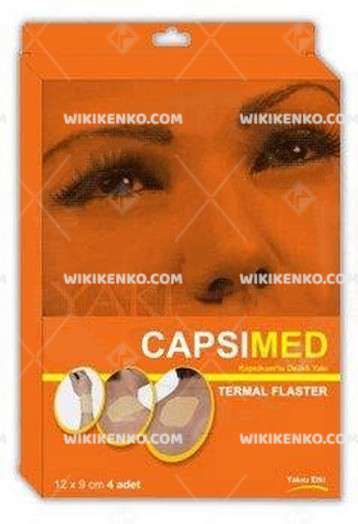
Capsimed Kapsikumlu Delikli Yaki

Dosage form

Pack size

Potency

Combined

Manufacturer

Origin

Generic Name (Ingredient)

23.75 Mg. Capsicum Oleoresin (1.9 Mg. Capsaicin) Contains Methyl Salicylate, Menthol, Camphor, Thymol.

Capsimed Kapsikumlu Delikli Yakı is a topical analgesic patch containing capsicum oleoresin (capsaicin), methyl salicylate, menthol, camphor and thymol, used for temporary relief of localized musculoskeletal pain.

read more

Assuming you’re in a life-threatening situation and require immediate access to medication, please visit our Community Support Network page.


Description

Capsimed Kapsikumlu Delikli Yakı (“kapsikumlu delikli yakı”) belongs to the class of external counter‑irritant and rubefacient preparations designed for application to intact skin over painful muscles and joints. Turkish manufacturers describe similar “kapsikumlu delikli yakı” products as traditional, perforated medicated plasters indicated for rheumatism, sciatica, lumbago, back and neck pain, and muscle strain, where the patch produces a sustained sensation of warmth and analgesia at the site of application.

Qualitative and Quantitative Composition

The stated formulation for Capsimed Kapsikumlu Delikli Yakı contains capsicum oleoresin 23.75 mg per patch, corresponding to 1.9 mg capsaicin, together with methyl salicylate, menthol, camphor and thymol as active counter‑irritant and analgesic components. This qualitative composition is consistent with numerous over‑the‑counter topical analgesic products that combine capsicum (capsaicin) with methyl salicylate and menthol, sometimes with camphor, for temporary relief of minor muscle and joint pain such as simple backache, arthritis, strains, bruises and sprains.

Active ingredients and their roles

  • Capsicum oleoresin (capsaicin) – topical analgesic and counter‑irritant derived from Capsicum annuum.

  • Methyl salicylate – salicylate ester with topical analgesic and anti‑inflammatory action.

  • Menthol – counter‑irritant that produces a cooling sensation via TRPM8 activation.

  • Camphor – counter‑irritant with cooling–warming sensation and mild local analgesic effect.

  • Thymol – phenolic monoterpene with antiseptic and mild local anesthetic properties, commonly used in topical preparations.

Pharmacology of Individual Components

Capsicum oleoresin (capsaicin)

Capsaicin activates the transient receptor potential vanilloid 1 (TRPV1) channel on nociceptive C‑fibers, initially causing burning and warmth, followed by desensitization and functional “defunctionalization” of nociceptors. This leads to reduced release of neuropeptides such as substance P and calcitonin gene‑related peptide (CGRP) from peripheral terminals, thereby attenuating transmission of pain signals to the central nervous system. Clinical meta‑analyses and randomized trials show that topical capsaicin (concentrations approximately 0.0125–5%) can significantly reduce pain scores in osteoarthritis and neuropathic pain compared with placebo, though at the cost of frequent local application‑site reactions.

Methyl salicylate

Methyl salicylate is a salicylic acid derivative that penetrates the skin and exerts anti‑inflammatory and analgesic effects by inhibiting cyclo‑oxygenase enzymes and decreasing prostaglandin synthesis at the site of application. It also contributes to a counter‑irritant effect, producing local warmth that distracts from deeper pain. Systemic absorption can occur, especially with large treated areas, occlusion, or prolonged use, and excessive exposure may lead to salicylate toxicity.

Menthol

Menthol activates TRPM8 receptors in cutaneous sensory neurons, eliciting a sensation of cooling that may modulate pain perception via “gate‑control” mechanisms at the spinal level. By stimulating superficial nerve endings and producing a cooling–then warming sensation, menthol acts as a counter‑irritant that distracts the central nervous system from underlying musculoskeletal pain.

Camphor

Camphor stimulates sensory nerve endings in the skin and mucosa, producing local warmth and mild analgesia. At therapeutic topical concentrations it acts as a counter‑irritant; however, systemic exposure at higher doses is associated with neurotoxicity and seizures, so modern regulatory frameworks emphasise limited concentrations and avoidance of ingestion.

Thymol

Thymol is a monoterpene phenol derived from Thymus species that exhibits antimicrobial, antifungal, and mild local anesthetic actions, and is included in some topical analgesic or antiseptic formulations as an adjunct. While not a primary analgesic, it may support overall tolerability and hygiene of the treated skin area.

Mechanism of Action of the Combination

The overall pharmacodynamic effect of Capsimed Kapsikumlu Delikli Yakı arises from additive and possibly synergistic actions of a TRPV1 agonist (capsaicin), a salicylate anti‑inflammatory (methyl salicylate), and multiple counter‑irritants (menthol, camphor, thymol).

  • Peripheral nociceptor desensitization: Capsaicin induces sustained desensitization of TRPV1‑expressing nociceptors, reducing peripheral input from the painful area.

  • Prostaglandin inhibition: Methyl salicylate reduces peripheral inflammatory mediators contributing to pain and hyperalgesia.

  • Counter‑irritation and sensory distraction: Menthol and camphor stimulate cutaneous receptors to create cooling and warming sensations, which can modulate pain perception via segmental inhibition.

  • Improved local acceptability: Thymol contributes mild antiseptic and anesthetic properties, supporting comfortable prolonged application.

This multimodal approach is typical of over‑the‑counter “capsicum–menthol–methyl salicylate” pain patches, which are labelled for temporary relief of minor aches and pains of muscles and joints associated with simple backache, arthritis, strains, bruises and sprains.

Pharmaceutical Form and Administration

“Kapsikumlu delikli yakı” is manufactured as a perforated adhesive patch intended for external use on intact skin. Turkish product descriptions for comparable capsicum patches specify rectangular plasters (for example 12 × 18 cm) containing capsicum extract equivalent to approximately 173.5 mg capsicum in the herbal extract per unit, applied directly over the painful area.

Typical directions for similar capsicum plasters are: clean and dry the application area, remove the protective liner, apply the patch over the painful site and leave in place until the warming effect diminishes, not exceeding about 48 hours per application, and avoid re‑applying to the same area for 10–14 days to reduce skin irritation. While exact instructions for Capsimed are not published in international regulatory databases, adherence to these standard usage patterns is advisable unless manufacturer‑specific instructions state otherwise.

Therapeutic Indications (Class‑Based)

Publicly available descriptions of “kapsikumlu delikli yakı” indicate intended use in:

  • Rheumatic and osteoarthritic joint pain.

  • Low‑back pain, lumbago and sciatica.

  • Muscular aches, strains and sprains of neck, shoulders and back.

  • Localized muscle tension and spasm.

These indications are consistent with monograph‑style information for capsicum/menthol/methyl salicylate combinations used as human over‑the‑counter topical analgesics.

Evidence Base for Efficacy

Capsaicin in musculoskeletal and neuropathic pain

A 2024 systematic review and meta‑analysis of topical capsaicin in osteoarthritis patients (0.0125–5% formulations) found that, compared with placebo, capsaicin significantly reduced pain severity on visual analogue scales, with a standardized mean difference around −0.84 (95% CI −1.48 to −0.19). Randomized trials of capsaicin patches at 0.625% and 1.25% concentrations demonstrated clinically meaningful reductions in neuropathic pain scores versus placebo or low‑dose cream, with the main limitation being application‑site discomfort and relatively high drop‑out rates.

Counter‑irritant combinations

Regulatory and pharmacopeial monographs for capsicum–menthol–methyl salicylate combinations support their use for temporary relief of minor aches and pains of muscles and joints (simple backache, arthritis, strains, bruises, sprains), with the combination described as providing “penetrating pain relief” via complementary mechanisms. Although high‑quality head‑to‑head randomized trials of this exact multi‑component formulation are limited, the extensive over‑the‑counter usage and historical clinical experience suggest short‑term efficacy for localized musculoskeletal pain when used as directed.

Safety Profile and Adverse Effects

Local adverse reactions

The most frequent adverse effects of topical capsaicin‑containing plasters are local application‑site reactions.

  • Burning, warmth or stinging sensation at the application site.

  • Erythema and flushing of the skin.

  • Pruritus, vesicles or mild edema in some cases.

In a trial of repetitive capsaicin patch and cream application, approximately 47% of patients developed minor skin problems such as burning, erythema, pruritus or vesicle formation, although severe systemic adverse events were rare and mainly associated with higher‑frequency cream application rather than patch. Turkish “kapsikumlu delikli yakı” product information similarly warns of localized skin irritation and recommends limiting application duration and interval.

Systemic toxicity

Systemic toxicity is uncommon when such patches are used appropriately on intact skin, but several components carry potential risks in case of misuse.

  • Methyl salicylate can cause salicylate toxicity if large areas are treated, if applied under occlusive dressings, or in pediatric populations, with possible symptoms including tinnitus, metabolic acidosis and CNS disturbances.

  • Camphor is neurotoxic at higher systemic doses and ingestion of camphor‑containing topical products has been associated with seizures; therefore, the product must be kept out of reach of children and not applied to broken skin.

  • Capsaicin itself has minimal systemic toxicity at topical doses but can cause significant discomfort and rarely blood pressure changes in very high‑concentration patches.

Patients with aspirin or other salicylate hypersensitivity, severe hepatic or renal impairment, or concurrent systemic salicylate therapy should use methyl salicylate‑containing products cautiously.

Contraindications and precautions (class‑based)

On the basis of class labelling for similar OTC patches, the following contraindications and precautions are applicable:

  • Do not apply to broken, infected, eczematous or mucosal surfaces.

  • Avoid use in individuals with known hypersensitivity to salicylates, NSAIDs, capsicum, menthol, camphor or thymol.

  • Avoid occlusive dressings over the patch unless specifically recommended.

  • Do not apply heat sources (heating pads) over the patch due to increased systemic absorption risk.

  • Use with caution in children, elderly patients, and individuals with impaired circulation or neuropathy.

Drug–Drug and Drug–Disease Interactions

Topical use generally carries low interaction potential, but certain situations should be considered:

  • Concomitant systemic salicylates or anticoagulants (for example warfarin) may pose a theoretical risk of additive bleeding or salicylate load, especially if large skin areas are treated.

  • Conditions with reduced skin barrier function (e.g., dermatitis, severe psoriasis) may increase systemic absorption of methyl salicylate and camphor.

  • Peripheral neuropathy may reduce perception of excessive heat or irritation at the patch site, warranting close monitoring.

No robust data indicate significant pharmacokinetic interactions with systemic drugs at standard topical doses, but prudence is advised in poly‑medicated and frail patients.

Use in Special Populations

Evidence for the exact Capsimed formulation is limited; recommendations are therefore extrapolated from class data.

  • Pregnancy: Occasional, localized use of topical salicylates is generally considered lower risk than systemic use, but prolonged or large‑area application is usually discouraged, especially in late pregnancy, due to theoretical fetal and maternal bleeding risk.

  • Lactation: Short‑term, small‑area application is unlikely to pose major risk, but direct contact of the infant with treated skin must be avoided.

  • Paediatric use: Many methyl salicylate/camphor/menthol OTC preparations advise against use in children below a certain age (often <12 years) because of toxicity risk and lack of controlled data.

  • Geriatric patients: May benefit from localized pain relief but are also more susceptible to skin fragility and systemic effects, so lower frequency and careful monitoring are recommended.

Practical Dosing and Application Considerations

For a typical capsicum plaster of comparable composition, recommended practice is:

  1. Clean and dry the affected area, ensuring skin integrity.

  2. Remove the protective backing and apply the patch directly over the painful region without tension.

  3. Leave in place until the warming effect diminishes, but not longer than approximately 48 hours per single patch, to limit irritation.

  4. After removal, allow the skin to recover and avoid re‑application to the same area for around 10–14 days.

  5. Wash hands thoroughly after handling to prevent accidental contact with eyes, mucous membranes or sensitive skin.

Patients should discontinue use and consult a healthcare professional if severe burning, blistering, or signs of allergic reaction occur, or if pain persists or worsens after several days of treatment.

Summary of Key Ingredients (Table)

Component Typical role in formulation Key pharmacological actions Main safety considerations
Capsicum oleoresin (capsaicin) Primary topical analgesic and counter‑irritant TRPV1 activation, nociceptor desensitization, reduced neuropeptide release Local burning, erythema, pruritus, vesicles; rare systemic effects
Methyl salicylate Analgesic, anti‑inflammatory, rubefacient COX inhibition, reduced prostaglandin synthesis, local warmth Risk of salicylate toxicity with excessive exposure or occlusion 
Menthol Counter‑irritant, sensory modulator TRPM8 activation, cooling sensation, gate‑control of pain Local irritation; avoid mucosal contact, excessive area use 
Camphor Counter‑irritant, mild analgesic Stimulation of cutaneous nerve endings, warming sensation  Neurotoxicity and seizures if ingested or massively absorbed
Thymol Antiseptic, adjunctive local anesthetic Membrane‑active phenolic compound with antimicrobial effects  Irritant in high concentrations; allergic contact dermatitis possible 

Regulatory and Quality Considerations

Databases listing capsicum–menthol–methyl salicylate combinations describe them as human over‑the‑counter medicines intended for temporary relief of minor muscle and joint pain, manufactured by multiple companies under various brand names. “Kapsikumlu delikli yakı” marketed in Türkiye is characterised as a traditional external medical product rather than a systemic medicine, with emphasis on its long‑standing empirical use and local action. However, absence of an accessible, detailed international regulatory monograph for Capsimed Kapsikumlu Delikli Yakı means that prescribers and patients should adhere closely to local labelling and national regulations for this specific brand.

Clinical Considerations and Counseling Points

For healthcare professionals, Capsimed Kapsikumlu Delikli Yakı can be considered as a non‑systemic adjunct in the management of localized musculoskeletal pain when oral analgesics are contraindicated or insufficient. Patients should be counselled regarding the expected initial burning or warming sensation, the importance of avoiding application to damaged skin, the need to limit duration and surface area of use, and the potential risks of concomitant use with other salicylate‑containing products. In individuals with chronic or unexplained pain, the patch should not replace diagnostic evaluation, and persistent symptoms warrant medical assessment for underlying pathology.

Reviews

There are no reviews yet.

Be the first to review “Capsimed Kapsikumlu Delikli Yaki”

Your email address will not be published. Required fields are marked *

Use the form below to report an error

Please answer the questions as thoroughly and accurately as possible. Your answers will help us better understand what kind of mistakes happen, why and where they happen, and in the end the purpose is to build a better archive to guide researchers and professionals around the world.


If an image of the drug is not available on the Wikikenko health encyclopedia, you have the option to submit images/leaflets of the product. Following verification by our pharmaceutical specialist, your submitted images/leaflets will be included in our archive, with due acknowledgment of your contribution. Your cooperation in this matter would greatly assist researchers in finding the information they seek. Upload Images/Leaflet (Less than 2MB)

No Choosen File

Wikikenko.com does not sell, distribute, or provide any pharmaceutical products or health services. Our platform functions solely as a health encyclopedia, providing information on a wide range of health topics, including but not limited to medications.


Medical Disclaimer: Seek Professional Advice

The information on this page is not intended to be a substitute for professional medical advice, diagnosis, or treatment. always seek the advice for your physician or another qualified health provider with any questions you may have regarding a medical condition. Always remember to

  1. Ask your own doctor for medical advice.
  2. Names, brands, and dosage may differ between countries.
  3. When not feeling well, or experiencing side effects always contact your own doctor.

Why you can't look for symptoms on the Internet

If diagnoses could be made simply from a textbook or an article on a website, we would all be doctors and treat ourselves. Nothing can replace the experience and knowledge of specially trained people. As in any field, in medicine there are unscrupulous specialists, differences of opinion, inaccurate diagnoses and incorrect test results. According to Wikipedia, cyberchondria is a mental disorder consisting in the desire to independently make a diagnosis based on the symptoms of diseases described on Internet sites.
 

More results…

Generic selectors
Exact matches only
Search in title
Search in content
Post Type Selectors

The expert search feature is especially useful for healthcare professionals, researchers, and scientists who require accurate and up-to-date information on pharmaceutical products. By narrowing down their searches using filters, they can easily access the relevant data they need, making informed decisions about treatment options or drug research endeavors.

Expert Search  →


Recent comments