
Description
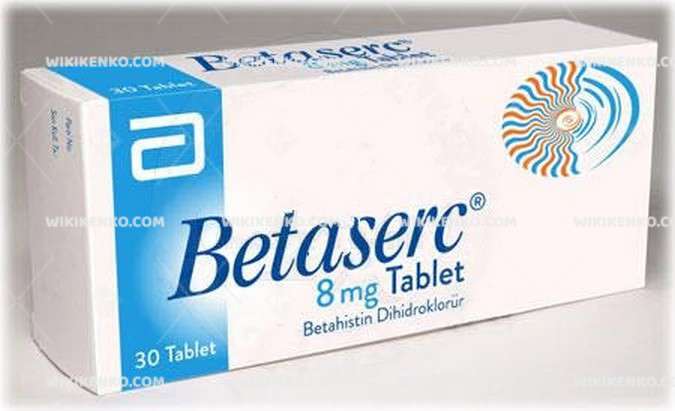
Betaserc is a branded formulation of betahistine dihydrochloride, classified pharmacologically as an antivertigo agent (ATC code N07CA01). Each 8 mg film‑uncoated tablet contains 8 mg of betahistine dihydrochloride as the active ingredient, with a total tablet weight of approximately 125 mg.
Excipients commonly listed for Betaserc tablets include microcrystalline cellulose, mannitol, citric acid monohydrate, colloidal anhydrous silica and talc. The 8 mg strength is typically presented as a white to off‑white round tablet, about 7 mm in diameter, often debossed with a code (e.g. “256”, or manufacturer‑specific markings) and may carry a score line to facilitate breaking for swallowing, although the score is not always intended to create two equal doses.
Mechanism of action and pharmacology
Betahistine is a structural analogue of histamine and acts primarily on histaminergic pathways within the inner ear and central nervous system. Pharmacodynamic data indicate that betahistine is a partial agonist at histamine H1 receptors and an antagonist at H3 receptors, particularly in the central and peripheral vestibular nuclei.
Several complementary mechanisms are proposed:
-
Enhancement of cochlear and vestibular blood flow through vasodilation in the stria vascularis and inner ear microcirculation.
-
Modulation of histamine turnover by H3‑receptor antagonism, increasing histamine release and thereby improving neuronal transmission in vestibular nuclei.
-
Facilitation of central vestibular compensation by acting on second‑order neurons in the vestibular nuclei, which may reduce the frequency and severity of vertiginous episodes.
Betahistine is rapidly absorbed after oral administration and exhibits extensive first‑pass metabolism to inactive metabolites such as 2‑pyridylacetic acid. Protein binding is low, and elimination occurs mainly via renal excretion of metabolites, with most of the administered dose recovered in urine within 24 hours.
Approved indications and clinical use
Ménière’s disease and Ménière’s syndrome
Regulatory product information specifies betahistine 8 mg tablets for the treatment of Ménière’s syndrome, defined by the triad of recurrent vertigo, fluctuating sensorineural hearing loss and tinnitus, often accompanied by nausea and vomiting. Clinical practice guidelines and reviews describe betahistine as maintenance therapy aimed at reducing the frequency, intensity, and duration of vertigo attacks rather than immediate symptomatic relief.
Peripheral vestibular vertigo
Betaserc is also used for symptomatic treatment of vestibular vertigo not necessarily associated with classical Ménière’s disease, including persistent or recurrent vertigo episodes in the absence of movement. In this setting, it is generally prescribed as part of a broader vestibular rehabilitation strategy, often combined with lifestyle measures and, when appropriate, other pharmacological agents.
Posology and method of administration
Standard adult dosage (including elderly)
For adults, including older patients, typical total daily doses range from 24 to 48 mg, administered in divided doses. With the 8 mg strength, this corresponds to 1–2 tablets three times daily, taken with meals or snacks to minimise gastrointestinal discomfort.
The usual initial regimen in many product characteristics is 8–16 mg three times daily (24–48 mg/day), with subsequent dose adjustment according to clinical response and tolerability. Long‑term administration is often required; improvement may be observed after approximately 2 weeks, but maximal benefit may only become evident after several months of continuous therapy.
Special populations
No routine dosage adjustment is generally required in patients with mild to moderate hepatic or renal impairment according to available prescribing information. However, as betahistine has limited data in severe hepatic or renal dysfunction, cautious use and clinical monitoring are advisable. Safety and efficacy data in children and adolescents are insufficient, and many product labels do not recommend routine use in paediatric populations.
Comparative dose and indication overview
The following table summarises key dosage and indication information for Betaserc 8 mg in adults as reported in regulatory and clinical references.
| Parameter | Typical information for Betaserc 8 mg tablets |
|---|---|
| Active ingredient | Betahistine dihydrochloride 8 mg per tablet |
| Main indication | Ménière’s disease/syndrome (vertigo, tinnitus, hearing loss, nausea) |
| Additional use | Symptomatic treatment of peripheral vestibular vertigo |
| Usual total daily dose (adults) | 24–48 mg/day in divided doses |
| Example regimen with 8 mg tablets | 1–2 tablets three times daily with meals |
| Onset of clinical effect | Often within 2 weeks; optimal effect may require several months |
| Need for dose adjustment (renal/hepatic) | Generally not required in mild–moderate impairment, but use with caution |
Efficacy evidence and clinical data
Evidence for betahistine in Ménière’s disease and vestibular disorders derives from randomised trials, observational studies, and systematic reviews. A Cochrane review on betahistine for Ménière’s disease noted that although many studies suggest a reduction in vertigo frequency and improvement in global symptoms, the overall quality of evidence is limited by small sample sizes, heterogeneity and methodological concerns.
Long‑term open‑label and real‑world data, however, consistently report improvements in vertigo burden and patient‑reported outcomes when betahistine is used as maintenance therapy, especially when initiated early in the disease course. Some mechanistic and imaging studies suggest that improved inner‑ear microcirculation and central vestibular compensation may underlie clinical benefits, but these observations remain partially inferential.
Safety profile and adverse reactions
Betaserc is generally well tolerated, with most adverse effects being mild and transient. The most frequently reported reactions include:
-
Gastrointestinal symptoms: dyspepsia, nausea, abdominal discomfort, bloating, abdominal pain and occasionally vomiting.
-
Nervous system effects: headache is commonly reported.
These reactions often improve when the medicine is taken with food or after dose reduction.
Hypersensitivity and dermatologic reactions
Less commonly, hypersensitivity reactions have been described, including skin rash, pruritus, urticaria and angioedema with swelling of the face, lips or throat, sometimes associated with dyspnoea and hypotension. In such cases, treatment should be discontinued immediately and appropriate medical management instituted.
Overdose cases up to approximately 640 mg have primarily produced mild to moderate symptoms (nausea, somnolence, abdominal pain), although more serious complications (seizures, cardiopulmonary issues) have been reported in intentional overdoses, particularly when other drugs were co‑ingested. There is no specific antidote; management consists of early gastric decontamination (e.g. gastric lavage when appropriate) and supportive care.
Contraindications and cautions
Absolute contraindications
Betaserc 8 mg is contraindicated in patients with:
-
Known hypersensitivity to betahistine dihydrochloride or any excipient.
-
Phaeochromocytoma, due to its histamine‑like effect and potential to provoke catecholamine release.
Conditions requiring caution
Caution is recommended in patients with:
-
Peptic ulcer disease or history of peptic ulcer, as dyspepsia and related gastrointestinal symptoms may be exacerbated.
-
Bronchial asthma, because histamine‑related effects may theoretically influence bronchial reactivity; careful monitoring is advised.
-
Chronic urticaria, rashes or allergic rhinitis, due to the risk of aggravating allergic manifestations.
Patients should be counselled to report new or worsening gastrointestinal pain, respiratory symptoms, or allergic manifestations promptly.
Drug interactions
Formal in vivo interaction studies with betahistine are limited, and clinically significant interactions appear rare. In vitro data suggest that betahistine is unlikely to inhibit major cytochrome P450 enzymes at therapeutic concentrations, making metabolic interactions less likely.
Given its structural similarity to histamine, a theoretical pharmacodynamic interaction with H1‑antihistamines is expected, whereby mutual attenuation of therapeutic effects may occur. Although clinically important interactions have not been consistently documented, it is prudent to consider potential reduced efficacy of either betahistine or concomitant antihistamines and to monitor symptom control carefully.
Use in pregnancy, lactation and special situations
Human data on betahistine exposure during pregnancy are limited, and most product characteristics recommend avoiding routine use in pregnancy unless the potential benefit justifies potential risks. Similarly, data on excretion into human breast milk are sparse; many references advise caution or avoidance during breastfeeding, with a decision made on whether to discontinue nursing or the drug based on clinical need.
There are no specific data indicating significant effects on fertility in humans at therapeutic doses. In clinical driving‑simulation studies, betahistine did not show meaningful impairment of the ability to drive or operate machinery, although underlying vertigo itself can affect these activities; patients should be individually assessed.
Practical administration and patient counselling
Patients should be advised to take Betaserc 8 mg tablets during or after meals to reduce gastrointestinal adverse effects, swallowing the tablets with water and not crushing or chewing them unnecessarily. Consistent daily dosing at evenly spaced intervals (e.g. morning, midday, evening) helps maintain stable plasma concentrations and potentially optimises symptom control.
It is important to emphasise that clinical improvement may be gradual; patients should continue therapy as prescribed for several weeks or months before judging overall benefit. They should seek medical review if vertigo worsens, new neurological symptoms emerge, or if significant gastrointestinal pain, allergic phenomena, or respiratory difficulty occur.
The following table highlights core pharmaceutical and clinical attributes of Betaserc 8 mg from a formulary perspective.
| Attribute | Description for Betaserc 8 mg |
|---|---|
| Pharmaceutical class | Antivertigo agent (ATC N07CA01) |
| Strength and form | 8 mg betahistine dihydrochloride per oral tablet, white/off‑white, round, ~7 mm diameter |
| Mechanism of action | Histamine analogue; H1‑receptor partial agonist and H3‑receptor antagonist; increases inner‑ear blood flow and facilitates vestibular compensation |
| Primary indication | Ménière’s disease/syndrome with vertigo, tinnitus and fluctuating hearing loss |
| Usual adult dosage range | 24–48 mg/day in divided doses; 1–2 tablets three times daily when using 8 mg strength |
| Key adverse effects | Headache, dyspepsia, nausea, abdominal discomfort; rare hypersensitivity reactions including rash and angioedema |
| Main cautions | Peptic ulcer disease, bronchial asthma, history of allergic disorders; contraindicated in phaeochromocytoma |
This evidence‑based profile supports Betaserc 8 mg as a standard oral betahistine preparation for the chronic management of Ménière’s disease and certain vestibular vertigo syndromes, with an established though not methodologically robust clinical evidence base and a generally favourable tolerability profile at recommended doses.











Mohsen abedin –
I need betahistin 8 mg
Medical Guidance Center –
Hi Mohsen abedin, this is WikiKenko. Thanks for reaching out to us about Betaserc.
I understand you’re looking for Betahistine 8 mg, but I want to clarify that WikiKenko does not sell any medications. We focus on providing accurate medical information rather than handling sales.
If you are in a life-threatening emergency or having a hard time finding a supplier, you might want to try filling out the “Community Support Network” form at https://wikikenko.com/community-support-network/. Our community members often help each other locate official sellers in their specific countries.