Description
Pharmaceutical composition and formulation
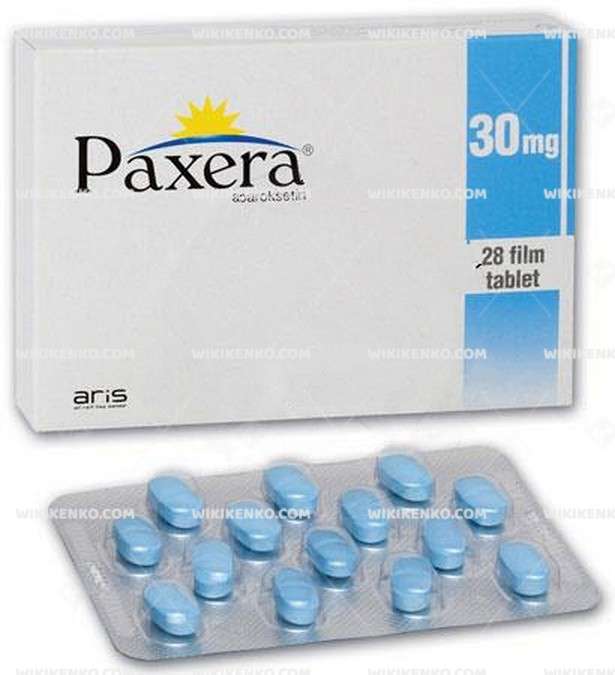
Each Paxera Film Tablet 30 mg contains 34.32 mg paroxetine hydrochloride, equivalent to 30 mg paroxetine base, as the active substance. The formulation also includes lactose monohydrate of bovine origin (approximately 202.68 mg per tablet) and typical film‑coating excipients such as titanium dioxide and colorants (e.g., indigo carmine) to provide a blue film coat.
The tablets are oblong, blue, film‑coated, with “30” debossed on one face and a score line on the other to allow subdivision into two equal 15 mg halves for dose flexibility. Paxera is classified under ATC code N06AB05 (paroxetine) within the nervous system psychoanaleptic antidepressants, specifically SSRIs.
Mechanism of action
Paroxetine is a potent and highly selective inhibitor of the serotonin (5‑hydroxytryptamine, 5‑HT) transporter in presynaptic neurons, resulting in blockade of serotonin reuptake into the presynaptic terminal. By increasing synaptic serotonin concentrations, paroxetine enhances serotonergic neurotransmission in brain regions implicated in mood and anxiety regulation.
At therapeutic doses, paroxetine has minimal affinity for noradrenergic, dopaminergic, muscarinic cholinergic, histaminergic, or α‑adrenergic receptors, which contributes to its relatively favorable receptor‑mediated side‑effect profile compared with older tricyclic antidepressants. Chronic administration produces downstream adaptations in postsynaptic receptors and intracellular signaling pathways that are thought to underlie the delayed onset of clinical antidepressant and anxiolytic effects.
Indications and clinical uses
Paxera (paroxetine) belongs to the SSRI class and is indicated in adults for several depressive and anxiety disorders, consistent with paroxetine’s established clinical profile.
Typical approved indications in adult patients include:
-
Major depressive disorder (MDD)
-
Obsessive–compulsive disorder (OCD)
-
Panic disorder, with or without agoraphobia
-
Social anxiety disorder (social phobia)
-
Generalized anxiety disorder (GAD)
-
Post‑traumatic stress disorder (PTSD)
In Turkey, Paxera is supplied in blister packs containing 14, 28, or 56 film tablets, allowing flexibility for both acute treatment and maintenance therapy. It is a prescription‑only medicine (“beyaz reçete”) and is listed as a generic beşeri (human) medicinal product.
Posology and method of administration
Paxera is administered orally once daily, usually in the morning, with or without food, and the film‑coated tablet should be swallowed with water. Treatment typically begins with a lower starting dose, followed by gradual titration based on clinical response and tolerability, up to the recommended target or maximum dose.
The 30 mg strength is often used as a maintenance or target dose, or as an intermediate step in titration for certain indications. The presence of a score line allows the tablet to be divided to achieve a 15 mg dose when clinically necessary.
The following table illustrates typical adult dosage ranges for paroxetine; local product information for Paxera should always be consulted for country‑specific recommendations.
| Indication (adults) | Usual starting dose (paroxetine) | Typical effective dose range | Common maximum dose in labels |
|---|---|---|---|
| Major depressive disorder | 20 mg once daily | 20–40 mg/day | Up to 50 mg/day |
| Obsessive–compulsive disorder | 20 mg once daily | 40–60 mg/day | 60 mg/day |
| Panic disorder | 10 mg once daily | 20–40 mg/day | 60 mg/day |
| Social anxiety disorder | 20 mg once daily | 20–50 mg/day | 50 mg/day |
| Generalized anxiety disorder | 20 mg once daily | 20–50 mg/day | 50 mg/day |
| PTSD | 20 mg once daily | 20–50 mg/day | 50 mg/day |
Dose adjustments (usually downward) are recommended in elderly patients, in patients with severe renal or hepatic impairment, and when interacting drugs are co‑administered.
Pharmacokinetics
After oral administration, paroxetine is well absorbed and undergoes first‑pass metabolism, reaching peak plasma concentrations in approximately 5–7 hours. It exhibits nonlinear pharmacokinetics at higher doses due to partial saturation of first‑pass metabolism, leading to disproportionate increases in plasma concentration with dose escalation.
Paroxetine is extensively distributed, is highly protein bound (about 95%), and is metabolized predominantly by hepatic cytochrome P450 isoenzymes (primarily CYP2D6) to inactive metabolites. The elimination half‑life is typically about 21 hours, supporting once‑daily dosing, and excretion occurs via both renal and fecal routes, mainly as metabolites rather than unchanged drug.
Contraindications
Paxera is contraindicated in several clinically important situations, consistent with SSRI class labeling.
Major contraindications include:
-
Concomitant use with monoamine oxidase inhibitors (MAOIs) or within the required washout periods (usually at least 14 days after stopping an MAOI, and several days after stopping paroxetine before starting an MAOI), due to risk of serious serotonin syndrome.
-
Concomitant use with thioridazine or pimozide, given the potential for elevated plasma levels of these antipsychotics and associated risk of QT prolongation and serious ventricular arrhythmias.
-
Known hypersensitivity to paroxetine or any excipient in the formulation (e.g., lactose, dyes).
-
Use in combination with linezolid or methylene blue, except under closely controlled conditions, because of risk of serotonin toxicity.
Paxera tablets contain lactose; patients with rare hereditary problems of galactose intolerance, total lactase deficiency, or glucose‑galactose malabsorption should not use this product.
Special warnings and precautions
Paroxetine and other SSRIs carry important warnings summarized below.
-
Suicidality: Antidepressants increase the risk of suicidal thinking and behavior in children, adolescents, and young adults, particularly early in treatment or when doses are changed; Paxera is generally not recommended in patients under 18 years and requires close monitoring in young adults.
-
Serotonin syndrome: Potentially life‑threatening serotonin syndrome may occur with concomitant serotonergic drugs (e.g., other SSRIs, SNRIs, triptans, tramadol, St John’s wort, MAOIs); clinical vigilance and avoidance of inappropriate combinations are critical.
-
Mania/hypomania: Use with caution in patients with bipolar disorder; Paxera should be discontinued if the patient enters a manic phase.
-
Seizures: SSRIs may lower seizure threshold; paroxetine should be used cautiously in patients with epilepsy and discontinued if seizures develop or increase in frequency.
-
Hyponatremia/SIADH: Elderly patients and those taking diuretics or otherwise volume‑depleted may develop hyponatremia; clinical and laboratory monitoring is advised if symptoms occur.
-
Bleeding risk: SSRIs can increase bleeding tendency, especially when combined with NSAIDs, aspirin, or anticoagulants; patients should be monitored for signs of bleeding.
-
Bone fracture: Epidemiologic data suggest an increased risk of bone fractures with SSRIs, including paroxetine, particularly in elderly patients.
-
Glaucoma: SSRIs may precipitate angle‑closure attacks in susceptible individuals due to mydriasis; caution is warranted in patients with narrow angles.
Drug interactions
Paroxetine is involved in clinically relevant pharmacokinetic and pharmacodynamic interactions.
Key interaction mechanisms include:
-
CYP2D6 inhibition: Paroxetine is a strong inhibitor of CYP2D6 and can increase plasma concentrations of substrates such as tricyclic antidepressants, certain antipsychotics (e.g., thioridazine, which is contraindicated), some antiarrhythmics, and metoprolol.
-
Serotonergic agents: Additive serotonergic effects with other serotonergic drugs (e.g., SSRIs, SNRIs, triptans, tramadol, lithium, MAOIs) increase the risk of serotonin syndrome; such combinations should be avoided or used with caution under close monitoring.
-
NSAIDs, aspirin, anticoagulants: Concomitant use may enhance bleeding risk through impaired platelet serotonin‑dependent aggregation; clinicians should weigh risks and benefits and monitor for bleeding.
-
Enzyme inducers/inhibitors: Potent enzyme inducers (e.g., carbamazepine, rifampicin) may decrease paroxetine exposure, while inhibitors (e.g., some antifungals or macrolides) could increase exposure; dose adjustment may be necessary.
Adverse reactions
Adverse reactions to Paxera largely reflect the known safety profile of paroxetine and the SSRI class.
Very common or common adverse effects (frequency categories drawn from paroxetine reference labeling) typically include:
-
Gastrointestinal: nausea, dry mouth, constipation, diarrhea
-
Central nervous system: somnolence, insomnia, dizziness, headache, tremor
-
Psychiatric: agitation, abnormal dreams, decreased libido
-
Metabolic: decreased appetite, weight change (often mild weight gain with long‑term use)
-
Sexual: erectile dysfunction, delayed ejaculation, anorgasmia
-
Others: sweating, asthenia, yawning
The following table summarizes selected adverse reactions by system organ class.
| System organ class | Very common/common adverse reactions (paroxetine) |
|---|---|
| Gastrointestinal | Nausea, dry mouth, constipation, diarrhea |
| Nervous system | Somnolence, insomnia, dizziness, tremor |
| Psychiatric | Agitation, anxiety, abnormal dreams, decreased libido |
| Reproductive | Sexual dysfunction (erectile dysfunction, delayed ejaculation, anorgasmia) |
| Metabolic | Decreased appetite, weight change |
| General | Asthenia, sweating, yawning |
Serious but less common adverse reactions include serotonin syndrome, seizures, clinically significant hyponatremia, bleeding events (e.g., gastrointestinal hemorrhage), and severe cutaneous reactions. Discontinuation symptoms (e.g., dizziness, sensory disturbances, sleep disturbances, anxiety, irritability, nausea) are relatively frequent if paroxetine is stopped abruptly; gradual tapering is recommended.
Use in pregnancy and lactation
Paroxetine exposure during the first trimester has been associated in some epidemiological studies with an increased risk of congenital malformations, particularly cardiac defects, although data are not entirely consistent; many labels therefore recommend avoiding paroxetine in pregnancy unless the potential benefit clearly outweighs the risk. Late‑pregnancy SSRI exposure has been linked to persistent pulmonary hypertension of the newborn (PPHN) and neonatal adaptation syndrome (e.g., respiratory distress, irritability, feeding difficulties, tremor), necessitating neonatal monitoring.
Paroxetine is excreted into breast milk in small quantities; although adverse effects in breast‑fed infants are uncommon, caution is advised and the risk–benefit balance of breastfeeding versus therapy should be carefully considered. Pre‑conception counseling and possible alternative therapies may be appropriate for women of child‑bearing potential who require antidepressant treatment.
Overdose
Paroxetine overdose is typically associated with nausea, vomiting, sedation, tremor, tachycardia, and in severe cases, altered consciousness, seizures, and cardiac conduction abnormalities. Fatal outcomes have most often occurred in the context of poly‑drug overdoses involving other psychotropics or alcohol rather than paroxetine alone.
There is no specific antidote for paroxetine; management is supportive and symptomatic, including ensuring airway patency, monitoring of vital signs and cardiac rhythm, and use of activated charcoal when appropriate. Forced diuresis, dialysis, hemoperfusion, or exchange transfusion are unlikely to be beneficial given the large volume of distribution and extensive tissue binding of paroxetine.
Regulatory and practical considerations
Paxera 30 mg Film Tablet is a locally manufactured generic paroxetine product in Turkey, with packaging sizes (14, 28, 56 tablets) and pricing regulated within the national reimbursement system. Its ATC classification (N06AB05) and status as a normal prescription medicine reflect its positioning as a standard SSRI for outpatient psychiatric indications.
Prescribers should base clinical decisions on the national Summary of Product Characteristics (Kısa Ürün Bilgisi) and patient information leaflet (Kullanma Talimatı), which provide detailed, country‑specific dosing recommendations, contraindications, and safety information for Paxera Film Tablet 30 mg. Continuous pharmacovigilance and periodic review of emerging safety data remain essential to optimize risk–benefit balance in patients treated with this SSRI.


beby –
precio
Medical Guidance Center –
Hola beby, aquí WikiKenko. ¡Gracias por tu consulta!
Entiendo que necesitas saber el costo de Paxera, pero ten en cuenta que los precios de los medicamentos pueden variar muchísimo dependiendo de tu ubicación exacta, la farmacia y la disponibilidad en el momento.
Como WikiKenko es una enciclopedia y no vendemos medicamentos, te sugiero que inicies sesión en tu cuenta de WikiKenko para ver la información de precios más reciente que tenemos registrada.