Description
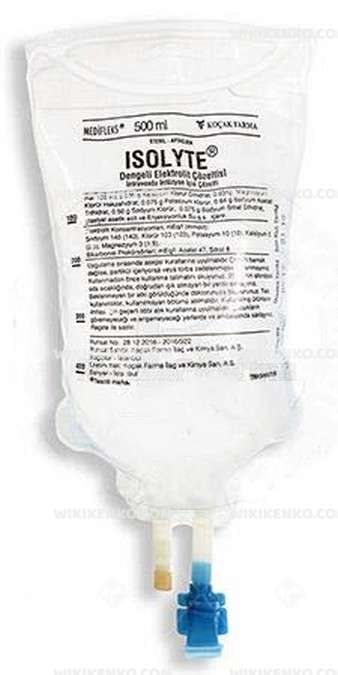
Isolyte Solution is a sterile, nonpyrogenic multi-electrolyte intravenous solution designed to provide hydration and essential electrolytes to patients experiencing dehydration and electrolyte imbalances. This balanced crystalloid solution serves as both a hydrating agent and an alkalinizing agent in clinical settings. While available in multiple packaging formats including PVC bags (Medifleks), this article provides detailed information about Isolyte’s composition, clinical applications, administration guidelines, and safety profile.
Composition and Formulation
Isolyte Solution contains a carefully balanced mixture of electrolytes designed to closely mimic the composition of human plasma. The specific formulation varies slightly between different Isolyte products (such as Isolyte S, Isolyte S pH 7.4, and Isolyte Dengeli Elektrolit Solüsyonu), but the core components remain consistent.
Primary Ingredients
Each 100 mL of Isolyte S pH 7.4 contains:
-
Sodium Chloride USP: 0.53 g
-
Sodium Gluconate USP: 0.5 g
-
Sodium Acetate Trihydrate USP: 0.37 g
-
Potassium Chloride USP: 0.037 g
-
Magnesium Chloride Hexahydrate USP: 0.03 g
-
Dibasic Sodium Phosphate Heptahydrate USP: 0.012 g
-
Monobasic Potassium Phosphate NF: 0.00082 g
-
Water for Injection USP: quantity sufficient
The solution has a pH of approximately 7.4 (range 7.0–7.8), closely matching physiological pH, with a calculated osmolarity of 295 mOsmol/liter. This isotonic nature helps prevent potentially harmful shifts in fluid between body compartments during administration.
Electrolyte Composition
The electrolyte concentration in Isolyte S provides a balanced profile with the following approximate values (in mEq/liter):
-
Sodium: 141
-
Potassium: 5
-
Magnesium: 3
-
Chloride: 98
-
Phosphate: 1
-
Acetate: 27
-
Gluconate: 23
This composition makes Isolyte distinct from other crystalloid solutions, with electrolyte levels designed to provide optimal correction of common imbalances while minimizing risks.
Mechanism of Action
Isolyte Solution’s primary mechanism of action involves the restoration of extracellular fluid volume and electrolyte balance. When administered intravenously, Isolyte expands both the interstitial and intravascular compartments of the extracellular fluid. The solution’s electrolyte composition closely resembles that of normal plasma, allowing for effective rehydration without disrupting electrolyte equilibrium.
The presence of metabolizable anions (acetate and gluconate) in Isolyte provides an alkalinizing effect, making it particularly valuable in treating mild to moderate acidosis. Unlike normal saline solutions that may cause hyperchloremic acidosis with large volume administration, Isolyte’s balanced formulation helps maintain acid-base homeostasis.
Additionally, the potassium content in Isolyte (approximately twice that of normal plasma) assists in addressing potassium deficiency states commonly associated with dehydration and surgical stress.
Clinical Indications
Dehydration Management
Isolyte Solution is primarily indicated for the treatment of dehydration and prevention of dehydration states. It effectively replaces lost fluids and electrolytes in various clinical scenarios, particularly when multiple electrolytes have been depleted simultaneously.
Specific Clinical Applications
The solution is particularly valuable in several clinical contexts:
-
Surgical patients: Isolyte helps prevent and treat the dehydration, electrolyte imbalances (especially hypokalemia), and acidosis commonly observed in surgical patients. Generally administered at a rate of one liter every 2-3 hours, with up to 3 liters administered over 24 hours in adult surgical patients.
-
Pediatric cases: Particularly beneficial in children with acute diarrhea, where rapid fluid and electrolyte losses require prompt replacement.
-
Metabolic acidosis: Useful in treating diabetic acidosis and renal acidosis due to its alkalinizing properties.
-
Acute infections: Helps manage dehydration associated with acute infectious diseases.
Diluent Function
Isolyte is also used as a diluent for concentrated intravenous medications that require dilution before administration.
Administration and Dosage
Administration Route
Isolyte Solution is strictly for intravenous administration only. It can be administered through either peripheral or central venous access, using sterile, pyrogen-free administration sets.
General Dosage Guidelines
Dosage must be determined by a physician based on several individual factors including:
-
Patient’s age
-
Body weight
-
Clinical condition
-
Laboratory determinations
-
Hydration status
During treatment, serum electrolyte concentrations should be carefully monitored to ensure appropriate correction of imbalances.
Specific Dosage Recommendations
For surgical patients: Generally administered at approximately one liter every 2-3 hours, with up to 3 liters over a 24-hour period.
For pediatric patients with acute diarrhea, diabetic/renal acidosis, and acute infection-related dehydration: 50-150 ml/kg daily.
General administration rate: 120-240 ml per hour per square meter of body surface area.
Special Populations
For patients with renal impairment, dose adjustment may be necessary as the solution is largely eliminated through the kidneys. The risk of toxicity increases with decreased renal function.
Side Effects
As with any intravenous solution, Isolyte may cause adverse reactions in some patients. These range from mild, localized reactions to severe systemic effects.
Common Side Effects
Local reactions at the infusion site may include:
-
Itching, redness, or swelling
-
Burning sensation
-
Discomfort during administration
Serious Adverse Reactions
More serious adverse reactions that require immediate medical attention include:
-
Allergic reactions: Respiratory distress, wheezing, chest pain
-
Cardiovascular effects: Extremely low blood pressure, shock, heart palpitations, cardiac rhythm disturbances
-
Neurological reactions: Dizziness, fainting sensation, clouding of consciousness
-
Muscular effects: Muscle paralysis, respiratory paralysis
-
Hematological reactions: Acute hemolytic anemia
-
Gastrointestinal effects: Cessation of bowel movements
-
Systemic reactions: Excessive warmth or cold sensation, swelling of extremities, face, or entire body
If a patient experiences fever or chills during administration (febril reaction), the infusion should be stopped immediately and medical intervention sought.
Precautions and Contraindications
While Isolyte is generally safe when appropriately prescribed and administered, certain precautions and contraindications should be observed to ensure patient safety.
Contraindications
The product information does not explicitly list contraindications in the search results, but based on its composition, caution would be warranted in patients with:
-
Severe renal impairment (due to electrolyte content)
-
Hyperkalemia (due to potassium content)
-
Fluid overload states
Special Precautions
When administering hypertonic solutions peripherally, use the largest possible vein with the smallest appropriate needle to minimize venous irritation. The infusion should be performed as slowly as possible, and care must be taken to avoid extravasation.
Storage and Handling
Isolyte Solution should be stored according to manufacturer guidelines to maintain stability and sterility. General storage recommendations for intravenous solutions apply:
-
Store at controlled room temperature
-
Protect from extreme temperatures
-
Inspect visually for particulate matter and discoloration before administration
-
Do not use if solution is cloudy or contains precipitates
-
Do not store solutions with additives
It is important to note that Isolyte is sterile and contains no bacteriostatic or antimicrobial agents.
Comparison with Other Electrolyte Solutions
Isolyte differs from other commonly used crystalloid solutions in several important ways. Compared to normal saline (0.9% NaCl), Isolyte provides a more physiologically balanced electrolyte profile, with less chloride content, helping to prevent hyperchloremic metabolic acidosis during large volume resuscitation.
When compared to Lactated Ringer’s solution, Isolyte S contains slightly more sodium (141 vs. 130 mEq/L), more potassium (5 vs. 4 mEq/L), less chloride (98 vs. 109 mEq/L), and includes magnesium (3 mEq/L) which is absent in Lactated Ringer’s. Additionally, while Lactated Ringer’s contains calcium (3 mEq/L) and uses lactate (28 mEq/L) as its metabolizable anion, Isolyte S uses a combination of acetate (27 mEq/L) and gluconate (23 mEq/L) instead.
Summary Table
| Parameter | Details |
|---|---|
| Composition | Sodium: 141 mEq/L, Potassium: 5 mEq/L, Magnesium: 3 mEq/L, Chloride: 98 mEq/L, Acetate: 27 mEq/L, Gluconate: 23 mEq/L |
| pH & Osmolarity | pH: 7.4 (range 7.0-7.8), Osmolarity: 295 mOsmol/L |
| Indications | Dehydration treatment/prevention, Electrolyte replacement, Surgical patients, Pediatric diarrhea, Diabetic/renal acidosis |
| Administration Route | Intravenous only (peripheral or central) |
| Adult Dosage | Surgical patients: Up to 3L/24hrs (1L every 2-3hrs); Rate: 120-240 mL/hr/m² body surface area |
| Pediatric Dosage | 50-150 mL/kg/day for dehydration, acidosis, acute infections |
| Common Side Effects | Infusion site reactions (redness, itching, burning) |
| Serious Adverse Reactions | Allergic reactions, hypotension, cardiac arrhythmias, respiratory distress, muscle paralysis, hemolytic anemia |
| Storage | Room temperature, protect from extremes, inspect before use |
| Special Features | Nonpyrogenic, sterile, no bacteriostatic/antimicrobial agents |
Conclusion
Isolyte Solution represents an important advancement in crystalloid fluid therapy, offering a physiologically balanced electrolyte profile suited for multiple clinical applications. Its carefully formulated composition provides effective hydration and electrolyte replacement while minimizing the risk of iatrogenic electrolyte and acid-base disturbances. While Isolyte offers significant advantages over traditional crystalloid solutions like normal saline, proper patient selection, appropriate dosing, and careful monitoring remain essential to ensure optimal outcomes and minimize adverse effects.
Healthcare providers should consider Isolyte’s specific electrolyte profile when selecting fluids for patient care, particularly in surgical settings, pediatric dehydration cases, and situations involving acid-base disturbances. As with all medical interventions, individualized therapy based on specific patient needs remains the cornerstone of safe and effective fluid management.


Reviews
There are no reviews yet.