
Description
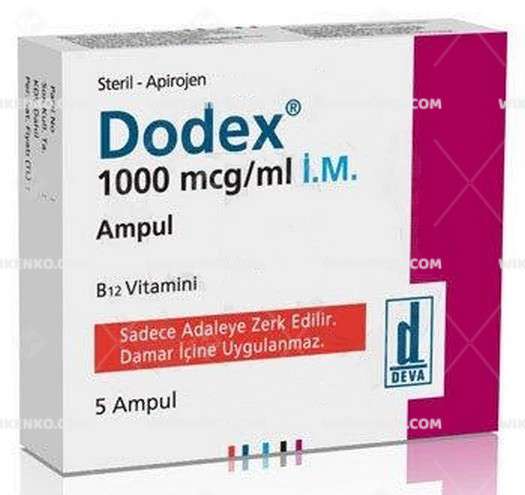
Dodex I.M. Ampul is a pharmaceutical preparation containing Vitamin B12 (Cyanocobalamin) designed for intramuscular administration. This injectable solution plays a critical role in addressing various medical conditions associated with Vitamin B12 deficiency. This comprehensive guide explores the composition, therapeutic applications, administration protocols, and safety considerations of Dodex I.M. Ampul to provide healthcare professionals and patients with valuable insights into this medication.
Composition and Physical Properties
Dodex Injectable (Cyanocobalamin Injection, USP) is presented as a sterile solution containing 1000 mcg of cyanocobalamin per milliliter. The formulation appears as a distinctive red, clear solution packaged in colorless 1 ml ampules. Each milliliter of Dodex contains not only the active ingredient cyanocobalamin but also includes sodium chloride (9.0 mg), benzyl alcohol (15.0 mg) as a preservative, and water for injection. The vivid red coloration is characteristic of cyanocobalamin in its pure form. The pharmaceutical is manufactured by Deva Holding A.Ş., a Turkish pharmaceutical company, and is available at a retail price of approximately 113.62 Turkish Lira.
Chemical Properties
Cyanocobalamin, the active component in Dodex, manifests as dark red crystals or as an amorphous or crystalline red powder. Its chemical structure is complex, with the molecular formula C₆₃H₈₈CoN₁₄O₁₄P and a molecular weight of 1355.39. This compound is sparingly soluble in water (1:80) and notably hygroscopic in its anhydrous form. While stable under autoclaving at 121°C for brief periods, the Vitamin B12 coenzymes exhibit significant instability when exposed to light.
Therapeutic Indications
Dodex I.M. Ampul is prescribed for various medical conditions where Vitamin B12 deficiency plays a central role in the pathophysiology. Understanding these applications enables healthcare providers to make informed decisions regarding its therapeutic use.
Hematological Indications
The primary application of Dodex involves the management of pernicious anemia and hypochromic macrocytic anemia resulting from Vitamin B12 deficiency. Vitamin B12 is essential for normal blood formation, cell reproduction, and nucleoprotein and myelin synthesis. Its deficiency can lead to significant hematological abnormalities that manifest as anemia characterized by enlarged red blood cells (macrocytosis).
Neurological Indications
Beyond its hematological applications, Dodex is used in treating various neurological conditions, including trigeminal neuralgia, sciatic pain, acute neuritis, neuralgia, shingles (herpes zoster), and intercostal neuralgia. Vitamin B12 plays a crucial role in maintaining neurological health, and its supplementation can alleviate nerve-related pain and inflammation.
Diagnostic Applications
Additionally, Dodex is utilized in the Schilling test, a diagnostic procedure designed to measure Vitamin B12 absorption and determine the cause of Vitamin B12 deficiency.
Dosage and Administration
The administration of Dodex I.M. Ampul follows specific dosage regimens tailored to the condition being treated. The medication is exclusively administered through intramuscular injection, which ensures optimal absorption and therapeutic efficacy.
Administration for Hematological Conditions
For pernicious anemia and hypochromic macrocytic anemia, treatment typically begins with 250-1000 mcg of Vitamin B12 administered every other day for 1-2 weeks. Subsequently, once weekly doses of 250 mcg are given until blood tests normalize. In cases with neurological complications, administration of 1000 mcg every other day continues.
After blood parameters improve, maintenance therapy consists of 1000 mcg administered intramuscularly once monthly.
Administration for Neurological Conditions
For acute neuralgias, a daily dose of 500-1000 mcg is recommended. Treatment for acute neuritis and neuralgia should typically continue for 10 days. In cases of recurrence, a repeat course of Dodex therapy may be initiated.
Contraindications
Dodex I.M. Ampul is contraindicated in certain conditions, and awareness of these contraindications is crucial for safe medication use. The product should not be administered to individuals with hypersensitivity to Vitamin B12 or any components of the formulation. Additionally, it is contraindicated in patients with Leber’s disease, a hereditary optic neuropathy where high concentrations of Vitamin B12 in the blood may be detrimental.
Precautions and Warnings
Healthcare providers should exercise caution when prescribing and administering Dodex I.M. Ampul. The medication is strictly for intramuscular use only. It should not be administered without a definitive diagnosis, as it may mask subacute degeneration of the spinal cord. Furthermore, its use is inappropriate in optical neuropathies where blood Vitamin B12 concentrations are elevated.
Regular monitoring is advised during maintenance therapy, with periodic examinations recommended every 3-6 months to identify any treatment resistance that may develop. Special consideration should be given when administering Dodex during infection, uremia, or concurrent use of medications that may interact with Vitamin B12.
Adverse Reactions
While generally well-tolerated, Dodex I.M. Ampul may cause certain adverse effects. Common reactions include pain or redness at the injection site, mild diarrhea, itching, or a sensation of generalized swelling. These effects are typically mild and transient.
More serious adverse effects may include hypokalemia, manifesting as muscle cramps, weakness, or irregular heartbeat. In rare cases, individuals with polycythemia vera may experience symptoms related to their blood disorder while receiving cyanocobalamin therapy.
Drug Interactions
The therapeutic efficacy of Dodex may be diminished when administered concurrently with chloramphenicol. Healthcare providers should carefully consider potential drug interactions when prescribing Dodex alongside other medications.
Clinical Pharmacology
Understanding the pharmacological properties of Dodex enhances its appropriate clinical application. Vitamin B12 is essential for growth, cell reproduction, hematopoiesis, and nucleoprotein and myelin synthesis.
Cyanocobalamin is rapidly and quantitatively absorbed from intramuscular and subcutaneous injection sites, with plasma levels peaking within one hour after intramuscular administration. Once absorbed, Vitamin B12 is transported via specific binding proteins, transcobalamin I and II, to various tissues throughout the body. The liver serves as the primary storage organ for Vitamin B12.
Within 48 hours following injection, significant amounts of administered Vitamin B12 are deposited in the liver, where it is stored and released as needed by the body, providing a biological reservoir for this essential nutrient.
Storage and Handling
To maintain the stability and efficacy of Dodex I.M. Ampul, proper storage conditions must be observed. The medication should be stored in a manner that protects it from light exposure, as Vitamin B12 coenzymes are highly unstable when exposed to light. Prior to administration, the solution should be inspected for particles or discoloration, and if either is present, the product should not be used.
At a glance
| Parameter | Details |
|---|---|
| Active Ingredient | Cyanocobalamin (Vitamin B12) 1000 mcg/ml |
| Dosage Forms | 1 ml ampules for intramuscular injection |
| Primary Uses | Pernicious anemia, B12 deficiency anemia, neuralgias, acute neuritis |
| Dosage for Anemia | Initial: 250-1000 mcg every other day for 1-2 weeks Maintenance: 1000 mcg monthly |
| Dosage for Nerve Pain | 500-1000 mcg daily for 10 days |
| Contraindications | Hypersensitivity to Vitamin B12 or components, Leber’s disease |
| Common Side Effects | Injection site pain/redness, mild diarrhea, itching, feeling of swelling |
| Serious Side Effects | Hypokalemia (muscle cramps, weakness, irregular heartbeat) |
| Storage | Protected from light |
| Manufacturer | Deva Holding A.Ş. |
| Prescription Status | Prescription required (White prescription) |
Conclusion
Dodex I.M. Ampul represents an important therapeutic option for addressing Vitamin B12 deficiency and associated conditions. Its formulation as an injectable solution ensures rapid and effective delivery of cyanocobalamin, addressing both hematological and neurological manifestations of Vitamin B12 deficiency. While generally safe and effective when used appropriately, healthcare providers should be mindful of contraindications, potential adverse effects, and the importance of proper administration techniques.
For optimal therapeutic outcomes, individualized treatment regimens should be established based on the specific condition being treated and regular monitoring should be conducted to assess response and adjust therapy as needed. Through informed and judicious use of Dodex I.M. Ampul, healthcare providers can effectively manage Vitamin B12 deficiency and its clinical sequelae, improving patient outcomes and quality of life.











Reviews
There are no reviews yet.