
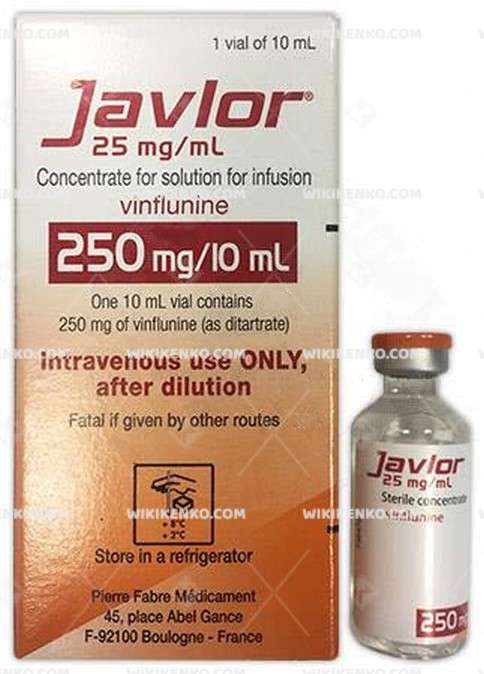
Description
Composition
Active Ingredient
- Vinflunine (as ditartrate): Each ml of concentrate contains 25 mg of vinflunine.
Excipients
- Water for injections.
Indications
Javlor is prescribed to patients with advanced or metastatic cancer of the bladder and urinary tract. It is particularly effective when prior treatment with platinum-based chemotherapy has not been successful.
Dosage and Administration
Recommended Dose
- The standard dose of Javlor is 320 mg/m², administered as a 20-minute intravenous infusion every three weeks.
Special Considerations
- For patients with WHO/ECOG performance status of 1 or those with prior pelvic radiation, the starting dose is reduced to 280 mg/m².
- To mitigate the risk of constipation, the use of laxatives and maintaining oral hydration from day 1 to 5 or 7 post-administration is advised.
Contraindications
Javlor should not be used in patients who:
- Are allergic to vinflunine or any other vinca alkaloids (vinblastine, vincristine, vindesine, vinorelbine).
- Have had a severe infection within the last two weeks or are currently experiencing one.
- Are breastfeeding.
- Have very low levels of white blood cells or platelets.
Precautions
Before Treatment
- Inform the healthcare provider if you have any liver, kidney, or heart conditions.
- Notify the doctor if you are taking any other medications, especially those listed in the “Using Other Medicines” section.
- It is crucial to mention any history of constipation, opioid use, abdominal cancer, or prior abdominal surgery.
During Treatment
- Regular blood cell monitoring is necessary, as a drop in blood cell count is a common side effect.
Side Effects
Common Side Effects
- Neutropenia (low neutrophil count)
- Thrombocytopenia (low platelet count)
- Anemia (low red blood cell count)
Other Side Effects
- Constipation
- Fatigue
- Nausea and vomiting
- Hair loss
Storage
- Store in a refrigerator (between 2°C and 8°C).
- Do not freeze the solution.
Benefits of Javlor Infusion Concentrate Solution 250 mg
Javlor is recognized for its effectiveness in treating advanced bladder cancer, especially when first-line platinum-based treatments have failed. The drug operates as a vinca alkaloid by disrupting the ability of cancer cells to divide, thereby halting the progression of the disease.
Effective for Advanced Bladder Cancer:
- Javlor is specifically indicated for patients with advanced or metastatic bladder cancer who have not responded to previous treatments, making it a valuable option when other therapies are ineffective.
Targeted Mechanism
- As a vinca alkaloid, vinflunine specifically targets the division process of cancer cells, effectively slowing or stopping tumor growth.
Improvement in Survival Rates
- Clinical trials show that Javlor can improve survival rates in patients with advanced bladder cancer.
Manageable Side Effects
- Although side effects like neutropenia, thrombocytopenia, anemia, and gastrointestinal discomfort are common, they are generally manageable with proper medical care.
Convenient Administration
- The treatment is administered via intravenous infusion every three weeks, allowing for regular patient monitoring and side effect management.
Pharmacokinetics of Javlor Infusion Concentrate Solution 250 mg
Absorption
- Vinflunine is administered intravenously, ensuring 100% bioavailability.
Distribution
- The volume of distribution is approximately 95 L/m².
- Protein binding for vinflunine is relatively high at 67.2%.
Metabolism
- Vinflunine is primarily metabolized in the liver by the cytochrome P450 enzyme system, especially CYP3A4. Its main metabolite, 4-O-deacetylvinflunine, retains some pharmacological activity.
Elimination
- The terminal half-life is approximately 40 hours.
- Vinflunine has a total body clearance rate of around 40 L/h.
- The drug and its metabolites are primarily excreted through feces (60%) and the rest via urine (40%).
Special Populations
- Elderly Patients: Clearance is reduced in patients over 80 years old.
- Renal Impairment: For patients with moderate renal impairment (creatinine clearance between 40 and 60 mL/min), the recommended dose is 280 mg/m². For those with severe renal impairment (20 to 40 mL/min), the dose is further reduced to 250 mg/m².
Therapeutic Uses of Javlor Infusion Concentrate Solution 250 mg
Javlor, containing vinflunine, is specifically used in the treatment of advanced or metastatic bladder and urinary tract cancers, particularly after failure of platinum-based regimens.
Advanced Transitional Cell Carcinoma
- Javlor is used as monotherapy for adult patients suffering from advanced or metastatic transitional-cell carcinoma of the urothelial tract after failure of prior platinum-based chemotherapy.
Second-Line Therapy
- This medication is often employed as a second-line therapy when patients do not respond to initial platinum-based chemotherapy.
Mechanism of Action of Vinflunine
Microtubule Inhibition
Vinflunine disrupts the function of microtubules, which are essential for cellular structure and division. It binds to tubulin at vinca-binding sites, inhibiting the polymerization of microtubules and preventing cancer cells from dividing.
Induction of Apoptosis
- By arresting cells in the G2/M phase of the cell cycle, vinflunine triggers programmed cell death, or apoptosis.
Antiangiogenic and Antivascular Effects
- At non-cytotoxic concentrations, vinflunine also inhibits the formation of new blood vessels that supply the tumor, thus limiting cancer growth and spread.
Clinical Studies
Phase II and III Trials
- Clinical studies, including phase III and phase II trials, support the use of Javlor for treating advanced or metastatic transitional cell carcinoma of the urothelial tract after failure of prior platinum-based chemotherapy.
Survival Rates
- Clinical data indicate that Javlor significantly improves survival rates for patients with advanced bladder cancer who have no other viable treatment options.
Table of Information on Javlor Infusion Concentrate Solution 250 mg
| Aspect | Details |
|---|---|
| Dosage | 320 mg/m² as a 20-minute IV infusion every 3 weeks |
| Common Side Effects | Neutropenia, thrombocytopenia, anemia, constipation, fatigue, nausea, hair loss |
| Usage | Advanced bladder and urinary tract cancer, after failure of platinum-based therapies |
| Benefits | Effective for advanced bladder cancer, improves survival rates, manageable side effects |
| Mechanism of Action | Microtubule inhibition, G2/M phase cell cycle arrest, induction of apoptosis |
| Elimination | Excreted mainly in feces (60%) and urine (40%) |
This article provides a comprehensive overview of Javlor, emphasizing its role in the treatment of advanced bladder cancer, its pharmacokinetics, clinical efficacy, and the management of side effects.










Reviews
There are no reviews yet.