
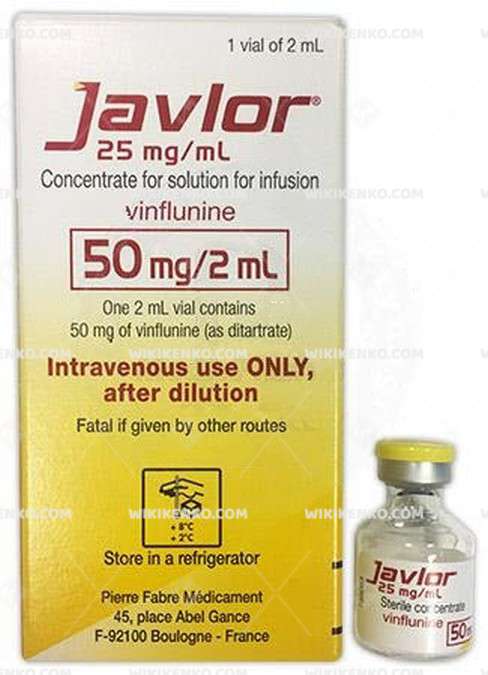
Description
Composition
Active Ingredient
- Vinflunine (as ditartrate): Each milliliter (mL) of Javlor contains 25 mg of vinflunine. The solution is available in 2 mL vials, delivering a total of 50 mg of the active substance.
Excipients
- Sodium chloride
- Water for injection
Indications
Javlor is indicated for adult patients with advanced or metastatic transitional cell carcinoma of the urothelial tract who have not responded to prior platinum-based therapies.
Dosage and Administration
Recommended Dosage
- Standard Dose: 320 mg/m² administered via a 20-minute intravenous infusion every three weeks.
- Adjusted Dose: For patients with a WHO/ECOG performance status of 1 or 0 and previous pelvic irradiation, the initial dose is reduced to 280 mg/m².
Administration Guidelines
- Javlor should be administered by intravenous infusion over a 20-minute period.
- Peripheral lines or a central catheter can be utilized for the infusion.
- The infusion should not be administered as a rapid bolus.
Mechanism of Action
Vinflunine is a microtubule inhibitor that works by disrupting the cytoskeleton within cancer cells. Its action centers on:
- Inhibition of Tubulin Polymerization: Vinflunine binds to tubulin, inhibiting its assembly into microtubules. These microtubules are essential for cell division and mitosis.
- Suppression of Microtubule Dynamics: The drug significantly suppresses the dynamics of microtubule growth and shortening, disrupting cellular processes like treadmilling, which is essential for maintaining the cell’s structure.
- Cell Cycle Arrest: Vinflunine causes cells to become arrested in the G2/M phase of the cell cycle, halting division and leading to the accumulation of cells in mitosis.
- Induction of Apoptosis: Through the suppression of microtubule activity and cell cycle arrest, vinflunine ultimately leads to programmed cell death, or apoptosis, effectively killing cancer cells.
Contraindications
Javlor is contraindicated in the following conditions:
- Hypersensitivity to vinflunine or other vinka alkaloids.
- Patients with severe infections within the last two weeks.
- Breastfeeding women.
- Individuals with critically low white blood cell (neutrophils) or platelet counts.
Side Effects
Javlor is associated with several side effects, some of which are significant and require close monitoring. These include:
| Side Effect | Description |
|---|---|
| Neutropenia | Significant reduction in neutrophil count, increasing the risk of infection. |
| Thrombocytopenia | Decreased platelet count, leading to increased bleeding and bruising. |
| Anemia | Reduced hemoglobin levels, causing fatigue and weakness. |
| Constipation | Common side effect, often requiring laxatives and dietary management. |
| Fatigue | General feeling of tiredness and lack of energy. |
| Nausea & Vomiting | Feeling sick or vomiting, often managed with anti-nausea medications. |
| Mucositis | Inflammation and ulceration of the mucous membranes, particularly in the digestive tract. |
Precautions
Before and during the administration of Javlor, several precautions must be taken into account:
Pre-Treatment Precautions
- Blood Monitoring: Regular monitoring of complete blood counts (CBC) is essential to assess levels of neutrophils, platelets, and hemoglobin before each vinflunine infusion. This is because neutropenia, thrombocytopenia, and anemia are common side effects.
During Treatment Precautions
- Constipation Management: Laxatives and hydration are recommended from day 1 to day 5 or 7 after each vinflunine administration to prevent constipation.
Dose Adjustments
- Neutropenia: If the patient’s absolute neutrophil count (ANC) is below 1,500 cells/mm³ or platelet count is below 100,000/mm³, initiation of vinflunine is contraindicated.
Special Considerations
- QT Interval Prolongation: Javlor may cause prolongation of the QT interval, raising the risk of ventricular arrhythmias. Caution is advised in patients with cardiac issues.
- Venous Irritation: Peripheral vein infusion may result in venous irritation, ranging from mild to severe. Central line infusion may be preferred in some cases.
Drug Interactions
Vinflunine can interact with several other medications, impacting its effectiveness or leading to enhanced side effects. The key interactions include:
| Interaction Type | Details |
|---|---|
| CYP3A4 Inhibitors | Co-administration with strong CYP3A4 inhibitors (e.g., ketoconazole) can increase vinflunine levels, increasing toxicity. |
| CYP3A4 Inducers | Drugs such as rifampicin or phenytoin can lower vinflunine levels, reducing its effectiveness. |
| Grapefruit Juice | Grapefruit juice can inhibit CYP3A4, potentially increasing vinflunine toxicity. |
Co-Medications
- Laxatives: To manage constipation, it is recommended that patients take laxatives and stay well-hydrated during treatment.
Storage
Javlor should be stored at 2°C to 8°C in a refrigerator and protected from light. It must be kept out of reach of children and handled with care to maintain its efficacy.
Alternative Treatments for Urothelial Carcinoma
Depending on the stage of the cancer and the patient’s overall health, alternative treatments for urothelial carcinoma may include:
| Alternative Treatment | Description |
|---|---|
| Surgical Options | Cystectomy involves the partial or total removal of the bladder for muscle-invasive cancer. |
| Chemotherapy | Systemic chemotherapy using cisplatin or carboplatin is common, depending on the patient’s tolerance. |
| Immunotherapy | Checkpoint inhibitors like pembrolizumab or atezolizumab are options for advanced cases. |
| Targeted Therapy | Erdafitinib and enfortumab vedotin target specific genetic mutations or cell markers. |
Conclusion
Javlor, with its active ingredient vinflunine, offers an important treatment option for patients with advanced or metastatic transitional cell carcinoma of the urothelial tract. While the drug is effective, it requires careful administration and monitoring to manage side effects, such as neutropenia, constipation, and potential drug interactions. Regular consultations with healthcare providers are essential to ensure optimal treatment outcomes, and patients should be aware of potential alternatives for managing their condition.









Yulia –
Hello I need 2 pieces of Javlor 50ml to be delivered to Russia
Medical Guidance Center –
Hello Yulia, this is WikiKenko,
Javlor is a third-generation member of the vinca alkaloid family with anti-tumor actions. It is used to treat advanced or metastatic transitional cell carcinoma of the urothelial tract after a platinum-containing treatment has failed. Javlor is given if previous therapy with a platinum-containing medicine has failed. It is an anti-mitotic agent that induces a cell cycle arrest at the G2/M phase and promotes cell death via apoptosis.
It is important to note that Javlor is a prescription medication and should only be used under the guidance of a healthcare professional. I’m sorry, but I couldn’t find any specific information about the availability of Javlor in Russia. It would be best to consult with a healthcare professional or a pharmacy in Russia for more information on how to obtain Javlor.