
Description
Pharmaceutical Identity and Composition
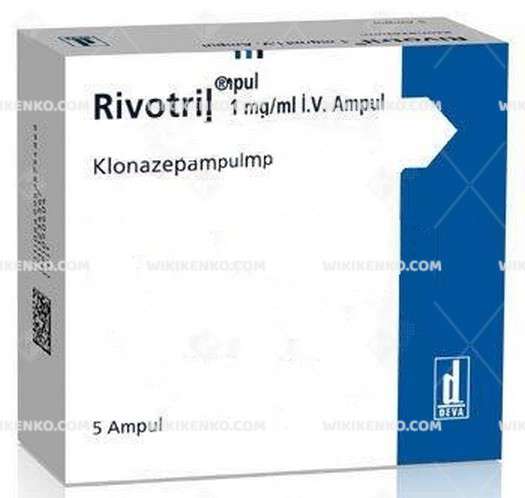
Rivotril I.V. Solution is a concentrated solution for injection presented in amber glass ampoules containing clonazepam 1 mg in 1 mL solution, usually supplied together with separate diluent ampoules containing water for injections. The solution appears as a clear to slightly yellowish liquid.
Qualitative and quantitative composition
-
Active substance: clonazepam 1 mg per 1 mL solution.
-
Excipients (may vary slightly by market, but commonly include):
-
Absolute ethanol/ethanol (approximately 20% v/v in some formulations).
-
Benzyl alcohol (around 30 mg/mL in several EU products).
-
Propylene glycol.
-
Glacial acetic acid (for pH adjustment).
-
Diluent ampoule: water for injections, separate from active solution.
-
This high‑strength solution must be diluted before intravenous administration to minimize venous irritation and thrombophlebitis.
Therapeutic Indications
Primary indication
The intravenous formulation of clonazepam (Rivotril I.V.) is indicated for the acute management of status epilepticus and severe acute epileptic seizures when rapid anticonvulsant effect is required and parenteral therapy is appropriate. In clinical practice it is particularly useful in generalized and focal status epilepticus where benzodiazepines are first‑line or early‑line treatments.
Other epileptic syndromes (background indication)
Beyond the acute IV indication, clonazepam (as a substance) is indicated in many countries for chronic treatment of various epilepsies, especially typical and atypical absences, myoclonic seizures and Lennox–Gastaut syndrome, although that chronic use is usually via oral formulations rather than the IV concentrated solution.
Mechanism of Action and Pharmacology
Pharmacodynamic properties
Clonazepam is a 1,4‑benzodiazepine with potent anticonvulsant, anxiolytic, sedative, muscle‑relaxant and amnestic properties. It acts as a positive allosteric modulator at the gamma‑aminobutyric acid type A (GABAA) receptor, enhancing the effect of endogenous GABA and increasing chloride influx through the GABA‑gated chloride channel. This results in hyperpolarization and decreased excitability of neurons in key seizure‑generating networks, thereby raising seizure threshold and limiting spread of epileptic activity.
Pharmacokinetic properties (relevant to IV use)
-
Absorption: after IV injection, bioavailability is 100% by definition, with rapid onset of effect within minutes.
-
Distribution: clonazepam is highly lipophilic, extensively protein‑bound (≈85%) and rapidly distributes from blood to the central nervous system.
-
Metabolism: extensively hepatic, mainly via reduction and hydroxylation followed by conjugation; metabolites are pharmacologically inactive or weakly active.
-
Elimination half‑life: typically in the range of 20–60 hours, supporting a long duration of action.
-
Excretion: primarily renal as metabolites, with a small proportion excreted unchanged.
The long half‑life implies potential accumulation with repeated doses and necessitates careful titration and monitoring in critically ill patients.
Dosage and Method of Administration
General principles
Rivotril I.V. must be administered in a controlled setting (e.g. intensive care or monitored emergency environment) with facilities for continuous monitoring of respiration, blood pressure and, when available, electroencephalogram (EEG). Because of the risk of respiratory depression, hypotension and venous irritation, the solution must be diluted and injected slowly into a large vein.
Recommended dosing for adults (status epilepticus)
Typical product information recommends:
-
Initial dose: 1 mg clonazepam (one ampoule) given by slow IV injection or as a short infusion.
-
Repeat dosing: The 1 mg dose may be repeated as needed depending on clinical response and tolerability, up to a maximum cumulative dose often cited as 2–4 mg in adults, with careful monitoring for respiratory and cardiovascular depression.
-
Injection rate: in adults, not more than 0.25–0.5 mg (0.5–1 mL of prepared diluted solution) per minute.
Pediatric dosing
For children, weight‑based dosing is generally used (exact values vary by local labelling). Product characteristics describe lower starting doses per kg body weight with gradual titration under specialist supervision. In status epilepticus, many national protocols restrict IV clonazepam dosing to specialized centers and pediatric neurology units.
Dilution and preparation
Product information specifies that the contents of the active ampoule (clonazepam 1 mg/mL) must be mixed thoroughly with the contents of the diluent ampoule (water for injection) before use. For IV infusion, the clonazepam solution may be further diluted in compatible infusion media (e.g. sodium chloride 0.9%, glucose 5%, or mixture solutions), maintaining at least a 1 mg : 85 mL ratio (e.g. 3 ampoules in 250 mL) to reduce venous irritation. The prepared solution should be used immediately and any unused portion discarded.
Contraindications
Rivotril I.V. shares the typical contraindication profile of benzodiazepines, with additional caution due to its excipients (benzyl alcohol, ethanol).
Major contraindications include:
-
Known hypersensitivity to clonazepam, any benzodiazepine, or any excipient (ethanol, benzyl alcohol, propylene glycol, etc.).
-
Severe respiratory insufficiency, acute pulmonary insufficiency or sleep apnoea syndrome where ventilatory support is not immediately available.
-
Severe hepatic impairment (risk of hepatic encephalopathy and reduced drug clearance).
-
Myasthenia gravis (exacerbation of muscular weakness).
-
History of acute narrow‑angle glaucoma (for benzodiazepines generally; clonazepam is not indicated to treat psychotic disorders).
In neonates and infants, the benzyl alcohol content is particularly problematic, as benzyl alcohol has been associated with “gasping syndrome” and severe toxicity; many guidelines therefore avoid this formulation in premature neonates and very young infants unless no safer alternative exists.
Warnings and Precautions
Central nervous system depression
Clonazepam can cause significant CNS depression with drowsiness, ataxia, confusion and impaired psychomotor performance. When given intravenously, especially in high doses or with rapid injection, there is a substantial risk of respiratory depression, apnea and hypotension, particularly in patients receiving other CNS depressants (e.g. opioids, barbiturates, anaesthetics). Continuous monitoring of respiratory function and readiness for assisted ventilation are mandatory in status epilepticus treatment.
Tolerance, dependence and withdrawal
With prolonged benzodiazepine therapy, tolerance to anticonvulsant and sedative effects may develop, and physical and psychological dependence can occur. Abrupt discontinuation, especially after long‑term or high‑dose use, may precipitate withdrawal symptoms including anxiety, agitation, tremor and, crucially, rebound seizures. Therefore, if IV clonazepam is used beyond the acute setting, dose reduction should be gradual and supervised.
Paradoxical reactions
Occasionally, benzodiazepines may cause paradoxical reactions such as increased agitation, hyperactivity, irritability, aggression or acute disinhibition, particularly in children and in patients with developmental or psychiatric comorbidity. In such cases, discontinuation and alternative therapy should be considered.
Special patient populations
-
Elderly and debilitated patients: increased sensitivity to sedative and respiratory‑depressant effects; lower starting doses and slower titration are recommended.
-
Patients with hepatic or renal impairment: reduced clearance and risk of accumulation; dose adjustment and close monitoring are advised, and severe hepatic impairment is a contraindication.
-
Pregnancy: benzodiazepines cross the placenta; chronic use has been associated with neonatal withdrawal and “floppy infant syndrome”; IV use in pregnancy should be restricted to situations where potential benefits outweigh fetal risks.
-
Lactation: clonazepam is excreted into breast milk; sedation and feeding difficulties have been described in breast‑fed infants, so breast‑feeding is usually not recommended or requires close monitoring.
Undesirable Effects (Adverse Reactions)
Adverse reactions to Rivotril I.V. largely mirror those of clonazepam given by other routes, with additional injection‑related events.
Common central nervous system effects
-
Somnolence, drowsiness, sedation.
-
Dizziness, ataxia, impaired coordination.
-
Cognitive slowing, confusion and reduced alertness, particularly early in treatment.
-
Muscle weakness and fatigue.
These effects are dose‑dependent and may diminish after initial stabilization or dose reduction.
Serious adverse reactions
-
Respiratory depression, apnea or respiratory arrest, especially when combined with other CNS depressants or with rapid/high‑dose IV administration.
-
Hypotension and circulatory collapse.
-
Worsening of seizures or paradoxical increase in seizure frequency at very high plasma concentrations (>100 ng/mL described in some series).
-
Anterograde amnesia.
-
Rarely, severe allergic reactions including anaphylaxis or angioedema.
Local and systemic effects of excipients
-
Thrombophlebitis and venous irritation at injection site, particularly if undiluted or inadequately diluted solution is injected into small veins.
-
Benzyl alcohol toxicity in neonates and infants (metabolic acidosis, respiratory distress, neurologic deterioration).
-
Ethanol‑related effects (CNS depression, disulfiram‑like reactions with some drugs) in susceptible individuals, due to the relatively high ethanol content.
Drug Interactions
Clonazepam’s CNS‑depressant action can be potentiated by a wide range of concomitant medications.
Key interaction categories:
-
Other benzodiazepines, barbiturates, general anaesthetics, opioids and sedating antipsychotics: additive or synergistic CNS and respiratory depression.
-
Alcohol: significant enhancement of sedative, psychomotor‑impairing and respiratory‑depressant effects; co‑use is contraindicated in non‑critical care settings and must be tightly controlled in hospital.
-
Antiepileptic drugs (e.g. valproate, phenytoin, carbamazepine, lamotrigine): complex bidirectional interactions involving pharmacodynamics and hepatic metabolism; some combinations can modify seizure control or increase toxicity.
-
Enzyme‑inducing drugs (e.g. rifampicin, some antiepileptics): may enhance clonazepam metabolism and reduce its clinical effect.
Because IV clonazepam is often used in combination with other antiepileptic therapies in status epilepticus, careful monitoring and protocol‑based dosing are essential.
Overdose and Management
Clinical presentation of overdose
Overdose with clonazepam, alone or combined with other CNS depressants, typically produces:
-
Profound drowsiness, confusion, diminished reflexes.
-
Ataxia and hypotonia.
-
Respiratory depression, apnea and, in severe cases, coma.
-
Hypotension and cardiovascular depression.
Isolated benzodiazepine overdose is usually less life‑threatening than mixed overdoses, but when clonazepam is given IV in high doses, complications can be significant.
Treatment
-
Immediate assessment of airway, breathing and circulation, with supportive care and assisted ventilation as required.
-
Activated charcoal is rarely relevant in pure IV overdose but may be considered if oral co‑ingestants are suspected and presentation is early.
-
Flumazenil, a specific benzodiazepine receptor antagonist, may reverse sedation and respiratory depression but should be used with great caution in epileptic patients, as it can precipitate seizures, especially if there is chronic benzodiazepine use or co‑ingested pro‑convulsant drugs.
-
Hemodialysis is not effective, as clonazepam is highly protein‑bound and extensively distributed.
Clinical Pharmacokinetics and Exposure–Response (Table)
The following table summarizes key pharmacokinetic parameters and their clinical implications for clonazepam relevant to Rivotril I.V. use:
| Parameter | Typical value / description | Clinical implication |
|---|---|---|
| Bioavailability (IV) | 100% (direct systemic delivery) | Rapid onset and full systemic exposure; titration must be cautious. |
| Tmax (IV) | Effect within minutes; peak plasma almost immediate | Suitable for emergent seizure control (status epilepticus). |
| Protein binding | ≈85% bound to plasma proteins | Altered free fraction in hypoalbuminemia or drug displacement states. |
| Volume of distribution | Large, reflecting lipophilicity | Extensive tissue distribution, long duration; dialysis ineffective. |
| Elimination half‑life | Approximately 20–60 hours | Potential accumulation with repeated dosing; careful spacing of injections. |
| Metabolism | Hepatic (reduction, hydroxylation, conjugation) | Reduced clearance in hepatic impairment; risk of toxicity. |
| Excretion | Mainly renal as metabolites | Dose adjustment may be needed in severe renal dysfunction. |
| Therapeutic plasma range | Often cited 20–70 ng/mL (mean ≈55 ng/mL) | Levels >100 ng/mL associated with toxicity and paradoxical seizure worsening. |
Practical Considerations in Hospital Use
From an institutional, evidence‑based perspective, Rivotril I.V. is typically integrated into status epilepticus protocols as one of several benzodiazepine options, alongside diazepam, lorazepam or midazolam. Its advantages are potent anticonvulsant efficacy, long half‑life (providing sustained seizure protection) and availability in concentrated ampoules suitable for rapid IV administration. Disadvantages include benzyl alcohol and ethanol content, risk of prolonged sedation and respiratory depression, and less robust randomized controlled trial data compared with some alternatives in adult status epilepticus.
Close interdisciplinary collaboration between neurologists, intensivists, anesthetists and pharmacists is essential to optimize patient outcomes, individualize dosing, monitor for adverse events and ensure appropriate transition from IV clonazepam to longer‑term antiepileptic regimens once status epilepticus is controlled.











Reviews
There are no reviews yet.