
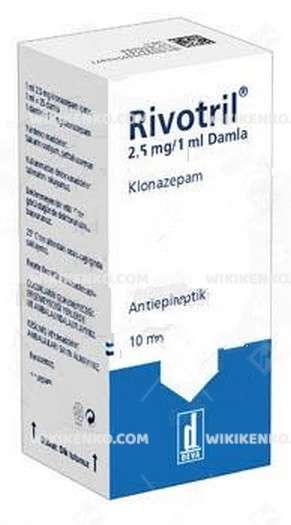
Description
Pharmaceutical Composition and Formulation
Each 1 mL of Rivotril oral drops contains clonazepam 2.5 mg as the active substance. The solution is usually supplied in a 10 mL amber glass bottle with an integrated dropper, and the official labelling describes a nominal content of 25 drops per mL, corresponding to 0.1 mg clonazepam per drop. Excipients commonly include propylene glycol, saccharin sodium, glacial acetic acid, peach flavouring, and the colourant brilliant blue FCF (E133), which together provide solubility, palatability and product stability.
Mechanism of Action
Clonazepam belongs to the benzodiazepine class and acts as a positive allosteric modulator at the GABAA receptor complex. By enhancing GABA-mediated chloride influx, clonazepam increases neuronal hyperpolarisation, thereby raising the seizure threshold and inhibiting polysynaptic transmission in the central nervous system. This action underlies its anticonvulsant, sedative, anxiolytic and muscle-relaxant effects, which are dose-dependent and subject to interindividual variability.
Pharmacokinetic Properties
Absorption
After oral administration of Rivotril drops, clonazepam is rapidly and almost completely absorbed, with absolute bioavailability of approximately 90%. Peak plasma concentrations are generally achieved within 1–4 hours, and the absorption half-life is around 25 minutes. The plasma concentration–dose relationship is largely linear within the usual therapeutic range, which facilitates predictable titration in clinical practice.
Distribution
Clonazepam distributes rapidly from the systemic circulation into tissues, including preferential uptake into brain structures. The apparent volume of distribution is approximately 3 L/kg, and about 85% of clonazepam is bound to plasma proteins. The drug crosses the placental barrier and is excreted into breast milk, which has important implications for use in pregnancy and lactation.
Metabolism and Elimination
Clonazepam is extensively metabolised in the liver by reduction and hydroxylation, followed by conjugation, with metabolites that are pharmacologically inactive or only weakly active. Elimination occurs predominantly via the kidneys as metabolites; unchanged clonazepam in urine is minimal. The elimination half-life is typically in the range of 20–40 hours, enabling once- or multiple-daily dosing but also predisposing to accumulation at steady state.
Indications and Therapeutic Uses
Rivotril oral drops are indicated as an antiepileptic agent for many forms of epilepsy in infants, children, and adults. Documented labelled indications include:
-
Infantile and childhood epilepsies, especially typical absence (petit mal), atypical absence, myoclonic seizures and generalized tonic-clonic seizures.
-
Focal (partial) epilepsies with or without secondary generalisation.
-
Status epilepticus, particularly absence status, as part of specialist management.
In some jurisdictions clonazepam is also used off-label for panic disorder, certain movement disorders, and other conditions, but such uses are not typically primary indications for the oral drop formulation and require specialist supervision.
Posology and Method of Administration
Dosing of Rivotril oral drops must be individualised and titrated according to clinical response and tolerability. The manufacturer of the 2.5 mg/mL solution specifies prescribing and administering doses in drops, with 1 drop containing approximately 0.1 mg clonazepam (25 drops per mL).
Adult Epilepsy
In adults, the recommended initial dose usually does not exceed 1.5 mg/day, divided into three doses, corresponding to about 0.6 mL/day or 15 drops/day. The daily dose may then be increased by 0.5 mg (approximately 0.2 mL or 5 drops) every 3 days until seizure control is achieved or adverse effects prevent further escalation. Maintenance doses commonly range from 3 to 6 mg/day, administered in 3 divided doses, equivalent to roughly 1.2–2.4 mL (30–60 drops) daily, although some patients may require slightly higher or lower doses.
Paediatric Epilepsy
In paediatric patients, particularly infants and young children, lower initial doses are used on a mg/kg basis with gradual titration. Because of the flexible drop formulation, clinicians can adjust the dose in small increments, enhancing individualisation and tolerability. Specific paediatric dosing schedules vary by guideline and regulatory region and must follow local product information and specialist recommendations.
Administration Technique
The solution is typically administered by counting the required number of drops from the integrated dropper onto a spoon or directly into a small amount of liquid, then swallowed. Some regulatory guidance discourages routine use of oral syringes for this specific formulation because dosing has been validated in drops rather than millilitres, and syringe use may be considered off-label in certain countries. To minimise dosing errors, prescriptions should clearly state the dose in drops and, where appropriate, the corresponding milligram amount.
Dose Strength and Drop Equivalence
The relationship between volume, drops, and dose is central to the safe use of Rivotril drops.
Dose Equivalence
| Parameter | Value (Rivotril 2.5 mg/mL) |
|---|---|
| Clonazepam concentration | 2.5 mg/mL oral solution |
| Drops per mL (nominal) | 25 drops/mL |
| Clonazepam per mL | 2.5 mg/mL |
| Clonazepam per drop | 0.1 mg/drop (2.5 mg ÷ 25) |
| Adult initial total daily dose | 1.5 mg ≈ 0.6 mL ≈ 15 drops/day |
| Typical adult maintenance range | 3–6 mg/day ≈ 1.2–2.4 mL (30–60 drops) |
Clinical Efficacy in Epilepsy
Clonazepam has demonstrated efficacy across a broad spectrum of generalized and focal epilepsies. Clinical experience and trials have shown particular benefit in absence seizures, myoclonic seizures, and certain Lennox–Gastaut spectrum epilepsies, as well as in focal seizures that are refractory to first-line agents. Plasma concentrations associated with optimal clinical effect are generally reported between about 20 and 70 ng/mL, with mean effective concentrations around 55 ng/mL. Sustained levels above approximately 100 ng/mL have been associated with a higher incidence of severe adverse effects, including paradoxical seizure exacerbation.
Safety Profile and Adverse Reactions
Common Adverse Effects
The adverse effect profile of clonazepam is typical for benzodiazepines and is closely related to dose and treatment duration. Commonly reported reactions include:
-
Somnolence and fatigue.
-
Dizziness, ataxia, and impaired coordination.
-
Slowed reaction time, confusion, and cognitive impairment.
-
Muscle weakness and hypotonia.
These effects are often most prominent during initial titration and may attenuate with continued therapy, although residual sedation and psychomotor impairment can persist.
Serious and Long-Term Risks
Serious risks include respiratory depression, particularly in patients with pre-existing respiratory compromise or when clonazepam is combined with other central nervous system depressants. Prolonged use can lead to physical and psychological dependence, with a characteristic withdrawal syndrome upon abrupt discontinuation, including anxiety, insomnia, tremor, and risk of seizure recurrence or rebound. In children, long-term benzodiazepine therapy has been associated with behavioural changes, salivation alterations, and potential cognitive effects, necessitating regular re-evaluation of the risk–benefit balance.
Contraindications
Rivotril oral drops are contraindicated in patients with known hypersensitivity to clonazepam, other benzodiazepines, or any component of the formulation. Absolute contraindications typically also include severe respiratory insufficiency, severe hepatic impairment, and acute narrow-angle glaucoma, reflecting class effects of benzodiazepines. The product is generally not recommended in patients with a history of benzodiazepine dependence or substance use disorder unless under strict specialist supervision.
Special Populations
Elderly
Older patients are more susceptible to sedation, confusion, falls, and respiratory depression with clonazepam. Lower initial doses, slower titration, and close monitoring are advisable, as pharmacodynamic sensitivity is often increased even when pharmacokinetics are only modestly altered.
Pregnancy and Lactation
Clonazepam crosses the placenta and is excreted in breast milk. Use during pregnancy, particularly in the first trimester, is generally reserved for situations where the potential benefit to the mother clearly outweighs potential risks to the fetus, and abrupt discontinuation in women with epilepsy may itself pose significant risk. Breastfeeding while taking clonazepam may lead to sedation and feeding difficulties in the infant; regulatory guidance often recommends avoiding breastfeeding or using alternative therapy where feasible.
Hepatic and Renal Impairment
Because clonazepam is hepatically metabolised, patients with hepatic impairment may show reduced clearance and increased plasma levels. Severe hepatic impairment is typically a contraindication, while mild to moderate impairment mandates careful dose adjustment and monitoring. Renal impairment has less impact on parent drug exposure but may influence metabolite accumulation; clinical monitoring remains important.
Drug–Drug Interactions
Clonazepam exhibits pharmacodynamic and pharmacokinetic interactions with a variety of drugs.
-
Co-administration with other CNS depressants (including alcohol, opioids, other benzodiazepines, sedating antiepileptics, and some antipsychotics) can potentiate sedation, respiratory depression, and psychomotor impairment.
-
Interactions with hepatic enzyme inducers or inhibitors (e.g., certain antiepileptics, antimicrobials) may alter clonazepam plasma concentrations.
-
A bidirectional interaction with phenytoin has been described, in which phenytoin levels may increase, decrease, or remain unchanged depending on individual factors and dosing.
Prescribers should review the full product information and clinical pharmacology data before combining clonazepam with other antiepileptic or psychotropic agents.
Overdose Management
Overdose with clonazepam typically manifests as pronounced CNS depression, ranging from drowsiness and confusion to ataxia, areflexia, hypotension, respiratory depression, and, in severe cases, coma. Isolated benzodiazepine overdose is rarely fatal with appropriate supportive care, but risk increases substantially in mixed overdoses with alcohol, opioids, or other sedatives. Management is primarily supportive, including airway protection, cardiorespiratory monitoring, and symptomatic treatment; flumazenil, a benzodiazepine antagonist, may be considered in strictly selected cases but carries a risk of precipitating seizures in patients with epilepsy.
Medication Errors and Dosing Confusion
The use of drops as a dosing unit can lead to confusion between “milligrams,” “millilitres,” and “drops” if prescriptions and labels are not explicit. Reports from clinical practice indicate that different assumptions about the volume per drop may result in miscalculation of the dose if healthcare professionals or caregivers attempt to convert independently instead of relying on the manufacturer’s nominal 25 drops per mL (0.1 mg per drop). Clear, standardised prescribing in drops, combined with patient and caregiver education and consistent device use, is therefore essential to minimise dosing errors.
Practical Clinical Considerations
Given its potent anticonvulsant activity, clonazepam in drop form is often reserved for situations where flexible titration is required, particularly in paediatric or complex epilepsies. Treatment initiation and adjustment should be supervised by clinicians experienced in epilepsy management, with regular reassessment of seizure control, adverse effects, and potential for dose reduction or withdrawal. When discontinuing therapy, gradual tapering over weeks or longer is crucial to reduce the risk of withdrawal symptoms and seizure exacerbation.
Summary of Key Pharmaceutical Characteristics
| Aspect | Description for Rivotril Drops (2.5 mg/mL) |
|---|---|
| Active ingredient | Clonazepam, benzodiazepine anticonvulsant |
| Strength | 2.5 mg clonazepam per mL |
| Pharmaceutical form | Oral solution (drops) in amber glass bottle with dropper |
| Typical indication | Epilepsy (generalised and focal) in infants, children, adults |
| Main mechanism | GABAA receptor modulation, enhanced inhibitory neurotransmission |
| Typical adult daily dose | 3–6 mg/day (1.2–2.4 mL; 30–60 drops) after titration |
| Major risks | Sedation, respiratory depression, dependence, withdrawal seizures |











Reviews
There are no reviews yet.