
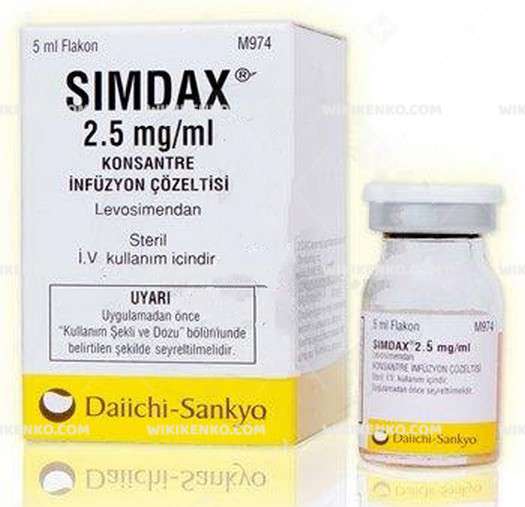
Simdax Iv Infusion Icin Konsantre Solution Iceren Vial

(1 customer review)
Dosage form

Pack size

Potency

2.5 Mg/Ml (5Ml)

Manufacturer

Origin

Generic Name (Ingredient)

Each Ml Of The Concentrated Solution Contains 2.5 Mg Of Levosimendan. Each 5 Ml Vial Contains 12.5 Mg Of Levosimendan.

Simdax (Levosimendan) is an intravenous medication used for the short-term management of acutely decompensated severe chronic heart failure (ADHF). It is typically administered in hospital settings where appropriate monitoring is available.

read more

Assuming you’re in a life-threatening situation and require immediate access to medication, please visit our Community Support Network page.


Description

Active Ingredient

Levosimendan: Each ml of concentrate contains 2.5 mg of levosimendan. Available in vials containing either 12.5 mg (5 ml) or 25 mg (10 ml) of levosimendan.

Excipients

A detailed list of excipients can be found in the product documentation.

Pharmaceutical Form Simdax is supplied as a clear yellow or orange solution concentrate for infusion, which must be diluted prior to administration.

Therapeutic Indications Simdax is indicated for short-term treatment of acutely decompensated severe chronic heart failure (ADHF) when conventional therapy is insufficient and inotropic support is needed.

Dosage and Administration

Method of Administration

Simdax must be diluted before use and can be administered via peripheral or central venous routes. It is intended for intravenous use only.

Dosage

Loading Dose

  • Initial Dose: 6-12 micrograms/kg infused over 10 minutes.
  • Lower Dose: 6 micrograms/kg for patients receiving other intravenous vasodilators or inotropes.

Continuous Infusion

  • Standard Rate: 0.1 micrograms/kg/min.
  • Adjustments: Increase to 0.2 micrograms/kg/min if stronger haemodynamic effect is needed or decrease to 0.05 micrograms/kg/min if adverse effects like hypotension or tachycardia occur.

Duration

  • Infusion Duration: Recommended duration is 24 hours.
  • Monitoring: Patients should be monitored during treatment and for at least three days post-infusion or until clinically stable.

Clinical Effects

Haemodynamic and Neurohormonal Effects

  • Decreased pulmonary capillary wedge pressure
  • Increased cardiac output (index)
  • Increased stroke volume
  • Decreased systemic vascular resistance
  • Decreased pulmonary vascular resistance
  • Reduced natriuretic peptide levels

Other Clinical Effects

  • Symptom relief for heart failure
  • Effects sustained with beta-blockers
  • Prolonged effects due to active metabolite
  • No development of tolerance
  • No increase in myocardial oxygen consumption
  • Anti-ischemic effect
  • No impairment of diastolic function

Safety and Monitoring

Monitoring Patients should be monitored during treatment, including urine output measurements, for at least three days post-infusion or until clinically stable.

Special Populations

  • Renal Impairment: Use with caution in mild to moderate cases; avoid in severe impairment.
  • Hepatic Impairment: Use with caution in mild to moderate cases; avoid in severe impairment.
  • Children: Not recommended for patients under 18 years of age.

Common Side Effects of Simdax

Very Common (may affect more than 1 in 10 people)

  • Abnormally fast heartbeat (tachycardia)
  • Headache
  • Drop in blood pressure (hypotension)

Common (may affect up to 1 in 10 people)

  • Dizziness
  • Ventricular tachycardia
  • Extrasystoles (extra heartbeats)
  • Atrial fibrillation (AF)
  • Hypokalaemia (low potassium levels)
  • Insomnia
  • Gastrointestinal disturbances
  • Anaemia

Potentially Fatal

  • Arrhythmias
  • Tachycardia
  • Atrial fibrillation with rapid ventricular response

If these side effects occur, contact a healthcare professional immediately.

Comparison with Other Heart Failure Medications

Mechanism of Action

Simdax (Levosimendan)

  • Inotropic and vasodilatory effects: Enhances cardiac contractility through calcium sensitization and promotes vasodilation by opening ATP-dependent potassium channels on vascular smooth muscle cells.
  • Sustained Effects: Active metabolite provides sustained haemodynamic effects for up to two weeks.

Dobutamine

  • Inotropic Agent: Increases cardiac output by stimulating beta-1 adrenergic receptors, leading to increased heart rate and contractility.
  • Short Duration: Effects are short-lived, requiring continuous infusion.

Milrinone

  • Phosphodiesterase Inhibitor: Increases cardiac output by inhibiting phosphodiesterase-3, leading to increased intracellular cyclic AMP and calcium levels.
  • Vasodilatory Effects: Reduces preload and afterload, similar to Levosimendan.

Clinical Effects

Simdax (Levosimendan)

  • Haemodynamic Stability: Provides significant benefits without increasing myocardial oxygen consumption.
  • Beta-Blocker Compatibility: Effects maintained with concurrent beta-blocker use.
  • Extended Benefits: Effects persist for 7-10 days post-infusion.

Dobutamine

  • Rapid Onset: Quick relief of heart failure symptoms.
  • Tolerance Development: Potential for tolerance with prolonged use.

Milrinone

  • Effective in Severe Cases: Used in severe heart failure and cardiogenic shock.
  • Hypotension Risk: Requires careful monitoring due to the risk of hypotension.

Safety and Monitoring

Simdax (Levosimendan)

  • Monitoring Required: Essential during treatment and for at least three days post-infusion.
  • Renal and Hepatic Impairment: Use with caution in mild to moderate impairment.

Dobutamine

Continuous Monitoring: Needed due to the risk of arrhythmias and increased myocardial oxygen consumption.

Milrinone

Invasive Monitoring: Often necessary due to the risk of hypotension and arrhythmias.

Contraindications for Simdax

Hypersensitivity

Patients with known hypersensitivity to Levosimendan or any excipients should avoid Simdax.

Cardiovascular Conditions

  • Severe hypotension
  • Severe tachycardia
  • Significant mechanical obstructions (e.g., aortic stenosis, mitral stenosis, LVOT obstruction)
  • History of Torsade de Pointes

Renal and Hepatic Impairment

  • Severe renal impairment (creatinine clearance <30 mL/min)
  • Severe hepatic impairment

Other Considerations

Not for use in children and adolescents under 18 years of age.

Potential Drug Interactions with Simdax

Increased Risk of Hypotension

  • IV Vasoactive Drugs: Concomitant use can increase hypotension risk.
  • Isosorbide Mononitrate: Can significantly potentiate orthostatic hypotensive response.

No Significant Interactions

  • Warfarin: Levosimendan does not inhibit CYP3A or CYP2C9; metabolism unaffected by CYP3A inhibitors.
  • Felodipine and Itraconazole: No significant interactions observed.

General Considerations

Other Inotropic Agents: Limited experience with concomitant use, except digoxin.

Pharmacokinetics

Absorption

Administered intravenously, bypassing the typical absorption phase of oral drugs.

Distribution

  • Volume of Distribution (Vss): Approximately 0.2 L/kg.
  • Protein Binding: 97-98% bound to plasma proteins, primarily albumin. Active metabolites (OR-1855 and OR-1896) have mean protein binding values of 39% and 42%, respectively.

Metabolism

  • Primarily metabolized by conjugation to cyclic or N-acetylated cysteinylglycine and cysteine conjugates.
  • About 5% metabolized in the intestine to aminophenylpyridazinone (OR-1855), reabsorbed and further metabolized to active metabolite OR-1896.

Excretion

  • Renal Excretion: 95% conjugated with glutathione to inert cysteine and renally excreted.
  • Half-Life: Approximately one hour, but active metabolites have longer half-lives, contributing to prolonged effects.

Administration in Clinical Practice

Preparation

Simdax must be diluted before use. Typical dilution: 5 ml Simdax concentrate into 250 ml 5% glucose solution, resulting in 0.05 mg/ml concentration.

Method of Administration

  • For intravenous use only, can be administered peripherally or centrally.
  • Loading Dose: 6-12 micrograms/kg infused over 10 minutes.
  • Continuous Infusion: 0.1 micrograms/kg/min. Dose and duration should be individualized based on clinical response.

Monitoring

  • Continuous monitoring of patients during treatment, including urine output. Monitoring should continue for at least three days post-infusion or until clinically stable.

Special Considerations

  • Adjustments: Lower loading doses for patients on other intravenous vasodilators or inotropes.
  • Response Assessment: Adjust infusion rate based on clinical response to avoid excessive effects like hypotension or tachycardia.

Table: Key Information on Simdax (Levosimendan)

Aspect Details
Usage Short-term treatment of acutely decompensated severe chronic heart failure
** Dosage
Benefits Significant haemodynamic and neurohormonal effects

Symptom relief in heart failure

Effects maintained with beta-blockers

Sustained benefits due to active metabolites

Common Side Effects Tachycardia, headache, hypotension, dizziness, ventricular tachycardia, atrial fibrillation, hypokalaemia, insomnia, gastrointestinal disturbances, anaemia
Potentially Fatal Side Effects Arrhythmias, rapid tachycardia, atrial fibrillation with rapid ventricular response
Contraindications Hypersensitivity to Levosimendan or excipients

Severe hypotension

Severe tachycardia

Significant mechanical obstructions

History of Torsade de Pointes

Severe renal or hepatic impairment

Not for children and adolescents under 18 years

Drug Interactions Increased risk of hypotension with IV vasoactive drugs and isosorbide mononitrate

No significant interactions with Warfarin, Felodipine, or Itraconazole

Pharmacokinetics Absorption: Intravenous administration

Distribution: 0.2 L/kg volume of distribution, 97-98% protein-bound

Metabolism: Primarily conjugated, with active metabolites

Excretion: Renal, 95% excreted, half-life approximately 1 hour for Levosimendan (longer for metabolites)

Monitoring Continuous monitoring during and for at least three days post-infusion

Monitoring of urine output

Conclusion

Simdax (Levosimendan) offers substantial benefits in the short-term management of acutely decompensated severe chronic heart failure. It combines inotropic and vasodilatory effects, providing haemodynamic stability and symptom relief without increasing myocardial oxygen consumption. The drug’s compatibility with beta-blockers and prolonged haemodynamic effects make it a valuable therapeutic option. However, its administration requires careful monitoring, particularly in patients with renal or hepatic impairment, to ensure safety and efficacy.

1 review for Simdax Iv Infusion Icin Konsantre Solution Iceren Vial

  1. Tamar

    How much does it cost?

    • Medical Guidance Center

      Hello Sebastian, this is WikiKenko.

      Simdax is a concentrated form of medicine that must be diluted before it is given to you as an intravenous infusion (drip). It both strengthens the pumping power of the heart and dilates blood vessels. Simdax is indicated for the short-term treatment of acutely decompensated severe chronic heart failure (ADHF) in situations where conventional therapy is not sufficient, and in cases where inotropic support is considered appropriate.

      Simdax is for in-hospital use only. It should be administered in a hospital setting where adequate monitoring facilities and expertise with the use of inotropic agents are available. So, it cannot be bought without a prescription. Prices for medications can change based on location and availability. Please log in to access the most recent prices.

      You will usually receive a rapid infusion over 10 minutes followed by a slower infusion for up to 24 hours. Your doctor should continuously monitor how you react to Simdax. Your doctor may reduce the infusion rate if your blood pressure drops, if your heart beats too fast or if you do not feel well.

      Some common side effects of Simdax include headache, dizziness, hypotension (low blood pressure), ventricular tachycardia (fast heart rate), extrasystoles (extra heartbeats), atrial fibrillation (irregular heartbeat), hypokalaemia (low potassium levels), insomnia, gastrointestinal disturbances and anaemia.

Add a review

Your email address will not be published. Required fields are marked *

Use the form below to report an error

Please answer the questions as thoroughly and accurately as possible. Your answers will help us better understand what kind of mistakes happen, why and where they happen, and in the end the purpose is to build a better archive to guide researchers and professionals around the world.


If an image of the drug is not available on the Wikikenko health encyclopedia, you have the option to submit images/leaflets of the product. Following verification by our pharmaceutical specialist, your submitted images/leaflets will be included in our archive, with due acknowledgment of your contribution. Your cooperation in this matter would greatly assist researchers in finding the information they seek. Upload Images/Leaflet (Less than 2MB)

No Choosen File

Wikikenko.com does not sell, distribute, or provide any pharmaceutical products or health services. Our platform functions solely as a health encyclopedia, providing information on a wide range of health topics, including but not limited to medications.


Medical Disclaimer: Seek Professional Advice

The information on this page is not intended to be a substitute for professional medical advice, diagnosis, or treatment. always seek the advice for your physician or another qualified health provider with any questions you may have regarding a medical condition. Always remember to

  1. Ask your own doctor for medical advice.
  2. Names, brands, and dosage may differ between countries.
  3. When not feeling well, or experiencing side effects always contact your own doctor.

Why you can't look for symptoms on the Internet

If diagnoses could be made simply from a textbook or an article on a website, we would all be doctors and treat ourselves. Nothing can replace the experience and knowledge of specially trained people. As in any field, in medicine there are unscrupulous specialists, differences of opinion, inaccurate diagnoses and incorrect test results. According to Wikipedia, cyberchondria is a mental disorder consisting in the desire to independently make a diagnosis based on the symptoms of diseases described on Internet sites.

 

More results…

Generic selectors
Exact matches only
Search in title
Search in content
Post Type Selectors

The expert search feature is especially useful for healthcare professionals, researchers, and scientists who require accurate and up-to-date information on pharmaceutical products. By narrowing down their searches using filters, they can easily access the relevant data they need, making informed decisions about treatment options or drug research endeavors.

Expert Search  →


Recent comments